THE CLASSIC COLLECTION✦An outlaw’s diary: the CommuneCLASSIC FREE BOOKS
An outlaw’s diary: the Commune
Cécile Tormay
THE CLASSIC COLLECTION · 1911
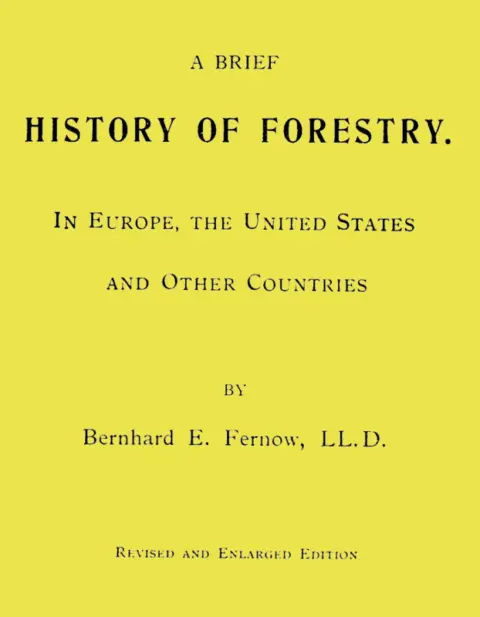
"A Brief History of Forestry" by B. E. Fernow is a historical account written in the early 20th century. The book provides a comprehensive overview of the development of forestry practices and policies across various regions, including Europe and the United States. It likely examines how historical, political, and economic factors have influenced forest management and conservation efforts throughout time. The opening of the text introduces the author’s motivation for compiling this information based on a series of lectures given at Yale University. It emphasizes the importance of understanding the historical context of forestry, as this enables readers to analyze the development of current practices and avoid past mistakes. Fernow highlights how forestry as a discipline has evolved, often dictated by necessity and the pressures of human expansion on natural resources. He sets the stage for a discussion that will span ancient practices to modern conservation measures, revealing how deeply intertwined forestry is with civilization's growth and industrial progress.
Introduction adapted from the source catalogue; source summaries may be automatically generated.
Free to read · English · 128,661 words · No account needed
MAKE TIME FOR A GOOD BOOK
On by default. Untick to stop anonymous reading totals. Each page counts after 10 seconds in view. How this works.
Anonymous counting is on unless you have switched it off.
The condition of affairs in the forest department can be briefly summarized as follows for the year 1909.
Total area under government control: 241,774 square miles, namely, Reserved, 94,561; Protected, 8,835; Unclassed, 138,378.
Officials (in 1905): Higher grades, 312; Lower grades, 1,663; Guards, 8,533. The controlling staff was in 1909 increased by 34; and numbers in all other grades increased.
Rounded off Expenditures, $4,500,000; Revenues, $8,225,000; Net Proceeds, $3,675,000 (45% of gross). Variation in the value of the rupee makes comparison with earlier years uncertain.
In spite of the many difficulties, a poor market (no market at all for a large number of woods), wild, unsurveyed, and practically unknown woodlands, requiring unusual and costly methods of organization and protection, the forestry department has succeeded, without curtailing the timber output of India, in so regulating forest exploitation as to insure not only a permanence in the output, but also to improve the woodlands by favoring the valuable species. It has prepared for an increase of output for the future, and at the same time has yielded the Government a steadily growing revenue, which bids fair to rank before long among the important sources of income.
In 1865 the net revenue was only $360,000, it had about doubled by 1875, and more than trebled by 1885, and since then has more than quadrupled.
While in the period of 1870 to 1874 the expense of the administration was still 70 per cent. of the gross income, it has gradually been reduced to near 45 per cent., while the outturn in material has in the last five years increased by 35% over the preceding quinquennium.
At first, the department and its operations as well as its finances were Imperial, the local governments having no control over its officers or over the revenue derived, but, in 1882, decentralization was effected, the local governments obtaining a direct interest in the revenues. As a result the financial interest overruled the conservative policy, and over-cutting was the consequence. In 1884, the general government recognized the need of a change. After some struggle, the Imperial department was placed at least in charge of preparing the working plans, and pressure for their execution if not direct enforcement can be brought through appeal to the general government by the Inspector-General, which, however, has never been necessary to use.
The organization of the forest service passed through various stages, and the arrangement in the different provinces is even now not quite uniform.
The forest service, then, is peculiarly organized as regards division of responsibilities and relationships between the imperial and the provincial governments, the autonomy of the latter being jealously guarded. It is divided into the Imperial and the Provincial Service, the former consisting of the higher grade officials entirely recruited from England, the latter, the executive service, being in administrative functions independent of the former.
Your reading position is saved on this browser. Take it to another device with a library code. Reading pages adapt to text, rather than matching a printed edition.
BEHIND THE BOOK
This eBook is for the use of anyone anywhere in the United States and most other parts of the world at no cost and with almost no restrictions whatsoever. You may copy it, give it away or re-use it under the terms of the Project Gutenberg License included with this eBook or online at www.gutenberg.org. If you are not located in the United States, you will have to check the laws of the country where you are located before using this eBook. Read the source licence.
The original source file, including credits and licence, is retained by this library. Request an original-format copy at no charge. Please include the book title and Project Gutenberg identifier #48874.
KEEP YOUR CURIOSITY GOING
Cécile Tormay

Moritz Busch
John L. Ransom
Frances Wright
Cécile Tormay

Mabel Potter Daggett