THE CLASSIC COLLECTION✦An outlaw’s diary: the CommuneCLASSIC FREE BOOKS
An outlaw’s diary: the Commune
Cécile Tormay
THE CLASSIC COLLECTION · 1911
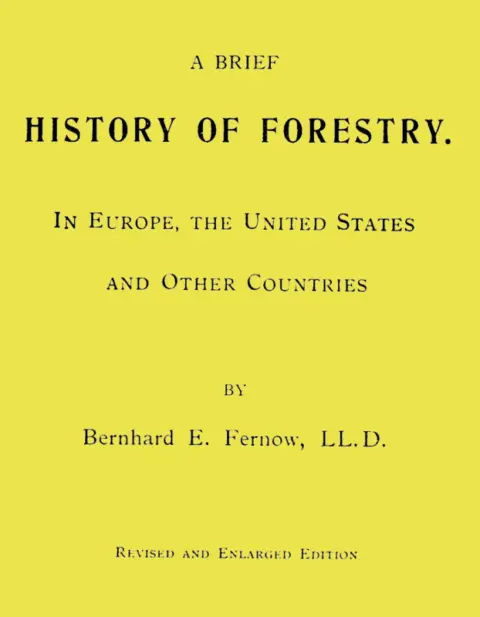
"A Brief History of Forestry" by B. E. Fernow is a historical account written in the early 20th century. The book provides a comprehensive overview of the development of forestry practices and policies across various regions, including Europe and the United States. It likely examines how historical, political, and economic factors have influenced forest management and conservation efforts throughout time. The opening of the text introduces the author’s motivation for compiling this information based on a series of lectures given at Yale University. It emphasizes the importance of understanding the historical context of forestry, as this enables readers to analyze the development of current practices and avoid past mistakes. Fernow highlights how forestry as a discipline has evolved, often dictated by necessity and the pressures of human expansion on natural resources. He sets the stage for a discussion that will span ancient practices to modern conservation measures, revealing how deeply intertwined forestry is with civilization's growth and industrial progress.
Introduction adapted from the source catalogue; source summaries may be automatically generated.
Free to read · English · 128,661 words · No account needed
MAKE TIME FOR A GOOD BOOK
On by default. Untick to stop anonymous reading totals. Each page counts after 10 seconds in view. How this works.
Anonymous counting is on unless you have switched it off.
The most noted work of the forest administration, and one for which it deserves high credit, has been that of the reclamation of waste lands, of which, in 1879, it was estimated there were still 20,000,000 acres in extent. Especially the “reboisement” work in the Alpine districts, as a result of the law of 1882, has become celebrated.
The movement for recovery of waste lands dates from the beginning of the 19th century, and to-day reforestation by state, communal and private effort encouraged by legislative acts during the last sixty years, has restored well-nigh more than 3,000,000 acres of ground which had been lost to forest production.
There are four definite regions of large extent in which systematic effort in this direction has been made, namely, the sand dunes of Gascony and the Landes of Southwestern France; the sandy plains of La Sologne; the limestone wastes of Champagne; and the mountain slopes in the Vosges and Jura-Alps.
The sand dunes on the coast of France comprise around 350,000 acres; those on the coast of Gascony in Southwest France alone have an extent of nearly 250,000 acres, these being the most important and having for a long time endangered the adjoining pastures and fields. It seems that the land occupied by dunes was originally forested, and that these were created by deforestation.
As early as 1717, successful attempts at reforestation were made by the inhabitants of La Teste, and from that time on sporadically small plantings came into existence. But the inauguration of systematic reforestation was begun only after a notable report by Brémontier, who, in 1786, secured, as chief engineer of the department of Bordeaux, a sum of $10,000 to be employed in ascertaining the possibilities of draining the Landes by means of a canal, and of fixing the dunes. As a result of this beginning, the method for their recovery having been, by 1793, experimentally determined by Brémontier, 275,000 acres of moving sand have been fixed during the last century. The revolutionary government, in 1799, created a Commission of Dunes, of which Brémontier was made president, and annual appropriation of $10,000 was made, later (in 1808) increased to $15,000. In 1817, the work was transferred to the Administration des Ponts et Chaussées. The appropriations were increased until, in 1854, they reached $100,000 a year, and in 1865, the work being nearly finished, the dunes were handed over to the forest administration. There being still about 20,000 acres to be recovered, this was achieved in 1865, when 200,000 acres had been reforested at an expense of about $2,000,000, and an additional expense of $700,000 to organize the newly formed pine forests--Pinus maritima was entirely used. These, at present, with their resinous products and wood are furnishing valuable material. An unfortunate policy of ceding some of these forest areas to private and communal owners, who claimed them as of ancient right, and also of sales was inaugurated just as the planting was finished, so that at present only 125,000 acres remain in the hands of the state. The returns from the sales, however, reimbursed the cost of the reboisement in excess by $140,000, so that the state really acquired for nothing, a property, now estimated to be worth $10,000,000.
Your reading position is saved on this browser. Take it to another device with a library code. Reading pages adapt to text, rather than matching a printed edition.
BEHIND THE BOOK
This eBook is for the use of anyone anywhere in the United States and most other parts of the world at no cost and with almost no restrictions whatsoever. You may copy it, give it away or re-use it under the terms of the Project Gutenberg License included with this eBook or online at www.gutenberg.org. If you are not located in the United States, you will have to check the laws of the country where you are located before using this eBook. Read the source licence.
The original source file, including credits and licence, is retained by this library. Request an original-format copy at no charge. Please include the book title and Project Gutenberg identifier #48874.
KEEP YOUR CURIOSITY GOING
Cécile Tormay

Moritz Busch
John L. Ransom
Frances Wright
Cécile Tormay

Mabel Potter Daggett