THE CLASSIC COLLECTION✦An outlaw’s diary: the CommuneCLASSIC FREE BOOKS
An outlaw’s diary: the Commune
Cécile Tormay
THE CLASSIC COLLECTION · 1911
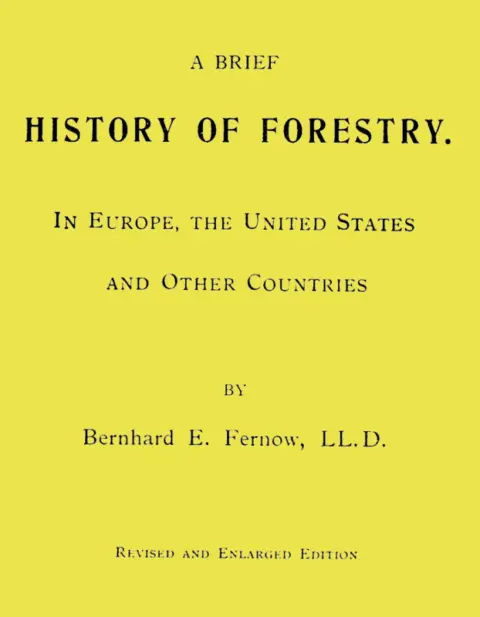
"A Brief History of Forestry" by B. E. Fernow is a historical account written in the early 20th century. The book provides a comprehensive overview of the development of forestry practices and policies across various regions, including Europe and the United States. It likely examines how historical, political, and economic factors have influenced forest management and conservation efforts throughout time. The opening of the text introduces the author’s motivation for compiling this information based on a series of lectures given at Yale University. It emphasizes the importance of understanding the historical context of forestry, as this enables readers to analyze the development of current practices and avoid past mistakes. Fernow highlights how forestry as a discipline has evolved, often dictated by necessity and the pressures of human expansion on natural resources. He sets the stage for a discussion that will span ancient practices to modern conservation measures, revealing how deeply intertwined forestry is with civilization's growth and industrial progress.
Introduction adapted from the source catalogue; source summaries may be automatically generated.
Free to read · English · 128,661 words · No account needed
MAKE TIME FOR A GOOD BOOK
On by default. Untick to stop anonymous reading totals. Each page counts after 10 seconds in view. How this works.
Anonymous counting is on unless you have switched it off.
It has been a matter of speculation whether Spain was, or was not, once heavily wooded (see page 11). In Roman times, only the Province of La Manca is reported as being unforested, and, in the 13th and 14th centuries, extensive forest zones are still recorded. The character of the country at present, and the climate, both resembling so much our own arid plains, make it questionable to what extent the forest descended from the mountain ranges, which were undoubtedly well wooded.
At present the forest is mainly confined to the higher mountains. The best is to be found in the Pyrenees and their continuation, the Cantabrian mountains.
The area of actual forest (bosques) is not known with precision, since in the official figures mere potential forest, i.e., brush and waste land, is included (montes), and the area varies, i.e., diminishes through new clearings, of which the statistics do not keep account. Moreover, the statistics refer only to the “public forests,” leaving out the statement of private forest areas, if any.
In 1859, this area was reported as over 25 million acres or 20 per cent. of the land area (196,000 square miles); in 1885, the acreage had been reduced to about 17.5 million acres; and, in 1900, about 16 million acres, or 13 per cent. of the land area remained as public forest, and the total was estimated at somewhat over 20 million acres.
The following peculiar classification, published in 1874, gives (in round figures) at once an insight into the meaning of montes, and the probable condition of the “public forest” area:
Acres.
State Reserves 865,000
Salable State Property 4,550,000
Public Institute Forest 20,000
Communal Forest 9,860,000
Open Commons for Wood and Pasture 1,880,000
Common Pasture for Draft Animals 425,000
----------
Total 17,600,000
An estimate of the actual forest (timber and coppice), does not exceed 12 million acres for a population of 18 million, or .7 acres per capita. The latest official figures claim as State property around 600,000 acres, and municipal institutional property 11.5 million acres; these constituting the public forests. According to official classification, these public forests are to the extent of 5.3 million acres high forest, 3 million coppice, the balance brushwoods.
In spite of this evident lack of wood material, except for firewood or charcoal, the importations in 1903 did not exceed 13.5 million dollars, accentuating the absence of industrial development. The official statement of imports reports 6.5 million dollars more than the above figure, but this includes horses and cattle enumerated as forest products--products of the “montes.” These also figure in the exportations of 15 million dollars, which to the extent of one-half consists of cork (some 5 million dollars from 630,000 acres) and tanbark, while chestnuts, filberts and esparto furnish the balance. In 1908, the imports of lumber and staves alone amounted to $7,382,000.
Your reading position is saved on this browser. Take it to another device with a library code. Reading pages adapt to text, rather than matching a printed edition.
BEHIND THE BOOK
This eBook is for the use of anyone anywhere in the United States and most other parts of the world at no cost and with almost no restrictions whatsoever. You may copy it, give it away or re-use it under the terms of the Project Gutenberg License included with this eBook or online at www.gutenberg.org. If you are not located in the United States, you will have to check the laws of the country where you are located before using this eBook. Read the source licence.
The original source file, including credits and licence, is retained by this library. Request an original-format copy at no charge. Please include the book title and Project Gutenberg identifier #48874.
KEEP YOUR CURIOSITY GOING
Cécile Tormay

Moritz Busch
John L. Ransom
Frances Wright
Cécile Tormay

Mabel Potter Daggett