THE CLASSIC COLLECTION✦An outlaw’s diary: the CommuneCLASSIC FREE BOOKS
An outlaw’s diary: the Commune
Cécile Tormay
THE CLASSIC COLLECTION · 1911
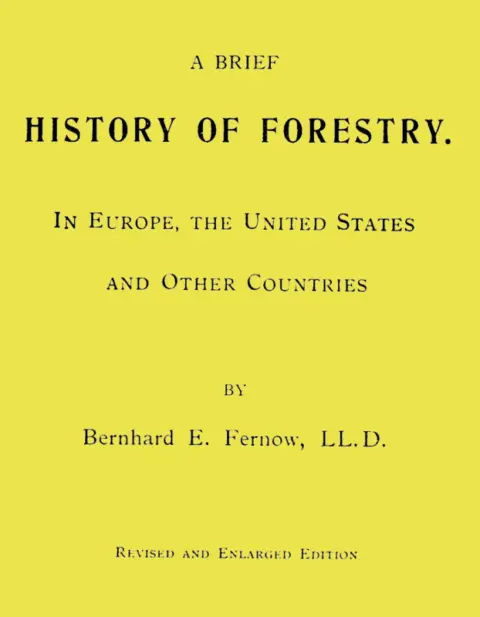
"A Brief History of Forestry" by B. E. Fernow is a historical account written in the early 20th century. The book provides a comprehensive overview of the development of forestry practices and policies across various regions, including Europe and the United States. It likely examines how historical, political, and economic factors have influenced forest management and conservation efforts throughout time. The opening of the text introduces the author’s motivation for compiling this information based on a series of lectures given at Yale University. It emphasizes the importance of understanding the historical context of forestry, as this enables readers to analyze the development of current practices and avoid past mistakes. Fernow highlights how forestry as a discipline has evolved, often dictated by necessity and the pressures of human expansion on natural resources. He sets the stage for a discussion that will span ancient practices to modern conservation measures, revealing how deeply intertwined forestry is with civilization's growth and industrial progress.
Introduction adapted from the source catalogue; source summaries may be automatically generated.
Free to read · English · 128,661 words · No account needed
MAKE TIME FOR A GOOD BOOK
On by default. Untick to stop anonymous reading totals. Each page counts after 10 seconds in view. How this works.
Anonymous counting is on unless you have switched it off.
In the other colonies at various times unsuccessful beginnings were made, and there exist in Queensland, New South Wales, and Victoria so-called Forest Branches or departments, but mostly without power or equipment, and no intelligent conception of forest policy seems practically to exist.
In Queensland, since 1897, the Governor in Council may reserve forest lands and regulate the cutting by diameter limit. One and a half million acres have been reserved, but no staff for administration exists.
In New South Wales six million acres were withdrawn from settlement, but it is mostly used for pasture, and withdrawal may be revoked at any time. No effective system of control exists.
In Victoria five and a half million acres have been declared reserves under act of 1890, nearly half the forest area. There exists a forest department of one Conservator, two Inspectors and 25 Foresters, but no plan of management. Four State nurseries of doubtful value seems the whole result.
The other colonies still merely exploit their forest resources under loosely managed license systems, without even an inefficient attempt at intelligent treatment.
Forestry of Japan, 1904, published by the Imperial Bureau of Forestry in connection with the Louisiana Purchase Exposition, and a reprint with additions in 1910, contains most of the information utilized above.
Aus den Waldungen Japans, by Dr. Heinrich Mayr, 1891, gives a full account of the forest geography, which is also to be found in J. J. Rein, Japan, 1886.
Der Wald in Japan, an article by Dr. Hefele in Forstwissenschaftliches Centralblatt, 1903, gives an insight into forest conditions from the point of view of a forester.
A very clear analysis of the development of property rights is to be found in an article by Dr. Zentaro Kawase in Allgemeine Forst- und Jagdzeitung, 1894.
An article in Zeitschrift für Forst- und Jagdwesen from the pen of Prof. H. Matsuno, the first professional forester of Japan, gives a brief account of the development of forestry, especially in earlier times.
A report by Special Canadian Trade Commissioner W. T. R. Preston, 1908, contains valuable statistics on the lumber trade.
The modernization of this remarkable island empire of Niphon (the native name), which began in 1868, included the organization of a forest department after German models. Curiously enough, there are other noteworthy points of similarity to be found in the historic development of forestry in Germany and Japan.
The empire comprises four larger islands--Kiushiu, Shikoku, Hondo or Honshiu, and Hokkaido or Yesso--and a host of smaller ones, stretching in a chain of nearly 3,000 miles north and south along the Asiatic shore, the width of land being nowhere over 200 miles. It comprises an area of nearly 150,000 square miles, with a population approximating 50 million, largely engaged in fisheries and other sea industries.
Your reading position is saved on this browser. Take it to another device with a library code. Reading pages adapt to text, rather than matching a printed edition.
BEHIND THE BOOK
This eBook is for the use of anyone anywhere in the United States and most other parts of the world at no cost and with almost no restrictions whatsoever. You may copy it, give it away or re-use it under the terms of the Project Gutenberg License included with this eBook or online at www.gutenberg.org. If you are not located in the United States, you will have to check the laws of the country where you are located before using this eBook. Read the source licence.
The original source file, including credits and licence, is retained by this library. Request an original-format copy at no charge. Please include the book title and Project Gutenberg identifier #48874.
KEEP YOUR CURIOSITY GOING
Cécile Tormay

Moritz Busch
John L. Ransom
Frances Wright
Cécile Tormay

Mabel Potter Daggett