THE CLASSIC COLLECTION✦An outlaw’s diary: the CommuneCLASSIC FREE BOOKS
An outlaw’s diary: the Commune
Cécile Tormay
THE CLASSIC COLLECTION · 1911
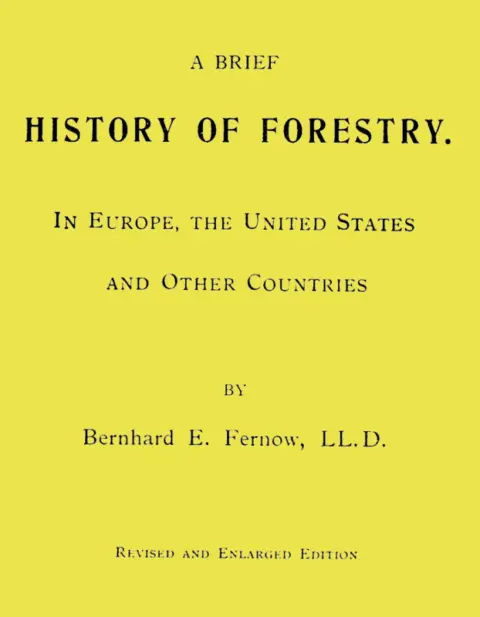
"A Brief History of Forestry" by B. E. Fernow is a historical account written in the early 20th century. The book provides a comprehensive overview of the development of forestry practices and policies across various regions, including Europe and the United States. It likely examines how historical, political, and economic factors have influenced forest management and conservation efforts throughout time. The opening of the text introduces the author’s motivation for compiling this information based on a series of lectures given at Yale University. It emphasizes the importance of understanding the historical context of forestry, as this enables readers to analyze the development of current practices and avoid past mistakes. Fernow highlights how forestry as a discipline has evolved, often dictated by necessity and the pressures of human expansion on natural resources. He sets the stage for a discussion that will span ancient practices to modern conservation measures, revealing how deeply intertwined forestry is with civilization's growth and industrial progress.
Introduction adapted from the source catalogue; source summaries may be automatically generated.
Free to read · English · 128,661 words · No account needed
MAKE TIME FOR A GOOD BOOK
On by default. Untick to stop anonymous reading totals. Each page counts after 10 seconds in view. How this works.
Anonymous counting is on unless you have switched it off.
English Forests and Forest Trees, 1853, anonymous, gives an interesting account of the old ‘forests’ and their history.
Our Forests and Woodlands, by JOHN NISBET, 1900, has a chapter on the historical development of forest laws.
WM. SCHLICH, Manual of Forestry, vol. I, 3d ed., 1906, brings in convenient form an account of conditions in various parts of the British Empire.
SCHWAPPACH, Forstliche Zustände in England, Zeitschrift für Forst- und Jagdwesen, 1903, is an account of forest conditions from the pen of a practical observer.
B. RIBBENTROP, Forestry in India, 1900. Also various reports of the forest departments of the various British Colonies.
It is a remarkable fact that the nation which can boast of the most extensive forest department in one of her colonies, has at home not yet been able to come to an intelligent conception even, not to speak of application, of proper forest policy or forest economy.
One of the English authorities on the subject writes still in 1900: “With so much land of poor quality lying uncultivated in many parts of the British Isles, the apathy shown towards forestry in Britain is one of the things that it is impossible to understand.”
If we should venture to seek for an explanation, we would find it in geographical and physical conditions, but still more in personal and political characteristics, historically developed, such as also in the United States make progress of forestry slower than it would otherwise be.
Due to her insular position with which in part the development of her naval supremacy is connected, England can readily supply her needs by importations. Situated within the influence of the Gulf stream, the climate is much milder than her northern location would indicate, and is in no respect excessive. The topography is mostly gentle, except in Scotland and Wales, and the riverflow even all the year. Hence the absence of forestcover has not been felt in its physical influences.
Britons, Picts, Scots, Scandinavians, Anglo-Saxons and Normans are the elements which have amalgamated to make the English people. Through endless warfare and political struggle the three countries, England, Scotland and Ireland had, by the year 1600, come under one ruler, although final legislative union with Scotland did not take place until 1707, and with Ireland not until 1800.
Theoretically, forming a constitutional monarchy, practically, an aristocracy with republican tendencies, the history of the islands has been a struggle, first to establish race supremacy, then to secure the ascendency of the nobility and landholders over the king and the commoners, in which the former have been more successful than the barons in other parts of Europe.
Your reading position is saved on this browser. Take it to another device with a library code. Reading pages adapt to text, rather than matching a printed edition.
BEHIND THE BOOK
This eBook is for the use of anyone anywhere in the United States and most other parts of the world at no cost and with almost no restrictions whatsoever. You may copy it, give it away or re-use it under the terms of the Project Gutenberg License included with this eBook or online at www.gutenberg.org. If you are not located in the United States, you will have to check the laws of the country where you are located before using this eBook. Read the source licence.
The original source file, including credits and licence, is retained by this library. Request an original-format copy at no charge. Please include the book title and Project Gutenberg identifier #48874.
KEEP YOUR CURIOSITY GOING
Cécile Tormay

Moritz Busch
John L. Ransom
Frances Wright
Cécile Tormay

Mabel Potter Daggett