THE CLASSIC COLLECTION✦An outlaw’s diary: the CommuneCLASSIC FREE BOOKS
An outlaw’s diary: the Commune
Cécile Tormay
THE CLASSIC COLLECTION · 1911
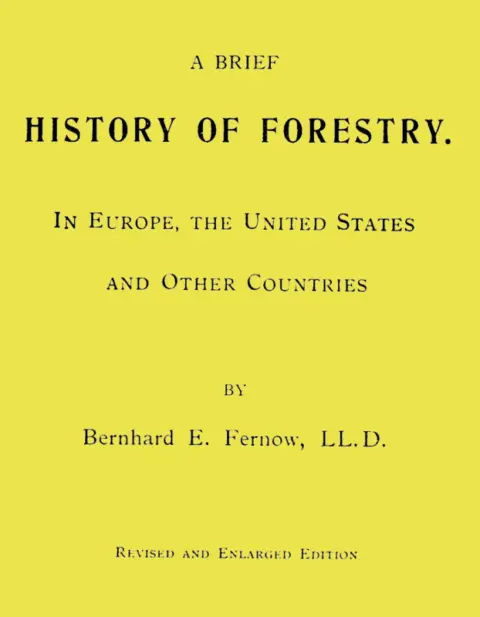
"A Brief History of Forestry" by B. E. Fernow is a historical account written in the early 20th century. The book provides a comprehensive overview of the development of forestry practices and policies across various regions, including Europe and the United States. It likely examines how historical, political, and economic factors have influenced forest management and conservation efforts throughout time. The opening of the text introduces the author’s motivation for compiling this information based on a series of lectures given at Yale University. It emphasizes the importance of understanding the historical context of forestry, as this enables readers to analyze the development of current practices and avoid past mistakes. Fernow highlights how forestry as a discipline has evolved, often dictated by necessity and the pressures of human expansion on natural resources. He sets the stage for a discussion that will span ancient practices to modern conservation measures, revealing how deeply intertwined forestry is with civilization's growth and industrial progress.
Introduction adapted from the source catalogue; source summaries may be automatically generated.
Free to read · English · 128,661 words · No account needed
MAKE TIME FOR A GOOD BOOK
On by default. Untick to stop anonymous reading totals. Each page counts after 10 seconds in view. How this works.
Anonymous counting is on unless you have switched it off.
Although attempts have been made from time to time to restrict the use of private forest, practically little has been accomplished, and such restrictions as have been enacted are hardly enforced.
A law, enacted in 1886, forbids clearing along waters adapted to fishing, and orders the leaving of seed trees or “providing otherwise for regeneration,” if more than 12 acres are cut at one time.
The method of utilizing the ground for combined forest and farm use, which is still frequently practised, was forbidden on the light sandy soils of the pineries, or was otherwise regulated. Forest fire laws are also on the statutes.
Propositions for further restrictions, made in 1891, were promptly
rejected by the parliament.
Educational opportunities are offered in the Forest Institute at Evois, first established in 1862 as a result of v. Berg’s visit, and re-organized in 1874. It accepts new students only every second year for the two years’ course. It has had a precarious existence, being left sometimes without students, and is naturally not of a high grade, practical acquaintance with woodswork being its main aim.
Since 1876, a school for forest guards and private underforesters has been in existence, where 6 students are annually accepted for a two years’ course.
In addition there are two instructors provided by the government, wandering teachers who are to advise private owners. Premiums are paid for the best managed woodlots on the government farms.
The Finnish forestry association, which is in part of propagandist nature, was organized in 1877. It supplies, besides an annual report, other forestry literature, and employs an experienced planter to direct efforts at reforestation.
A forestry journal (quarterly) is also published, and a professional literature is beginning to start into existence.
It may be of interest in this connection to cite a rough calculation made by Dr. Mayr of the available material in European Russia and Finland combined, which he places at 4,500 million cubic feet, and of which he considers one-half available for export.
It is impossible to prognosticate what position Russia and Finland, together the largest wood producers in Europe, will take in the future world commerce, and how rapidly better practices, for which the machinery is already half started, will become generally adopted. At present, especially in Russia proper, the general corruption of the bureaucracy is an almost insurmountable obstacle to improvement.
In the English language the Report on Forestry in Sweden, by Gen. C. C. ANDREWS, U. S. Minister at Stockholm, 1872, revised 1900, 35 pp., gives a statement of present conditions with historical notes.
A very good idea in detail of the wood trade of Sweden may be obtained from The Wood Industries of Sweden, published by TIMBER TRADES JOURNAL of London in 1896.
Your reading position is saved on this browser. Take it to another device with a library code. Reading pages adapt to text, rather than matching a printed edition.
BEHIND THE BOOK
This eBook is for the use of anyone anywhere in the United States and most other parts of the world at no cost and with almost no restrictions whatsoever. You may copy it, give it away or re-use it under the terms of the Project Gutenberg License included with this eBook or online at www.gutenberg.org. If you are not located in the United States, you will have to check the laws of the country where you are located before using this eBook. Read the source licence.
The original source file, including credits and licence, is retained by this library. Request an original-format copy at no charge. Please include the book title and Project Gutenberg identifier #48874.
KEEP YOUR CURIOSITY GOING
Cécile Tormay

Moritz Busch
John L. Ransom
Frances Wright
Cécile Tormay

Mabel Potter Daggett