THE CLASSIC COLLECTION✦An outlaw’s diary: the CommuneCLASSIC FREE BOOKS
An outlaw’s diary: the Commune
Cécile Tormay
THE CLASSIC COLLECTION · 1911
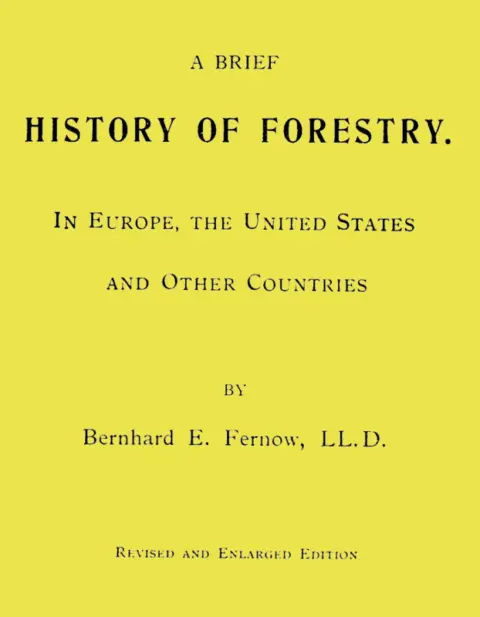
"A Brief History of Forestry" by B. E. Fernow is a historical account written in the early 20th century. The book provides a comprehensive overview of the development of forestry practices and policies across various regions, including Europe and the United States. It likely examines how historical, political, and economic factors have influenced forest management and conservation efforts throughout time. The opening of the text introduces the author’s motivation for compiling this information based on a series of lectures given at Yale University. It emphasizes the importance of understanding the historical context of forestry, as this enables readers to analyze the development of current practices and avoid past mistakes. Fernow highlights how forestry as a discipline has evolved, often dictated by necessity and the pressures of human expansion on natural resources. He sets the stage for a discussion that will span ancient practices to modern conservation measures, revealing how deeply intertwined forestry is with civilization's growth and industrial progress.
Introduction adapted from the source catalogue; source summaries may be automatically generated.
Free to read · English · 128,661 words · No account needed
MAKE TIME FOR A GOOD BOOK
On by default. Untick to stop anonymous reading totals. Each page counts after 10 seconds in view. How this works.
Anonymous counting is on unless you have switched it off.
Although, as was natural, owing to the difference in conditions the forestry literature in Austria began much later than that of Germany, a very active progress is noticeable since the middle of the last century, and the Austrians are vying successfully with the Germans in this direction. The names of Fioceli, Pokorny, Böhm, Wiesner, Molish, Willkomm, Hempel and Kerner in the direction of forest botany, Wessely, von Lorenz-Liburnau, Feistmantel, Dimitz, Wachtl (Entomology), Dombrowski (encyclopedia 1886), Exner, Janka (wood technology), Guttenberg (forest mensuration and regulation), von Seckendorff, Schiffel (forest mensuration), Cieslar, Reuss, Böhmerle, Hufnagl, Marchet, and many others are familiar to all German readers. In addition a very considerable literature in the Bohemian language is in existence, some in the Italian by Austrian authors, and some in the Slavonian.
The magazine literature began with publications by various forestry associations which became active after 1848. At the present time weekly, monthly, bi-monthly, quarterly, yearly and irregular publications to the number of not less than 14 in German, in addition to several in Bohemian, may be counted, among which the monthly Centralblatt für das Gesammte Forstwesen, in existence since 1875, and the weekly Oesterreichische Forstzeitung, since 1883, are perhaps the most widely known.
Hungary is mainly a fertile plain, traversed by the Danube and Theiss, an agricultural country, with the forest confined to the hilly portions, to the mountainous southern provinces of Slavonia and Croatia, and to the Carpathians, which bound it on the north and east. Nevertheless, while wood in the plain is scarce, the total forest area, including that of the two mentioned provinces, is but little less than that of Austria proper, namely, 23,000,000 acres (28%). Large areas of shifting sands, and, along the Danube and Theiss rivers, swamps, partly created by deforestation, are interspersed with the heavy black prairie and compact clay-soils.
At present, of the 23 million acres of forest the State owns 16%, corporations somewhat over 20%, churches, cloisters and other institutes 7.5%, and the balance, over 13 million acres, is owned privately. The administration of the State forests is in the Department of Agriculture but some are still under the control of the military and railroad departments.
All but the private forests are under State surveillance. Of the private properties the majority consists of large holdings and about ten per cent. are entailed, a hopeful condition for conservative management. Yet with an export of 10 to 12 million dollars or more, exploitation would appear still to be general, and devastated areas abound. It is claimed that half the area is under working plans, and that the 1000 million cubic feet of annual cut do not approach the annual increment. The State forests yield now in the neighborhood of $600,000 net.
Your reading position is saved on this browser. Take it to another device with a library code. Reading pages adapt to text, rather than matching a printed edition.
BEHIND THE BOOK
This eBook is for the use of anyone anywhere in the United States and most other parts of the world at no cost and with almost no restrictions whatsoever. You may copy it, give it away or re-use it under the terms of the Project Gutenberg License included with this eBook or online at www.gutenberg.org. If you are not located in the United States, you will have to check the laws of the country where you are located before using this eBook. Read the source licence.
The original source file, including credits and licence, is retained by this library. Request an original-format copy at no charge. Please include the book title and Project Gutenberg identifier #48874.
KEEP YOUR CURIOSITY GOING
Cécile Tormay

Moritz Busch
John L. Ransom
Frances Wright
Cécile Tormay

Mabel Potter Daggett