
The Writing of News A Handbook with Chapters on Newspaper Correspondence and Copy Reading
Charles G. (Charles Griffith) Ross
THE CLASSIC COLLECTION · 1916
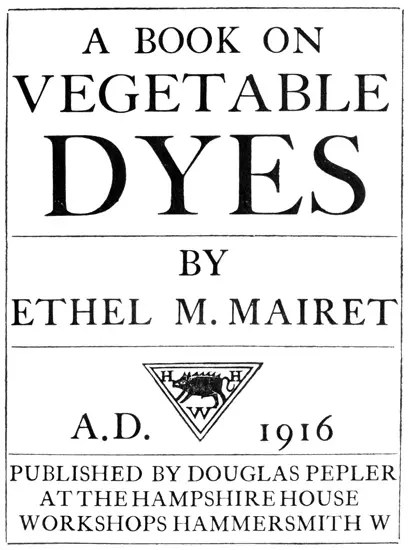
"A Book on Vegetable Dyes" by Ethel Mairet is a practical guide on the art of dyeing using natural materials, likely written in the early 20th century. The book delves into the traditions of vegetable dyeing, discussing its decline in favor of synthetic dyes and emphasizing the importance of natural color in craftsmanship. It aims to revive and document the practices, knowledge, and recipes for dyeing various fibers with traditional substances. The opening of this book sets the stage for a robust exploration of dyeing as an artistic craft, lamenting the loss of traditional methods in a modern world inundated with synthetic options. Mairet reflects on how the beauty of colors obtainable through natural dyes has been overshadowed by the ease of chemical dyes, urging artisans to reconnect with the rich history of dyeing. The introduction also outlines the book's contents, which reveal a structured approach to not only the dyeing process but also the types of materials and techniques needed for effective results, ultimately encouraging readers to develop their own practices in this fading art.
Introduction adapted from the source catalogue; source summaries may be automatically generated.
Free to read · English · 28,649 words · No account needed
MAKE TIME FOR A GOOD BOOK
On by default. Untick to stop anonymous reading totals. Each page counts after 10 seconds in view. How this works.
Anonymous counting is on unless you have switched it off.
Blue Dye Plants, 39.
Blue stone, 33.
Blue vitriol, 33-36.
Bois de Campêche, 77.
Bois jaune, Fustic, yellow wood.
Brazil woods, 106.
British Dye Plants, 37-44.
Broom, 41, 134.
Brown, 122-133; from lichens, 45-49, 51, 56, 57, 60-62, 140; from madder, 102, 106; from weld, 112; from woad, 76.
Brown Dye Plants, 43.
Buff, 115.
C.--Campeachy Wood, 77.
Camwood, 106, 131.
Carthamus. Safflower, an annual plant cultivated in S. Europe, Egypt and Asia for the red dye from its flowers.
Catechu, 33, 35, 36, 122-6.
Caustic Soda. Carbonate of soda, boiled with lime.
Chestnut, 35.
Chrome, 32, 33.
Cinnamon, 102.
Claret, 51, 84.
Coal Tar Colours. Colours obtained by distillation and chemical treatment from coal tar, a product of coal during the making of gas. There are over 2,000 colours in use.
Cochineal, 92-7, 132.
Copper, 33-5.
Copper sulphate, 33.
Copperas, 29, 30, 129.
Corcur, 51.
Cotton, 18; the dyeing of, 19; without mordant, 21; method in India, 19, 20; the mordanting of, 26.
Cream, from catechu, 124.
Cream of Tartar, 28-32, 34. See argol.
Crimson, 94-96, 106; from lichens, 49, 60.
Crottle, 46, 56-60, 62.
Cudbear, 45, 52, 54, 55, 57, 58, 67, 85, 129.
D.--Detergent, 15. A cleansing agent.
Dip. Generally applied to immersing cloth etc. in the blue vat.
Divi-divi, 35, 36. The dried pods of Cæsalpina coriaria, growing in the West Indies and S. America. They contain 20 to 35% tannin and a brown colouring matter.
Dock, 40, 44, 50, 69, 120, 135.
Drab, 80, 118, 126.
Dyer's Broom, 40, 121, 135.
Dyer's Spirit, 32. Aqua fortis, 10 parts; Sal Ammoniac, 5 parts; Tin, 2 parts; dissolved together.
Dyer's Weed, 40, 134.
E.--Enter. To enter wool, to put it into the dye or mordant liquor.
Extract of Indigo, 65-69.
F.--Felting, to prevent, 15.
Fenugrec, Fenugreek, 107. Trigonnella fœnugræcum.
Ferrous sulphate, 29.
Flavin. A colouring matter extracted from quercitron.
Fleece, various kinds of, 13.
Flesh colour, 132.
Full, to. To tread or beat cloth for the purpose of cleansing and
thickening it.
Fuller's Herb. Saponaria officinalis. A plant used in the process of
fulling.
Fuller's Thistle or Teasle. Dipsacus fullonum. Used for fulling
cloth.
Fustet. Young fustic. Venetian Sumach. Rhus cotinus. It gives a fine orange colour, which has not much permanence.
Fustic, 113-116, 130, 131, 135.
G.--Galls, Gall nuts, 26, 129. Oak galls produced by the egg of an insect,--the female gall wasp. An excrescence is produced round the egg, & the insect, when developed, pierces a hole & escapes. Those gall nuts which are not pierced contain most tannic acid. The best come from Aleppo and Turkey.
Gramme or Gram. About 15½ grains (Troy).
Green, 133-9; with fustic, 137-8; with weld, 139.
Green Dye Plants, 42.
Green Vitriol, 29.
Green wood, 107, 108, 134.
Greening weed, 121.
Grey, 67, 79; from logwood, 80, 85.
H.--Hazel colour, 128.
Heather, 40, 85, 121, 135.
I.--Iceland moss, 51, 61.
Indigo, 63-75, 135-139.
Indigo Extract, 64-70; for green, 135-139.
Iron, 29-30.
K.--Kermes, 87-91.
Kilo. Kilogramme. Equals 2 lbs. 3·2 oz.
Korkalett, 50.
L.--Lac, 97, 98.
Larch, 43, 131, 137.
Lavender, 84.
Lesser Dye, 77, 79.
Ley, see lye.
Lichen, 45-62, 140.
Lilac, 95, 96, 97.
Lima Wood, 106, 107.
Linen, 21; to bleach, 22; the mordanting of, 26; various kinds of,
21.
Litre, 80. Nearly 1¾ pints.
Your reading position is saved on this browser. Take it to another device with a library code. Reading pages adapt to text, rather than matching a printed edition.
BEHIND THE BOOK
This eBook is for the use of anyone anywhere in the United States and most other parts of the world at no cost and with almost no restrictions whatsoever. You may copy it, give it away or re-use it under the terms of the Project Gutenberg License included with this eBook or online at www.gutenberg.org. If you are not located in the United States, you will have to check the laws of the country where you are located before using this eBook. Read the source licence.
The original source file, including credits and licence, is retained by this library. Request an original-format copy at no charge. Please include the book title and Project Gutenberg identifier #50079.
KEEP YOUR CURIOSITY GOING
Charles G. (Charles Griffith) Ross
Hannah Webster Foster

Emily Lawless
Edwin Hamlin Carr

Charles De Lano Hine
Andrew Ure