
The Writing of News A Handbook with Chapters on Newspaper Correspondence and Copy Reading
Charles G. (Charles Griffith) Ross
THE CLASSIC COLLECTION · 1916
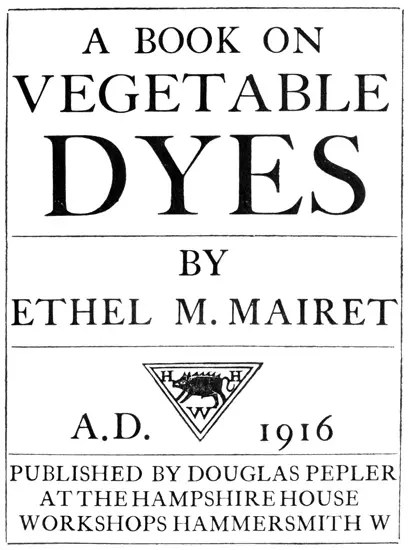
"A Book on Vegetable Dyes" by Ethel Mairet is a practical guide on the art of dyeing using natural materials, likely written in the early 20th century. The book delves into the traditions of vegetable dyeing, discussing its decline in favor of synthetic dyes and emphasizing the importance of natural color in craftsmanship. It aims to revive and document the practices, knowledge, and recipes for dyeing various fibers with traditional substances. The opening of this book sets the stage for a robust exploration of dyeing as an artistic craft, lamenting the loss of traditional methods in a modern world inundated with synthetic options. Mairet reflects on how the beauty of colors obtainable through natural dyes has been overshadowed by the ease of chemical dyes, urging artisans to reconnect with the rich history of dyeing. The introduction also outlines the book's contents, which reveal a structured approach to not only the dyeing process but also the types of materials and techniques needed for effective results, ultimately encouraging readers to develop their own practices in this fading art.
Introduction adapted from the source catalogue; source summaries may be automatically generated.
Free to read · English · 28,649 words · No account needed
MAKE TIME FOR A GOOD BOOK
On by default. Untick to stop anonymous reading totals. Each page counts after 10 seconds in view. How this works.
Anonymous counting is on unless you have switched it off.
Rawson, Gardiner and Laycock. A Dictionary of Dyes, Mordants, 1901.
James Haigh. The Dyer's Assistant. 1778.
James Napier. A Manual of Dyeing Receipts. 1855.
James Napier. A Manual of the Art of Dyeing. 1853.
A Profitable Boke. (On Dyeing). Translated from the Dutch. 1583.
Darwin and Meldola. Woad. ("Nature", Nov. 12, 1896).
Mrs. Anstruther Mackay. Simple Home Dyeing.
English Encyclopædia. Dyeing. 1802.
Gardiner D. Hiscock. 20th Century Book of Recipes, Formulas and
Processes. 1907.
F. J. Bird. The Dyer's Hand Book. 1875.
Hurst. Silk Dyeing and Printing. (Technological Hand Book. 1892).
Smith. Practical Dyers' Guide. 1849.
T. Sims. Dyeing and Bleaching. (British Manufacturing Industries.
1877.)
David Smith. The Dyers' Instructor. 1857.
The Dyer and Colour Maker's Companion. 1859.
Thomas Love. The Practical Dyer and Scourer. 1854.
Knecht, Rawson and Lowenthal. A Manual of Dyeing. 1893.
Berthollet. The Art of Dyeing. 1824.
George Jarmain. On Wool Dyeing. 6 Lectures. 1876.
Hellot, Macquer, M. le Pilleur D'Apligny. The Art of Dyeing Wool, Silk and Cotton. (Translated from the French, 1789. New Edition, 1901.)
The Art of Dyeing. (Translated from the German. 1705. Reprint 1913.)
R. P. Milroy. Handbook on Dyeing for Woollen Homespun Workers. (Congested Districts Board for Ireland).
Dr. W. L. Lindsay. On the Dyeing Properties of Lichens. (Edinburgh New Philosophical Journal, 1855).
T. Edmonston. "On the Native Dyes of the Shetland Islands." (Transactions of Botanical Society of Edinburgh, Vol. I. 1841).
Edward Bancroft. The Philosophy of Permanent Colours. 1794.
Francheville. On Ancient and Modern Dyes, 1767. (Royal Academy of
Sciences, Berlin).
Parnell's Applied Chemistry.--Article on Dyeing.
William Morris. "Of Dyeing as an Art." (Essays by Members of the Arts and Crafts Exhibition Society, 1903).
William Morris. "The Lesser Arts of Life." (From Architecture,
Industry and Wealth. 1902).
Brewster's Edinburgh ncyclopædia. 1830. Dyeing.
Sansome. "Dyeing." 1888.
John M. Thomson. The Practical Dyer's Assistant. 1849.
A.--Adjective dyes, 24. Dyes which require a mordant.
Alder bark, 43, 44, 100, 126.
Alizarin. The chief colouring principle of madder. It is also the name for an extensive series of chemical colours produced from anthracene, one of the coal tar hydrocarbons, discvrd., 1868.
Alkaline ley, 28.
Almond, 120.
Amber, 132.
Alum, 26-29.
Aluminium sulphate, 26.
Aniline, 3. Discovered, 1826 (añil, Span. indigo). First prepared from indigo by means of caustic potash. Found in coal in 1834. Manufactured on a large scale after Perkin's discovery of mauve in 1856.
Anatta, (Anotto, Arnotto, Roucou), 111. A dye obtained from the pulp surrounding the seeds of the Bixa orellana; chiefly used in dyeing silk an orange colour, but is of a fugitive nature.
Archil, 52, 53, 54.
Argol, 131. The tartar deposited from wines completely fermented, and adhering to the sides of casks as a hard crust. When purified it becomes Cream of Tartar.
Ash, 41, 120.
Astringents, 19, 26.
B.--Barberry, 41, 120.
Barwood, 67, 106.
Beck.--A large vessel or tub used in dyeing.
Bichromate of Potash, 32.
Birch, 38, 42, 43, 99, 103.
Black, 122-123; from logwood, 79-85.
Black Dye Plants, 44.
Blue, 63; from Indigo, 66-75; from lichen, 61; from logwood, 79-85.
Blue black, 81.
Your reading position is saved on this browser. Take it to another device with a library code. Reading pages adapt to text, rather than matching a printed edition.
BEHIND THE BOOK
This eBook is for the use of anyone anywhere in the United States and most other parts of the world at no cost and with almost no restrictions whatsoever. You may copy it, give it away or re-use it under the terms of the Project Gutenberg License included with this eBook or online at www.gutenberg.org. If you are not located in the United States, you will have to check the laws of the country where you are located before using this eBook. Read the source licence.
The original source file, including credits and licence, is retained by this library. Request an original-format copy at no charge. Please include the book title and Project Gutenberg identifier #50079.
KEEP YOUR CURIOSITY GOING
Charles G. (Charles Griffith) Ross
Hannah Webster Foster

Emily Lawless
Edwin Hamlin Carr

Charles De Lano Hine
Andrew Ure