
The Writing of News A Handbook with Chapters on Newspaper Correspondence and Copy Reading
Charles G. (Charles Griffith) Ross
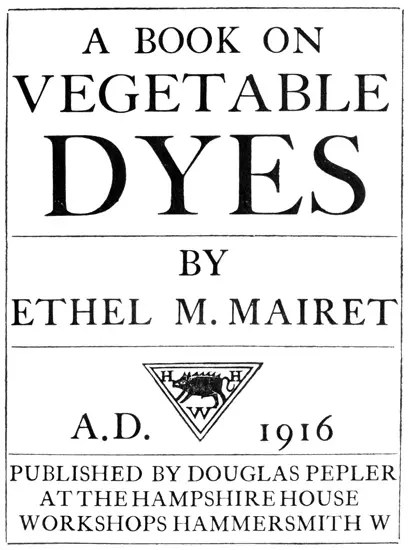
THE CLASSIC COLLECTION · 1916
"A Book on Vegetable Dyes" by Ethel Mairet is a practical guide on the art of dyeing using natural materials, likely written in the early 20th century. The book delves into the traditions of vegetable dyeing, discussing its decline in favor of synthetic dyes and emphasizing the importance of natural color in craftsmanship. It aims to revive and document the practices, knowledge, and recipes for dyeing various fibers with traditional substances. The opening of this book sets the stage for a robust exploration of dyeing as an artistic craft, lamenting the loss of traditional methods in a modern world inundated with synthetic options. Mairet reflects on how the beauty of colors obtainable through natural dyes has been overshadowed by the ease of chemical dyes, urging artisans to reconnect with the rich history of dyeing. The introduction also outlines the book's contents, which reveal a structured approach to not only the dyeing process but also the types of materials and techniques needed for effective results, ultimately encouraging readers to develop their own practices in this fading art.
Introduction adapted from the source catalogue; source summaries may be automatically generated.
Free to read · English · 28,649 words · No account needed
MAKE TIME FOR A GOOD BOOK
On by default. Untick to stop anonymous reading totals. Each page counts after 10 seconds in view. How this works.
Anonymous counting is on unless you have switched it off.
The introduction of foreign dye woods and other dyes during the 17th and 18th centuries rapidly displaced the native dye plants, except in certain out of the way places such as the Highlands and parts of Ireland. Some of these British dye plants had been used from early historical times for dyeing. Some few are still in use in commercial dye work (pear, sloe, and a few others); but their disuse was practically completed during the 19th century when the chemical dyes ousted them from the market.
The majority of these plants are not very important as dyes, and could not probably now be collected in sufficient quantities. Some few however are important, such as woad, weld, heather, walnut, alder, oak, some lichens; and many of the less important ones would produce valuable colours if experiments were made with the right mordants. Those which have been in use in the Highlands are most of them good dyes. Among these are Ladies Bedstraw, whortleberry, yellow iris, bracken, bramble, meadow sweet, alder, heather and many others. The yellow dyes are the most plentiful, and many of these are good fast colours. Practically no good red, in quantity, is obtainable. Madder is the only reliable red dye among plants, and that is no longer indigenous in England. Most of the dye plants require a preparation of the material to be dyed, with alum, or some other mordant, but a few, such as Barberry, and some of the lichens, are substantive dyes, and require no mordant.
Potentil. Potentilla Tormentilla. Roots.
Wild Madder. Rubia peregrina.
Lady's Bedstraw. Galium verum. Roots.
Gromwell. Lithospermum arvense.
Marsh Potentil. Potentilla Comarum. Roots.
Birch. Betula alba. Fresh inner bark.
Bed-straw. Galium boreale. Roots.
Common Sorrel. Rumex acetosa. Roots.
Evergreen Alkanet. Anchusa sempervirens. With chloride of tin.
Dyer's Woodruff. Asperula tinctoria. Roots.
Woad. Isatis Tinctoria.
Whortleberry or blaeberry. Vaccinium Myrtillus. Berries.
Elder. Sambucus nigra. Berries.
Privet. Ligustrum vulgare. Berries, with alum and salt.
[2]Sloe. Prunus communis. Fruit.
Red bearberry. Arctostaphylos Uva-Ursi.
Dogs Mercury. Mercurialis perennis.
Yellow Iris. Iris Pseudacorus. Root.
Devil's Bit. Scabiosa succisa. Leaves prepared like woad.
Weld. Reseda luteola.
Meadow Rue. Thalictrum flavum. Roots.
Marsh Marigold. Caltha palustris. Flowers.
S. John's Wort. Hypericum perforatum.
Heath. Erica vulgaris. With Alum.
Spindle tree. Euonymus Europæus.
Buckthorn. Rhamnus frangula and R. cathartica. Berries and
Bark.
[3]Dyer's Greenwood. Genista tinctoria. Young shoots and leaves.
Kidney Vetch. Anthyllis Vulnararia.
Marsh Potentil. Potentilla Comarum.
Ling. Calluna vulgaris.
Yellow Centaury. Chlora perfoliata.
Hornbeam. Carpinus Betulus. Bark.
Hedge stachys. Stachys palustris.
Polygonum Persecaria.
Polygonum Hydropiper.
Hop. Humulus lupulus.
Stinking Willy, or Ragweed. Senecio Jacobæa.
Yellow Camomile. Anthemis tinctoria.
Your reading position is saved on this browser. Take it to another device with a library code. Reading pages adapt to text, rather than matching a printed edition.
BEHIND THE BOOK
This eBook is for the use of anyone anywhere in the United States and most other parts of the world at no cost and with almost no restrictions whatsoever. You may copy it, give it away or re-use it under the terms of the Project Gutenberg License included with this eBook or online at www.gutenberg.org. If you are not located in the United States, you will have to check the laws of the country where you are located before using this eBook. Read the source licence.
The original source file, including credits and licence, is retained by this library. Request an original-format copy at no charge. Please include the book title and Project Gutenberg identifier #50079.
KEEP YOUR CURIOSITY GOING
Charles G. (Charles Griffith) Ross
Hannah Webster Foster

Emily Lawless
Edwin Hamlin Carr

Charles De Lano Hine
Andrew Ure