
The Writing of News A Handbook with Chapters on Newspaper Correspondence and Copy Reading
Charles G. (Charles Griffith) Ross
THE CLASSIC COLLECTION · 1916
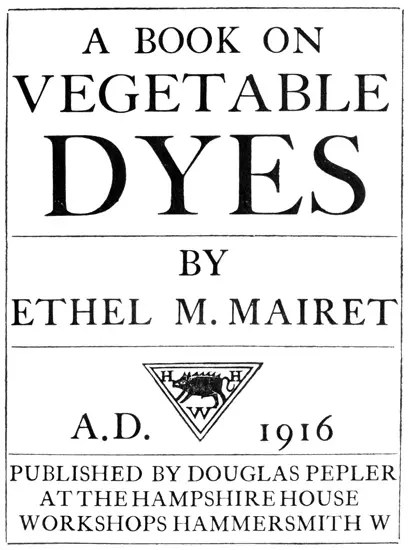
"A Book on Vegetable Dyes" by Ethel Mairet is a practical guide on the art of dyeing using natural materials, likely written in the early 20th century. The book delves into the traditions of vegetable dyeing, discussing its decline in favor of synthetic dyes and emphasizing the importance of natural color in craftsmanship. It aims to revive and document the practices, knowledge, and recipes for dyeing various fibers with traditional substances. The opening of this book sets the stage for a robust exploration of dyeing as an artistic craft, lamenting the loss of traditional methods in a modern world inundated with synthetic options. Mairet reflects on how the beauty of colors obtainable through natural dyes has been overshadowed by the ease of chemical dyes, urging artisans to reconnect with the rich history of dyeing. The introduction also outlines the book's contents, which reveal a structured approach to not only the dyeing process but also the types of materials and techniques needed for effective results, ultimately encouraging readers to develop their own practices in this fading art.
Introduction adapted from the source catalogue; source summaries may be automatically generated.
Free to read · English · 28,649 words · No account needed
MAKE TIME FOR A GOOD BOOK
On by default. Untick to stop anonymous reading totals. Each page counts after 10 seconds in view. How this works.
Anonymous counting is on unless you have switched it off.
Urceolaria calcarea. Corkir, Limestone Urceolaria. Found in
Scotland, Western Islands, Shetland and Wales, growing on limestone
rocks.
U. Scruposa. Rock Urceolaria. Grows on rocks in hilly districts in
England.
U. cinerea. Greyish Urceolaria. In England, on rocks.
Parmelia saxatilis. Crottle, stane-raw, Staney-raw, (Scotland). Scrottyie, (Shetland). Sten-laf, Sten-mossa, (Norway and Sweden). Found on rocks and stones in Scotland, Shetland, and Scandinavia. In winter the Swedish peasantry wear home made garments dyed purple by this lichen. By the Shetlanders it is usually collected in August, when it is considered richest in colouring matter.
P. omphalodes. Black Crottle, Cork, Corker, Crostil or Crostal, (Scotch Highlands). Arcel, (Ireland). Kenkerig, (Wales). Alaforel-leaf, (Sweden). Found on rocks, especially Alpine, in Scotland, Ireland, Wales and Scandinavia. One of the most extensively used dye-lichens. It yields a dark brown dye readily to boiling water, and it is easily fixed to yarns by simple mordants. It is stated to yield a red, crimson or purple dye.
P. caperata. Stone crottle, Arcel. Found in North of Ireland and
Isle of Man, on trees. Said to dye yarn brown, orange and lemon
yellow.
P. conspersa. Sprinkled parmelia. Found growing on rocks in England.
Evernia prunastri. Ragged hoary lichen. Stag's horn lichen. Found in
Scotland, on trees.
Ramalina scopulorum. Ivory-like ramalina. Scotland, on maritime
rocks. A red dye.
R. farinacea. Mealy ramalina. On trees in England.
Borrera ashney. Chutcheleera. India.
Solorina crocea. Saffron yellow solorina. In Scotland, on mountain
summits. The colouring matter is ready formed and abundant in the
thallus.
Nephroma parilis. Chocolate colored nephroma. Scotland, on stones.
Said to dye blue.
Sticta pulmonacea. On trees.
Lecidea sanguinaria. Red fruited lecidea. In Scotland, on rocks.
Conicularia aculeata. var. spadicea. Brown prickly cornicularia. Canary Islands, Highland Mountains.
Usnea barbata. Bearded Usnea. Pennsylvania and South America. On old trees. Stated to dye yarn orange.
U. florida. Flowering Usnea. Pale greenish yellow or reddish brown.
U. plicata. Plaited usnea. On trees.
Cetraria Islandica. Iceland moss. Iceland heaths, and hills. It yields a good brown to boiling water, but this dye appears only to have been made available to the Icelanders.
Parmelia physoides. Dark crottle, Bjork-laf. Found in Sweden, Scotland & Scandinavia, on rocks and trees.
P. omphalodes. In Scandinavia and Scotland. Withering asserts that it yields a purple dye paler, but more permanent, than orchil; which is prepared in Iceland by steeping in stale lye, adding a little salt and making it up into balls with lime.
Your reading position is saved on this browser. Take it to another device with a library code. Reading pages adapt to text, rather than matching a printed edition.
BEHIND THE BOOK
This eBook is for the use of anyone anywhere in the United States and most other parts of the world at no cost and with almost no restrictions whatsoever. You may copy it, give it away or re-use it under the terms of the Project Gutenberg License included with this eBook or online at www.gutenberg.org. If you are not located in the United States, you will have to check the laws of the country where you are located before using this eBook. Read the source licence.
The original source file, including credits and licence, is retained by this library. Request an original-format copy at no charge. Please include the book title and Project Gutenberg identifier #50079.
KEEP YOUR CURIOSITY GOING
Charles G. (Charles Griffith) Ross
Hannah Webster Foster

Emily Lawless
Edwin Hamlin Carr

Charles De Lano Hine
Andrew Ure