
The Writing of News A Handbook with Chapters on Newspaper Correspondence and Copy Reading
Charles G. (Charles Griffith) Ross
THE CLASSIC COLLECTION · 1916
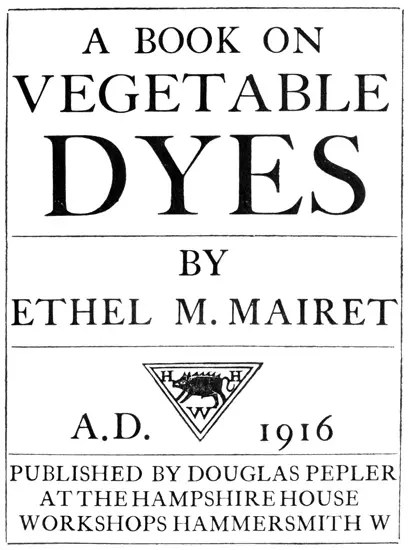
"A Book on Vegetable Dyes" by Ethel Mairet is a practical guide on the art of dyeing using natural materials, likely written in the early 20th century. The book delves into the traditions of vegetable dyeing, discussing its decline in favor of synthetic dyes and emphasizing the importance of natural color in craftsmanship. It aims to revive and document the practices, knowledge, and recipes for dyeing various fibers with traditional substances. The opening of this book sets the stage for a robust exploration of dyeing as an artistic craft, lamenting the loss of traditional methods in a modern world inundated with synthetic options. Mairet reflects on how the beauty of colors obtainable through natural dyes has been overshadowed by the ease of chemical dyes, urging artisans to reconnect with the rich history of dyeing. The introduction also outlines the book's contents, which reveal a structured approach to not only the dyeing process but also the types of materials and techniques needed for effective results, ultimately encouraging readers to develop their own practices in this fading art.
Introduction adapted from the source catalogue; source summaries may be automatically generated.
Free to read · English · 28,649 words · No account needed
MAKE TIME FOR A GOOD BOOK
On by default. Untick to stop anonymous reading totals. Each page counts after 10 seconds in view. How this works.
Anonymous counting is on unless you have switched it off.
Lixiviation. The process of separating a soluble substance from an insoluble by the percolation of water.
Lixivium. (Lye). A term often used in old dye books. Water
impregnated with alkaline salts extracted by lixiviation from wood
ashes.
Logwood, 77, 130, 131, 137.
Lye or Ley. Any strong alkaline solution, especially one used for the purpose of washing, such as soda lye, soap lye.
M.--Madder, 38, 98-105, 132.
Magenta, 44.
Maize, 132.
Mercerised Cotton. Cotton prepared by treating with a solution of caustic potash or soda or certain other chemicals. Discovered by John Mercer in 1844.
Milling. The operation of fulling cloth.
Mordants, 24; general remarks on, 34; primitive mordants, 25.
Muriate of Tin, 31.
Myrobalans, 26, 35, 36. The fruit of several species of trees,
growing in China & the East Indies, containing tannic acid, (25-40%
tannin).
O.--Oak bark, 128.
Oak galls, 35, 36.
Oil of Vitriol, 64, 65, 67. Sulphuric acid.
Old Fustic, see Fustic.
Old Gold, 109, 112-114.
Olive, 109, 113, 118, 135.
Onion skins, 128.
Orange, 91, 93, 102, 106, 109, 120, 132; from lichens, 48, 51, 58,
60-2.
Orchil, 45, 52-55.
Organzine. Twisted raw silk from best cocoons, used for warp.
Orseille, 58.
Oxalic Acid, 30, 31.
P.--Pastel, 77. Woad.
Peach, 120.
Peach wood, 106-107.
Pear, 41, 120.
Pearl ash. Carbonate of Potash.
Peat Soot, 128.
Persian Berries. The dried unripe fruit of various species of Rhamnus. Also called French berries, Grains of Avignon.
Philamort, 48.
Pink, 93; from lichen, 57.
Plum colour, from lichen, 48.
Poplar, 42, 135.
Potassium Carbonate. (Potashes). Carbonate of Potash has been known since ancient times as a constituent of the ashes of land plants, from which it is obtained by extraction with water. In most cases Sodium Carbonate, which it strongly resembles, can be used in its place.
Potassium dichromate, 32.
Privet, 39, 41, 42, 121.
Purple, from lichens, 53, 57-60, 62; with cochineal, 95, 96; with
logwood, 82, 85, 86, 87.
Purple Dye Plants, 43.
Q.--Quercitron, 116-120; for green, 135-137.
R.--Red, 87-107; from lichens, 48-51, 53, 56, 58, 60.
Red Dye Plants, 38.
Red Spirits. Tin spirits. Applied to tin mordants generally. A
solution of Stannous chloride.
Red woods. Camwood, Barwood, Sanderswood (Santal, Sandal, Red Sanders), Brazil wood, Sapan wood, Peach wood.
Retting, 21.
Roucou. Anatta, Arnotto.
S.--Sandalwood or Saunderswood, 106.
Sadden, to, saddening, 14, 30, 34, 127, 130, 132. To darken or dull
in colour.
Sapan wood, 106.
Savory, 107, 108.
Sawwort, 41, 135.
Saxon blue, 67, 70, 136. The dye made by Indigo dissolved in oil of
vitriol.
Saxon green, 118, 136, 138.
Scarlet, 88, 91, 92, 93, 94, 95, 97, 98.
Scarlet of Grain, 87.
Scotch ell. 37·2 inches.
Scour, to. To wash.
Scroop. The rustling property of silk.
Scrottyie, 49, 50, 59.
Silk, 16-18; to alum, 18; general method of dyeing, 17; to mordant, 26; the preparation of, 17; to soften, 18; various kinds of, 16; raw, 16, 17; waste, 16.
Silver drab, 84.
Sloe, 39.
Soda ash. Carbonate of soda.
Soda ley, 101.
Sour water, 28. To every gallon of water, add 1 gill vitriol; stir thoroughly. Stuff steeped in this should be covered with the liquor, otherwise it will rot.
Your reading position is saved on this browser. Take it to another device with a library code. Reading pages adapt to text, rather than matching a printed edition.
BEHIND THE BOOK
This eBook is for the use of anyone anywhere in the United States and most other parts of the world at no cost and with almost no restrictions whatsoever. You may copy it, give it away or re-use it under the terms of the Project Gutenberg License included with this eBook or online at www.gutenberg.org. If you are not located in the United States, you will have to check the laws of the country where you are located before using this eBook. Read the source licence.
The original source file, including credits and licence, is retained by this library. Request an original-format copy at no charge. Please include the book title and Project Gutenberg identifier #50079.
KEEP YOUR CURIOSITY GOING
Charles G. (Charles Griffith) Ross
Hannah Webster Foster

Emily Lawless
Edwin Hamlin Carr

Charles De Lano Hine
Andrew Ure