
The Writing of News A Handbook with Chapters on Newspaper Correspondence and Copy Reading
Charles G. (Charles Griffith) Ross
THE CLASSIC COLLECTION · 1916
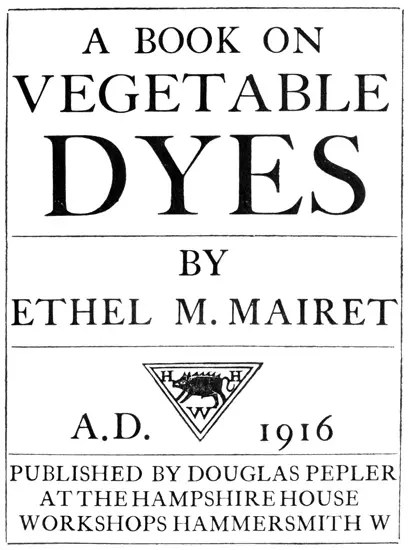
"A Book on Vegetable Dyes" by Ethel Mairet is a practical guide on the art of dyeing using natural materials, likely written in the early 20th century. The book delves into the traditions of vegetable dyeing, discussing its decline in favor of synthetic dyes and emphasizing the importance of natural color in craftsmanship. It aims to revive and document the practices, knowledge, and recipes for dyeing various fibers with traditional substances. The opening of this book sets the stage for a robust exploration of dyeing as an artistic craft, lamenting the loss of traditional methods in a modern world inundated with synthetic options. Mairet reflects on how the beauty of colors obtainable through natural dyes has been overshadowed by the ease of chemical dyes, urging artisans to reconnect with the rich history of dyeing. The introduction also outlines the book's contents, which reveal a structured approach to not only the dyeing process but also the types of materials and techniques needed for effective results, ultimately encouraging readers to develop their own practices in this fading art.
Introduction adapted from the source catalogue; source summaries may be automatically generated.
Free to read · English · 28,649 words · No account needed
MAKE TIME FOR A GOOD BOOK
On by default. Untick to stop anonymous reading totals. Each page counts after 10 seconds in view. How this works.
Anonymous counting is on unless you have switched it off.
6). GREEN WITH QUERCITRON FOR WOOL. Dye the wool blue in the Indigo vat. Wash well. For 100 parts of wool, put 3 parts of chalk and 10 or 12 of alum. Boil the wool in this for 1 hour. Then to the same bath, add 10 or 12 parts of Quercitron, and continue the boiling for ¼ hour. Then add 1 part of chalk, and this addition is repeated at intervals of 6 to 8 minutes till a fine green colour is brought out.
7). GREEN WITH QUERCITRON FOR COTTON. First, the cotton is dyed a sky blue colour by means of indigo dissolved by potash and orpiment; then it is passed through a strong decoction of sumach, in which it is left until well cooled. It is then dried, passed through the mordant of acetate of alumina, dried again, washed, worked for 2 hours in tepid bath of Quercitron, (26¼ lbs. to 110 lbs. cotton).
8). GREEN WITH INDIGO EXTRACT & WELD FOR WOOL. Mordant 1 lb. wool with 4 oz. alum and ½ oz. cream of tartar. Dye blue with sufficient quantity of Indigo Extract. Wash and dry. Prepare a dye bath with weld which has been previously chopped up and boiled. Enter wool and boil for half-an-hour or more.
[18] Note page 42 on British plants which dye green.
Continued from page 62
S. scrobiculata. Aik-raw, Oak rag. Found on trees in Scotland and
England.
Gyrophora deusta. Scorched looking gyrophora. Found on rocks in Scandinavia. Linnæus states that it furnishes a paint called "Tousch," much used in Sweden.
G. cylindrica. Cylindrical gyrophora. On rocks in Iceland. Greenish
brown. Also G. deusta.
Alectoria jubata. Horse hair lichen, Rock hair. On fir trees in
England, pale greenish brown.
Parmelia parietina. Common yellow wall lichen, Wäg-mässa, Wag-laf. England and Sweden on trees, rocks, walls, palings. Used to dye Easter eggs. Used in Sweden for wool dyeing.
Cetraria juniperina. En-mossa. On trees in Scandinavia.
Borrera flavicans. Yellow borrera. On trees in Germany, gamboge
yellow.
Lecanora candelaria. Ljus mässa. On trees in Sweden.
Evernia flavicans. Wolf's-bane evernia. On trees in Scandinavia,
gamboge yellow.
Lecidea atro-virens. Map lichen. On rocks in Scandinavia.
Lepraria chlorina. Brimstone coloured lepraria. Scandinavia, on
rocks.
L. Iolithus. Viol-mässa. Sweden, on stones. Gives to stones the
appearance of blood stains.
Prof. G. Henslow. Uses of British Plants.
Dr. Plowright. British Dye Plants. (Journal of the Royal Horticultural
Society, Vol. 26. 1901.)
Sowerby. Useful Plants of Great Britain.
Sowerby. English Botany.
Professor G. S. Boulger. The Uses of Plants. 1889.
Alfred Edge. Some British Dye Lichens. (Journal of the Society of Dyers and Colourists. May 1914).
J. J. Hummel. The Dyeing of Textile Fabrics.
Clement Bolton. A Manual of Wool Dyeing. 1913.
W. Crooks. Dyeing and Tissue Printing. 1882.
Your reading position is saved on this browser. Take it to another device with a library code. Reading pages adapt to text, rather than matching a printed edition.
BEHIND THE BOOK
This eBook is for the use of anyone anywhere in the United States and most other parts of the world at no cost and with almost no restrictions whatsoever. You may copy it, give it away or re-use it under the terms of the Project Gutenberg License included with this eBook or online at www.gutenberg.org. If you are not located in the United States, you will have to check the laws of the country where you are located before using this eBook. Read the source licence.
The original source file, including credits and licence, is retained by this library. Request an original-format copy at no charge. Please include the book title and Project Gutenberg identifier #50079.
KEEP YOUR CURIOSITY GOING
Charles G. (Charles Griffith) Ross
Hannah Webster Foster

Emily Lawless
Edwin Hamlin Carr

Charles De Lano Hine
Andrew Ure