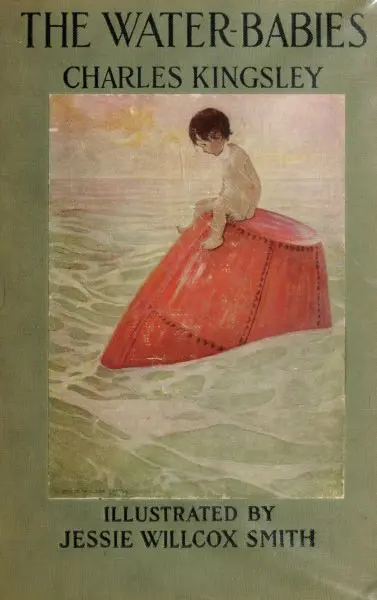
The Water-Babies
Charles Kingsley
THE CLASSIC COLLECTION · 1851
"Yeast: a Problem" by Charles Kingsley is a socio-political commentary written in the mid-19th century. The book explores the issues facing the rural poor in England during a time of social reform and political change, advocating for improvements in their living conditions and questioning the morality of the elite. The narrative introduces various characters, including Lancelot Smith, a young man seeking purpose and enlightenment against the backdrop of societal expectations and personal struggles. The opening of the text presents a thoughtful preface, reflecting on social progress over the past twelve years, particularly concerning the laboring class and the impact of reforms such as the new Poor Law and free trade. Kingsley discusses the responsibility of the gentry towards the agricultural poor and critiques the apathy of educated classes in addressing the plight of these workers. Through the lens of characters like Lancelot, who grapples with personal and societal dilemmas, the text sets the stage for deeper exploration of themes such as class disparity, moral integrity, and the quest for a meaningful existence amidst the challenges of the era. The engaging discourse suggests that the book will confront not only the issues of its time but also the potential for individual and collective growth in addressing these pressing matters.
Introduction adapted from the source catalogue; source summaries may be automatically generated.
Free to read · English · 97,723 words · No account needed
MAKE TIME FOR A GOOD BOOK
On by default. Untick to stop anonymous reading totals. Each page counts after 10 seconds in view. How this works.
Anonymous counting is on unless you have switched it off.
'What do you want, in Heaven's name?' asked Argemone, half
terrified.
'I want YOU to tell me that. Here I am, with youth, health, strength, money, every blessing of life but one; and I am utterly miserable. I want some one to tell me what I want.'
'Is it not that you want--religion?'
'I see hundreds who have what you call religion, with whom I should scorn to change my irreligion.'
'But, Mr. Smith, are you not--are you not wicked?--They tell me so,' said Argemone, with an effort, 'And is that not the cause of your disease?'
Lancelot laughed.
'No, fairest prophetess, it is the disease itself. "Why am I what I am, when I know more and more daily what I could be?"--That is the mystery; and my sins are the fruit, and not the root of it. Who will explain that?'
Argemone began,--
'The Church--'
'Oh, Miss Lavington,' cried he, impatiently, 'will you, too, send me back to that cold abstraction? I came to you, however presumptuous, for living, human advice to a living, human heart; and will you pass off on me that Proteus-dream the Church, which in every man's mouth has a different meaning? In one book, meaning a method of education, only it has never been carried out; in another, a system of polity,--only it has never been realised;--now a set of words written in books, on whose meaning all are divided; now a body of men who are daily excommunicating each other as heretics and apostates; now a universal idea; now the narrowest and most exclusive of all parties. Really, before you ask me to hear the Church, I have a right to ask you to define what the Church is.'
'Our Articles define it,' said Argemone drily.
'The "Visible Church," at least, it defines as "a company of faithful men, in which," etc. But how does it define the "Invisible" one? And what does "faithful" mean? What if I thought Cromwell and Pierre Leroux infinitely more faithful men in their way, and better members of the "Invisible Church," than the torturer-pedant Laud, or the facing bothways Protestant-Manichee Taylor?'
It was lucky for the life of young Love that the discussion went no further: Argemone was becoming scandalised beyond all measure. But, happily, the colonel interposed,--
'Look here; tell me if you know for whom this sketch is meant?'
'Tregarva, the keeper: who can doubt?' answered they both at once.
'Has not Mellot succeeded perfectly?'
Your reading position is saved on this browser. Take it to another device with a library code. Reading pages adapt to text, rather than matching a printed edition.
Charles Kingsley
Charles Kingsley
Charles Kingsley
Charles Kingsley
BEHIND THE BOOK
This eBook is for the use of anyone anywhere in the United States and most other parts of the world at no cost and with almost no restrictions whatsoever. You may copy it, give it away or re-use it under the terms of the Project Gutenberg License included with this eBook or online at www.gutenberg.org. If you are not located in the United States, you will have to check the laws of the country where you are located before using this eBook. Read the source licence.
The original source file, including credits and licence, is retained by this library. Request an original-format copy at no charge. Please include the book title and Project Gutenberg identifier #10364.
KEEP YOUR CURIOSITY GOING
Coulson Kernahan

Maurice Baring
Frances Wright
Cécile Tormay

Frederic Jesup Stimson

W. H. P. (William Henry Pope) Jarvis