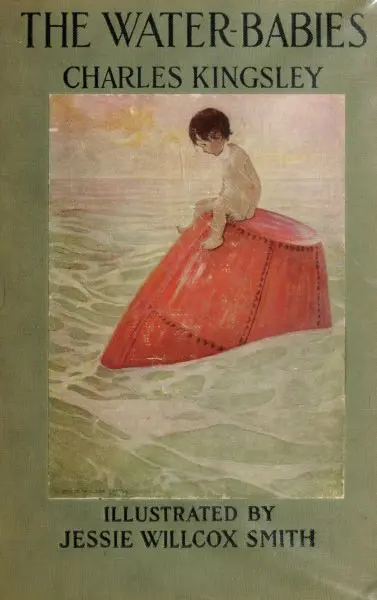
The Water-Babies
Charles Kingsley
THE CLASSIC COLLECTION · 1851
"Yeast: a Problem" by Charles Kingsley is a socio-political commentary written in the mid-19th century. The book explores the issues facing the rural poor in England during a time of social reform and political change, advocating for improvements in their living conditions and questioning the morality of the elite. The narrative introduces various characters, including Lancelot Smith, a young man seeking purpose and enlightenment against the backdrop of societal expectations and personal struggles. The opening of the text presents a thoughtful preface, reflecting on social progress over the past twelve years, particularly concerning the laboring class and the impact of reforms such as the new Poor Law and free trade. Kingsley discusses the responsibility of the gentry towards the agricultural poor and critiques the apathy of educated classes in addressing the plight of these workers. Through the lens of characters like Lancelot, who grapples with personal and societal dilemmas, the text sets the stage for deeper exploration of themes such as class disparity, moral integrity, and the quest for a meaningful existence amidst the challenges of the era. The engaging discourse suggests that the book will confront not only the issues of its time but also the potential for individual and collective growth in addressing these pressing matters.
Introduction adapted from the source catalogue; source summaries may be automatically generated.
Free to read · English · 97,723 words · No account needed
MAKE TIME FOR A GOOD BOOK
On by default. Untick to stop anonymous reading totals. Each page counts after 10 seconds in view. How this works.
Anonymous counting is on unless you have switched it off.
Let us pass over the period of dull, stupefied misery that followed, when Lancelot had returned to his lonely lodging, and the excitement of his feelings had died away. It is impossible to describe that which could not be separated into parts, in which there was no foreground, no distance, but only one dead, black, colourless present. After a time, however, he began to find that fancies, almost ridiculously trivial, arrested and absorbed his attention; even as when our eyes have become accustomed to darkness, every light-coloured mote shows luminous against the void blackness of night. So we are tempted to unseemly frivolity in churches, and at funerals, and all most solemn moments; and so Lancelot found his imagination fluttering back, half amused, to every smallest circumstance of the last few weeks, as objects of mere curiosity, and found with astonishment that they had lost their power of paining him. Just as victims on the rack have fallen, it is said, by length of torture, into insensibility, and even calm repose, his brain had been wrought until all feeling was benumbed. He began to think what an interesting autobiography his life might make; and the events of the last few years began to arrange themselves in a most attractive dramatic form. He began even to work out a scene or two, and where 'motives' seemed wanting, to invent them here and there. He sat thus for hours silent over his fire, playing with his old self, as though it were a thing which did not belong to him--a suit of clothes which he had put off, and which,
'For that it was too rich to hang by the wall,
It must be ripped,'
and then pieced and dizened out afresh as a toy. And then again he started away from his own thoughts, at finding himself on the edge of that very gulf, which, as Mellot had lately told him, Barnakill denounced as the true hell of genius, where Art is regarded as an end and not a means, and objects are interesting, not in as far as they form our spirits, but in proportion as they can be shaped into effective parts of some beautiful whole. But whether it was a temptation or none, the desire recurred to him again and again. He even attempted to write, but sickened at the sight of the first words. He turned to his pencil, and tried to represent with it one scene at least; and with the horrible calmness of some self- torturing ascetic, he sat down to sketch a drawing of himself and Argemone on her dying day, with her head upon his bosom for the last time--and then tossed it angrily into the fire, partly because he felt just as he had in his attempts to write, that there was something more in all these events than he could utter by pen or pencil, than he could even understand; principally because he could not arrange the attitudes gracefully enough. And now, in front of the stern realities of sorrow and death, he began to see a meaning in another mysterious saying of Barnakill's, which Mellot was continually quoting, that 'Art was never Art till it was more than Art; that the Finite only existed as a body of the Infinite; and that the man of genius must first know the Infinite, unless he wished to become not a poet, but a maker of idols.' Still he felt in himself a capability, nay, an infinite longing to speak; though what he should utter, or how--whether as poet, social theorist, preacher, he could not yet decide. Barnakill had forbidden him painting, and though he hardly knew why, he dared not disobey him. But Argemone's dying words lay on him as a divine command to labour. All his doubts, his social observations, his dreams of the beautiful and the blissful, his intense perception of social evils, his new- born hope--faith it could not yet be called--in a ruler and deliverer of the world, all urged him on to labour: but at what? He felt as if he were the demon in the legend, condemned to twine endless ropes of sand. The world, outside which he now stood for good and evil, seemed to him like some frantic whirling waltz; some serried struggling crowd, which rushed past him in aimless confusion, without allowing him time or opening to take his place among their ranks: and as for wings to rise above, and to look down upon the uproar, where were they? His melancholy paralysed him more and more. He was too listless even to cater for his daily bread by writing his articles for the magazines. Why should he? He had nothing to say. Why should he pour out words and empty sound, and add one more futility to the herd of 'prophets that had become wind, and had no truth in them'? Those who could write without a conscience, without an object except that of seeing their own fine words, and filling their own pockets--let them do it: for his part he would have none of it. But his purse was empty, and so was his stomach; and as for asking assistance of his uncle, it was returning like the dog to his vomit. So one day he settled all bills with his last shilling, tied up his remaining clothes in a bundle, and stoutly stepped forth into the street to find a job--to hold a horse, if nothing better offered; when, behold! on the threshold he met Barnakill himself.
Your reading position is saved on this browser. Take it to another device with a library code. Reading pages adapt to text, rather than matching a printed edition.
Charles Kingsley
Charles Kingsley
Charles Kingsley
Charles Kingsley
BEHIND THE BOOK
This eBook is for the use of anyone anywhere in the United States and most other parts of the world at no cost and with almost no restrictions whatsoever. You may copy it, give it away or re-use it under the terms of the Project Gutenberg License included with this eBook or online at www.gutenberg.org. If you are not located in the United States, you will have to check the laws of the country where you are located before using this eBook. Read the source licence.
The original source file, including credits and licence, is retained by this library. Request an original-format copy at no charge. Please include the book title and Project Gutenberg identifier #10364.
KEEP YOUR CURIOSITY GOING
Coulson Kernahan

Maurice Baring
Frances Wright
Cécile Tormay

Frederic Jesup Stimson

W. H. P. (William Henry Pope) Jarvis