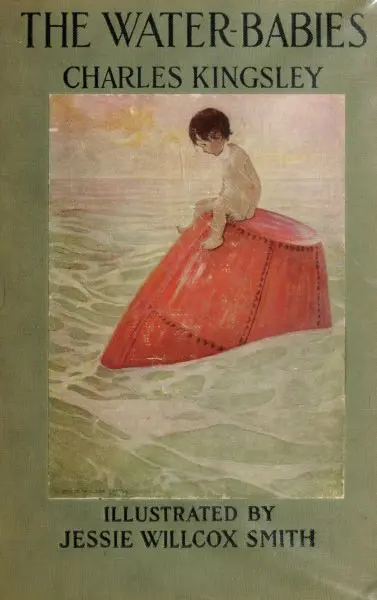
The Water-Babies
Charles Kingsley
THE CLASSIC COLLECTION · 1851
"Yeast: a Problem" by Charles Kingsley is a socio-political commentary written in the mid-19th century. The book explores the issues facing the rural poor in England during a time of social reform and political change, advocating for improvements in their living conditions and questioning the morality of the elite. The narrative introduces various characters, including Lancelot Smith, a young man seeking purpose and enlightenment against the backdrop of societal expectations and personal struggles. The opening of the text presents a thoughtful preface, reflecting on social progress over the past twelve years, particularly concerning the laboring class and the impact of reforms such as the new Poor Law and free trade. Kingsley discusses the responsibility of the gentry towards the agricultural poor and critiques the apathy of educated classes in addressing the plight of these workers. Through the lens of characters like Lancelot, who grapples with personal and societal dilemmas, the text sets the stage for deeper exploration of themes such as class disparity, moral integrity, and the quest for a meaningful existence amidst the challenges of the era. The engaging discourse suggests that the book will confront not only the issues of its time but also the potential for individual and collective growth in addressing these pressing matters.
Introduction adapted from the source catalogue; source summaries may be automatically generated.
Free to read · English · 97,723 words · No account needed
MAKE TIME FOR A GOOD BOOK
On by default. Untick to stop anonymous reading totals. Each page counts after 10 seconds in view. How this works.
Anonymous counting is on unless you have switched it off.
'No,' she said, 'I am not prepared for this. It is too solemn to be undertaken in this miserable whirlwind of passion. I will fast, and meditate, and go up formally to the little chapel, and there devote myself to God; and, in the meantime, to write at once to the superior of the Beguines; to go to my mother, and tell her once for all--What? Must I lose him?--must I give him up? Not his love--I cannot give up that--would that I could! but no! he will love me for ever. I know it as well as if an angel told me. But to give up him! Never to see him! never to hear his voice! never to walk with him among the beech woods any more! Oh, Argemone! Argemone! miserable girl! and is it come to this?' And she threw herself on the sofa, and hid her face in her hands.
Yes, Argemone, it is come to this; and the best thing you can do, is just what you are doing--to lie there and cry yourself to sleep, while the angels are laughing kindly (if a solemn public, who settles everything for them, will permit them to laugh) at the rickety old windmill of sham-Popery which you have taken for a real giant.
At that same day and hour, as it chanced, Lancelot, little dreaming what the said windmill was grinding for him, was scribbling a hasty and angry answer to a letter of Luke's, which, perhaps, came that very morning in order to put him into a proper temper for the demolishing of windmills. It ran thus,--
'Ay, my good Cousin,--So I expected--
'Suave mari magno turbantibus aequora ventis
E terra magnum alterius spectare laborem . . .
Pleasant and easy for you Protestants (for I will call you what you are, in spite of your own denials, a truly consistent and logical Protestant--and therefore a Materialist)--easy for you, I say, to sit on the shore, in cold, cruel self-satisfaction, and tell the poor wretch buffeting with the waves what he ought to do while he is choking and drowning. . . . Thank Heaven, the storm has stranded me upon the everlasting Rock of Peter;--but it has been a sore trouble to reach it. Protestants, who look at creeds as things to be changed like coats, whenever they seem not to fit them, little know what we Catholic-hearted ones suffer. . . . If they did, they would be more merciful and more chary in the requirements of us, just as we are in the very throe of a new-born existence. The excellent man, to whose care I have committed myself, has a wise and a tender heart . . . he saw no harm in my concealing from my father the spiritual reason of my giving up my curacy (for I have given it up), and only giving the outward, but equally true reason, that I found it on the whole an ineligible and distressing post. . . . I know you will apply to such an act that disgusting monosyllable of which Protestants are so fond. He felt with me and for me--for my horror of giving pain to my father, and for my wearied and excited state of mind; and strangely enough--to show how differently, according to the difference of the organs, the same object may appear to two people--he quoted in my favour that very verse which you wrest against me. He wished me to show my father that I had only changed my heaven, and not my character, by becoming an Ultramontane- Catholic . . . that, as far as his esteem and affection were founded on anything in me, the ground of it did not vanish with my conversion. If I had told him at once of my altered opinions, he would have henceforth viewed every word and action with a perjudiced eye. . . . Protestants are so bigoted . . . but if, after seeing me for a month or two the same Luke that he had ever known me, he were gradually informed that I had all the while held that creed which he had considered incompatible with such a life as I hope mine would be--you must see the effect which it ought to have. . . . I don't doubt that you will complain of all this. . . . All I can say is, that I cannot sympathise with that superstitious reverence for mere verbal truth, which is so common among Protestants. . . . It seems to me they throw away the spirit of truth, in their idolatry of its letter. For instance,--what is the use of informing a man of a true fact but to induce a true opinion in him? But if, by clinging to the exact letter of the fact, you create a false opinion in his mind, as I should do in my father's case, if by telling him at once of my change, I gave him an unjust horror of Catholicism,--you do not tell him the truth. . . . You may speak what is true to you,-- but it becomes an error when received into his mind. . . . If his mind is a refracting and polarising medium--if the crystalline lens of his soul's eye has been changed into tourmaline or Labrador spar- -the only way to give him a true image of the fact, is to present it to him already properly altered in form, and adapted to suit the obliquity of his vision; in order that the very refractive power of his faculties may, instead of distorting it, correct it, and make it straight for him; and so a verbal wrong in fact may possess him with a right opinion. . . .
Your reading position is saved on this browser. Take it to another device with a library code. Reading pages adapt to text, rather than matching a printed edition.
Charles Kingsley
Charles Kingsley
Charles Kingsley
Charles Kingsley
BEHIND THE BOOK
This eBook is for the use of anyone anywhere in the United States and most other parts of the world at no cost and with almost no restrictions whatsoever. You may copy it, give it away or re-use it under the terms of the Project Gutenberg License included with this eBook or online at www.gutenberg.org. If you are not located in the United States, you will have to check the laws of the country where you are located before using this eBook. Read the source licence.
The original source file, including credits and licence, is retained by this library. Request an original-format copy at no charge. Please include the book title and Project Gutenberg identifier #10364.
KEEP YOUR CURIOSITY GOING
Coulson Kernahan

Maurice Baring
Frances Wright
Cécile Tormay

Frederic Jesup Stimson

W. H. P. (William Henry Pope) Jarvis