THE CLASSIC COLLECTION✦An outlaw’s diary: the CommuneCLASSIC FREE BOOKS
An outlaw’s diary: the Commune
Cécile Tormay
THE CLASSIC COLLECTION · 1892
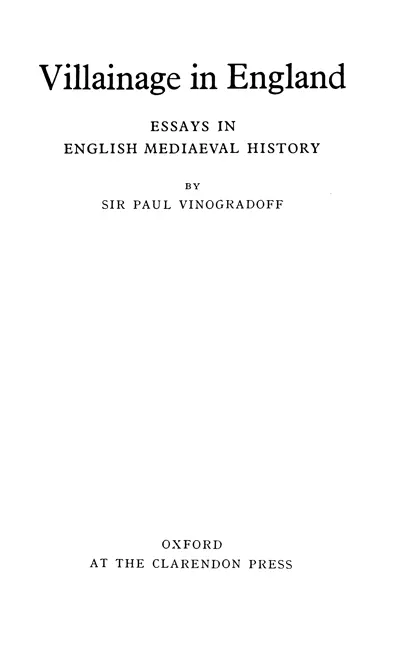
"Villainage in England: Essays in English Mediaeval History" by Sir Paul Vinogradoff is a scholarly historical account written in the late 19th century. The book delves into the complex social structures and legal status of the peasantry during the feudal period in England, particularly focusing on the concept of villainage, a form of servitude distinct from slavery. It examines the rights, disabilities, and socio-economic conditions of villains, offering a comprehensive analysis of how these factors shaped medieval agrarian society. The opening of the book presents a detailed preface where the author discusses his motivations for exploring such a nuanced topic as English social history, framed in the context of his Russian background. He articulates the significance of studying historical documents to uncover the dynamics of social classes, especially the relationship between lords and their peasant subjects. Vinogradoff emphasizes the importance of legal frameworks that defined villainage, arguing that understanding these relationships provides valuable insights into the broader historical narrative of agrarian development and social organization in medieval England. The initial portion sets the stage for an in-depth exploration of the peasantry's legal and economic positions, showcasing a methodical approach to historical inquiry that anticipates the detailed essays that follow.
Introduction adapted from the source catalogue; source summaries may be automatically generated.
Free to read · English · 173,596 words · No account needed
MAKE TIME FOR A GOOD BOOK
On by default. Untick to stop anonymous reading totals. Each page counts after 10 seconds in view. How this works.
Anonymous counting is on unless you have switched it off.
[511] Eynsham Reg., 6, b: 'Robertus Tony tenet de domino unam virgatam terre in bondagium ... Idem semel arabit cum vicino adiuncto.' Ramsey Cart., i. 56. Comp. Q.R. Min. Acc., B^{le} 513, N. 97: 'Estimatur quod communiter tres custumarii possunt facere unam carucam (tenent 20 acras).'
[512] Rot. Hundr., ii. 461, b: 'Robertus de Tony habet in villenagio scil. Reginaldum Toni qui tenet 5 acras ... Item si ipse habeat cum uno vel cum duobus sociis unam carucam, arabit unam selionem terre domini.' Comp. 462, a. Add. MSS. 6159, f. 22, b: 'W.J. tenet de domino in villenagio unum mesuagium et 10 acras terre.... Et arabit cum caruca sua sive jungat sive non 4 acras.'
[513] Black Book of St. Augustine's, 53.
[514] Domesday of St. Paul's, 58.
[515] Augm. Off. Misc. Books, N. 57, f. 65, b. See Cartulary of Battle Abbey (Camd. Soc.), p. 133.
[516] Ely Inqu., 185, a: '... tenent dimidium tenmanland, scilicet 60 acras terre ... Al. et M. et eorum participes tenent unum tenmanland, scilicet 120 acras terre.' The expression may be corrupted from tunmanland, or else it may be a mark of a beginning of cultivation in Danish times.
[517] Chapter-house Books, A. 4/22, p. 21: 'Custumarii tenent 22
virgatas quas vocant wistas.'
[518] Battle Abbey Cart., Augment. Off. Misc. Books, N. 57, f. 27, a;
comp. 15, b.
[519] Glastonbury Inqu. (Roxburghe Ser.), 66, 90.
[520] Worcester Cart., 41, b.
[521] Glastonbury Inqu., 67, 70; Rot. Hundr., ii. 404, b.
[522] Gloucester Cart., iii. 207.
[523] Abingdon Cart., ii. 304: 'In dominio camerae sunt 4 hidae uno
cotsettel minus.'
[524] Glastonbury Inqu., 41: 'Robertus blundus tenet dimidiam virgatam eodem servicio. Hec terra solet esse divisa in duo cotsetlanda, set in tempore werre deciderunt, eo ex his duabus terris facta fuit dimidia virgata. Si esset divisa utilius esset domino.'
[525] Domesday of St. Paul's, 19; Ramsey Cart. (Rolls Ser.), i. 309.
[526] Gloucester Cart., iii. 61.
[527] Black Book of St. Augustine's, 57.
[528] Ibid.
[529] Domesday of St. Paul's, 49.
[530] Gloucester Cart., ii. 109.
[531] Exch. Q.R. Anc. Misc., xxi. 513/82 (Curia de Brigstock, Friday after Annunciation, 27 Edw. I): 'Ille due dimidie rode prati ... pertinent ad Hakermannislond, et nemo potest habere seysinam predictarum sine breui Domini Regis.'
[532] Glastonbury Inqu., 2: 'In marisco 110 acras terrae et quoddam molendinum, et octo deneratas terrae secus molendinum.'
[533] Madox, Exch., i. 155, n. 257: 'Duodecim tamen nummatas quas Ordurcus tenuit ... usque ad 10 annos debemus tenere, singulis annis reddentes ei 12 denarios ad festum S^{ti} Michaelis.'
Your reading position is saved on this browser. Take it to another device with a library code. Reading pages adapt to text, rather than matching a printed edition.
BEHIND THE BOOK
This eBook is for the use of anyone anywhere in the United States and most other parts of the world at no cost and with almost no restrictions whatsoever. You may copy it, give it away or re-use it under the terms of the Project Gutenberg License included with this eBook or online at www.gutenberg.org. If you are not located in the United States, you will have to check the laws of the country where you are located before using this eBook. Read the source licence.
The original source file, including credits and licence, is retained by this library. Request an original-format copy at no charge. Please include the book title and Project Gutenberg identifier #38876.
KEEP YOUR CURIOSITY GOING
Cécile Tormay

Moritz Busch
John L. Ransom
Frances Wright
Cécile Tormay

Mabel Potter Daggett