THE CLASSIC COLLECTION✦An outlaw’s diary: the CommuneCLASSIC FREE BOOKS
An outlaw’s diary: the Commune
Cécile Tormay
THE CLASSIC COLLECTION · 1892
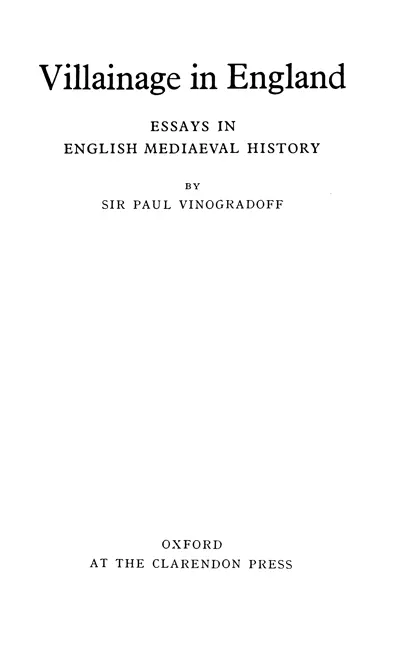
"Villainage in England: Essays in English Mediaeval History" by Sir Paul Vinogradoff is a scholarly historical account written in the late 19th century. The book delves into the complex social structures and legal status of the peasantry during the feudal period in England, particularly focusing on the concept of villainage, a form of servitude distinct from slavery. It examines the rights, disabilities, and socio-economic conditions of villains, offering a comprehensive analysis of how these factors shaped medieval agrarian society. The opening of the book presents a detailed preface where the author discusses his motivations for exploring such a nuanced topic as English social history, framed in the context of his Russian background. He articulates the significance of studying historical documents to uncover the dynamics of social classes, especially the relationship between lords and their peasant subjects. Vinogradoff emphasizes the importance of legal frameworks that defined villainage, arguing that understanding these relationships provides valuable insights into the broader historical narrative of agrarian development and social organization in medieval England. The initial portion sets the stage for an in-depth exploration of the peasantry's legal and economic positions, showcasing a methodical approach to historical inquiry that anticipates the detailed essays that follow.
Introduction adapted from the source catalogue; source summaries may be automatically generated.
Free to read · English · 173,596 words · No account needed
MAKE TIME FOR A GOOD BOOK
On by default. Untick to stop anonymous reading totals. Each page counts after 10 seconds in view. How this works.
Anonymous counting is on unless you have switched it off.
I hope the heading of this chapter may not be misunderstood. It would be difficult to speak of free peasantry in the modern sense at the time with which we are now dealing. Some kind or form of dependence often clings even to those who occupy the best place among villagers as recognised free tenants, and in most cases we have a very strong infusion of subjection in the life of otherwise privileged peasants. But if we keep to the main distinctions, and to the contrast which the authorities themselves draw between the component elements of the peasant class, its great bulk will arrange itself into two groups: the larger one will consist of those ordinarily designated as villains; a smaller, but by no means an insignificant or scanty one, will present itself as free, more or less protected by law, and more or less independent of the bidding of the lord and his steward. There is no break between the two groups; one status runs continuously into the other, and it may be difficult to distinguish between the intermediate shades; but the fundamental difference of conception is clearly noticeable as soon as we come to look at the whole, and it is not only noticeable to us but was noticed by the contemporary documents.
[General condition of England.]
In very many cases we are actually enabled to see how freedom and legal security gradually emerge from subjection. One of the great movements in the social life of the thirteenth and fourteenth centuries is the movement towards the commutation of services for money rents. In every survey we find a certain number of persons who now pay money, whereas they used to do work, and who have thus emancipated themselves from the most onerous form of subjection[369]. In the older documents it is commonly specified that the lord may revert to the old system, give up the rents, and enforce the services[370]. In later documents this provision disappears, having become obsolete, and there is only a mention of certain sums of money. The whole process, which has left such distinct traces in the authorities, is easily explained by England's economic condition at that time. Two important factors co-operated to give the country an exceptionally privileged position. England was the only country in Europe with a firmly constituted government. The Norman Conquest had powerfully worked in the sense of social feudalism, but it had arrested the disruptive tendencies of political feudalism. The opposition between the two races, the necessity for both to keep together, the complexity of political questions which arose from conquest and settlement on the one hand, from the intercourse with Normandy and France on the other,--all these agencies working together account for a remarkable intensity of action on the part of the centripetal forces of society, if I may use the expression: there was in England a constant tendency towards the concentration and organisation of political power in sharp contrast with the rest of Europe where the state had fallen a prey to local and private interests. One of the external results of such a condition was the growth of a royal power supported by the sympathy of the lower English-born classes, but arranging society by the help of Norman principles of fiscal administration. Not less momentous was the formation of an aristocracy which was compelled to act as a class instead of acting as a mere collection of individuals each striving for his own particular advantage; as a class it had to reckon with, and sometimes represent, the interests and requirements of other classes. In all these respects England was much ahead of Germany, where tribal divisions were more powerful than national unity, and the state had to form itself on feudal foundations in opposition to a cosmopolitan Imperial power; it was not less in advance of France, where the work of unification, egotistically undertaken by the king, had hardly begun to get the upper hand in its conflict with local dynasties; not less in advance of Italy, so well situated for economic progress, but politically wrecked by its unhappy connexion with Germany, the anti-national influence of the Papacy, and the one-sided development of municipal institutions. By reason of its political advantages England had the start of other European countries by a whole century and even by two centuries. The 'silver streak' acted already as a protection against foreign inroads, the existence of a central power insured civil order, intercourse between the different parts of the island opened outlets to trade, and reacted favourably on the exchange of commodities and the circulation of money.
Your reading position is saved on this browser. Take it to another device with a library code. Reading pages adapt to text, rather than matching a printed edition.
BEHIND THE BOOK
This eBook is for the use of anyone anywhere in the United States and most other parts of the world at no cost and with almost no restrictions whatsoever. You may copy it, give it away or re-use it under the terms of the Project Gutenberg License included with this eBook or online at www.gutenberg.org. If you are not located in the United States, you will have to check the laws of the country where you are located before using this eBook. Read the source licence.
The original source file, including credits and licence, is retained by this library. Request an original-format copy at no charge. Please include the book title and Project Gutenberg identifier #38876.
KEEP YOUR CURIOSITY GOING
Cécile Tormay

Moritz Busch
John L. Ransom
Frances Wright
Cécile Tormay

Mabel Potter Daggett