THE CLASSIC COLLECTION✦An outlaw’s diary: the CommuneCLASSIC FREE BOOKS
An outlaw’s diary: the Commune
Cécile Tormay
THE CLASSIC COLLECTION · 1892
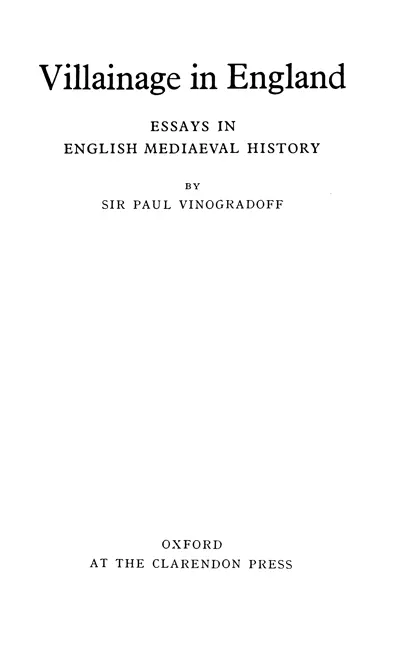
"Villainage in England: Essays in English Mediaeval History" by Sir Paul Vinogradoff is a scholarly historical account written in the late 19th century. The book delves into the complex social structures and legal status of the peasantry during the feudal period in England, particularly focusing on the concept of villainage, a form of servitude distinct from slavery. It examines the rights, disabilities, and socio-economic conditions of villains, offering a comprehensive analysis of how these factors shaped medieval agrarian society. The opening of the book presents a detailed preface where the author discusses his motivations for exploring such a nuanced topic as English social history, framed in the context of his Russian background. He articulates the significance of studying historical documents to uncover the dynamics of social classes, especially the relationship between lords and their peasant subjects. Vinogradoff emphasizes the importance of legal frameworks that defined villainage, arguing that understanding these relationships provides valuable insights into the broader historical narrative of agrarian development and social organization in medieval England. The initial portion sets the stage for an in-depth exploration of the peasantry's legal and economic positions, showcasing a methodical approach to historical inquiry that anticipates the detailed essays that follow.
Introduction adapted from the source catalogue; source summaries may be automatically generated.
Free to read · English · 173,596 words · No account needed
MAKE TIME FOR A GOOD BOOK
On by default. Untick to stop anonymous reading totals. Each page counts after 10 seconds in view. How this works.
Anonymous counting is on unless you have switched it off.
Ayllington or Elton, Hunts, is remarkable on account of the contrast between its free and servile holdings, as described in the Hundred Rolls. It would be interesting to know whether the former are to be considered as ancient free tenements, or as the outcome of modern exemptions. The Hundred Rolls point in the first direction (ii. 656). Some of the tenements under discussion are said to be held de conquestu, and it would be impossible to put any other interpretation on this term than that of 'original occupation.' It means the same as the 'de antiquo conquestu' of other surveys (sup. p. 453).
But when we compare the inquisition published in the Ramsey Cartulary (Rolls Ser. i. 487 sqq.) we come upon a difficulty. There the holdings are constantly arranged under the two headings of virgatae operariae and virgatae positae ad censum, the population is divided into operarii and censuarii, and in one case we find even the following passage: 'item quaelibet domus, habens ostium apertum versus vicum, tam de malmannis, quam de cotmannis et operariis, inveniret unum hominem ad lovebone, sine cibo domini, praeter Ricardum Pemdome, Henricum Franceys, Galfridum Blundy, Henricum le Monnier.' And so most of the free people are actually called molmen, and this would seem to imply that they were libere tenentes only in consequence of commutation.
It seems to me that there is no occasion for such an inference. The molmen in the passage quoted are evidently the same as the censuarii of other passages, and although, in a general way, the expression mal was probably employed of quit-rents, still it was wide enough to interchange with gafol, and to designate all kinds of rents, without any regard to their origin. And of course, this is even more the case with census. Upon the whole, I do not see sufficient reason to doubt that we have freeholders before us who held their land and paid rent ever since the original occupation of the soil.
Agreement as the origin of free tenure, 335;
between lord and village, 359.
Akerman, 147.
Amercement, 163.
Ancient conquest, 453.
Ancient demesne, definition, 89, 90;
privileges, 92;
tenantry, 114;
Saxon origin, 123, 136;
courts, 379.
Ancient freehold, 344, 352.
Anelipeman, 213.
Approvement, 273.
Assarts, 332.
Assessment, 244.
Assisa terra, 333.
Aston and Cote, Oxon, 392, 450.
Astrier, 56.
Auxilium, 293.
Averagium, 285, 286, 309.
Aver-earth, 280.
Aver-land, 257.
Ayllington (Elton), Hunts, 337, 460.
Bailiff, 318.
Balk, 232.
Barlick-silver, 291.
Beadle, 318.
Ben-earth, 281.
Birth, influence on status, 59.
Blackstone, view of English history, 7;
on copyholds, 80;
on ancient demesne tenure, 112.
Board-lands, 314.
Bockyng, Essex, 315.
Bondus, 145.
Boonwork, 174.
Borda, 256.
Bordarius, 145, 149.
Borough English, 82, 157, 185.
Bosing-silver, 291.
Bovati, 238.
Bracton, on villainage, 47;
on status, 60;
on convention between villain and lord, 71;
on waynage, 74;
on villain tenure and villain services, 77;
on villain socage, 89, 115, 121;
on rights of common, 269.
Braseum, 289.
Britton, on prescription, 63;
on the prohibition against devising villains, 76;
on privileged villainage, 109.
Butta, 232.
Campus, 228.
Carriage duties, 285.
Carta, 199, 452.
Carucarius, 147.
Censuarius, 186.
Your reading position is saved on this browser. Take it to another device with a library code. Reading pages adapt to text, rather than matching a printed edition.
BEHIND THE BOOK
This eBook is for the use of anyone anywhere in the United States and most other parts of the world at no cost and with almost no restrictions whatsoever. You may copy it, give it away or re-use it under the terms of the Project Gutenberg License included with this eBook or online at www.gutenberg.org. If you are not located in the United States, you will have to check the laws of the country where you are located before using this eBook. Read the source licence.
The original source file, including credits and licence, is retained by this library. Request an original-format copy at no charge. Please include the book title and Project Gutenberg identifier #38876.
KEEP YOUR CURIOSITY GOING
Cécile Tormay

Moritz Busch
John L. Ransom
Frances Wright
Cécile Tormay

Mabel Potter Daggett