THE CLASSIC COLLECTION✦An outlaw’s diary: the CommuneCLASSIC FREE BOOKS
An outlaw’s diary: the Commune
Cécile Tormay
THE CLASSIC COLLECTION · 1892
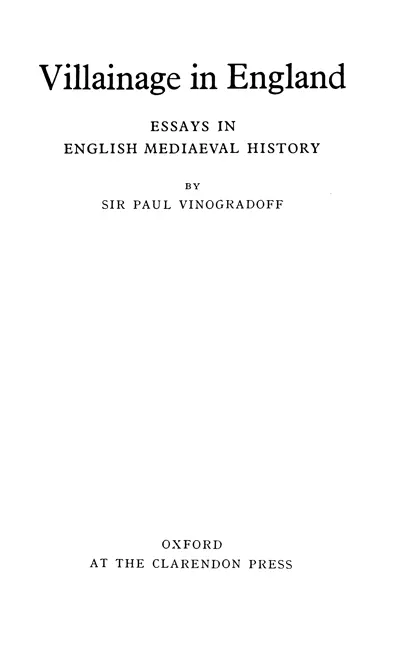
"Villainage in England: Essays in English Mediaeval History" by Sir Paul Vinogradoff is a scholarly historical account written in the late 19th century. The book delves into the complex social structures and legal status of the peasantry during the feudal period in England, particularly focusing on the concept of villainage, a form of servitude distinct from slavery. It examines the rights, disabilities, and socio-economic conditions of villains, offering a comprehensive analysis of how these factors shaped medieval agrarian society. The opening of the book presents a detailed preface where the author discusses his motivations for exploring such a nuanced topic as English social history, framed in the context of his Russian background. He articulates the significance of studying historical documents to uncover the dynamics of social classes, especially the relationship between lords and their peasant subjects. Vinogradoff emphasizes the importance of legal frameworks that defined villainage, arguing that understanding these relationships provides valuable insights into the broader historical narrative of agrarian development and social organization in medieval England. The initial portion sets the stage for an in-depth exploration of the peasantry's legal and economic positions, showcasing a methodical approach to historical inquiry that anticipates the detailed essays that follow.
Introduction adapted from the source catalogue; source summaries may be automatically generated.
Free to read · English · 173,596 words · No account needed
MAKE TIME FOR A GOOD BOOK
On by default. Untick to stop anonymous reading totals. Each page counts after 10 seconds in view. How this works.
Anonymous counting is on unless you have switched it off.
[499] Black Book of St. Augustine's, Cotton MSS., Faustina, A. i. 15, a: 'In Taneto sunt 45 sullung 150 acre reddentes gablum denariorum. In festo S^{ti} Martini videlicet de unoquoque sullung reddunt de Gabulo 2 solidos 2 denarios, summa quorum facit 25 libras 105 solidos 10 denarios obolum. Ipsi qui tenent predictos sullung reddunt in equinoctio autumpnae de unoquoque sullung pro horsarer 16 den. et de 150 acris 12 den. Ipsi idem arant pro anererthe in purificacione de unoquoque sullung unam acram et 150 acris 3 virgatas. Ipsi idem reddunt in festo S^{ti} Johannis de unoquoque sullung 2 agnos separabiles et de 150 acris 1 agnum et valenciam dimidii agni. Ipsi idem reddunt in natali de unoquoque sullung unum ferendel ordei,' etc.
[500] Ibid. 60; Suolinga de Ores: 'Heredes Salomonis de Ores tenent 8 acras ... Heredes Willelmi de Ores tenent 12 acras ... Jacobus tenet 3 acras et dimidiam perchatam ... Thomas filius G. de Hores tenet 2 acras ... Ricardus et Salomon filius Augustini ... et Willelmus filius Ricardi tenent 2 acras et dimidiam,' etc.
[501] Augment. Off. Misc. Books, N. 57, f. 96, a: 'Johannes Bairot heredes Hamoni Daniel, heredes Johannis hugheleyn, heredes Roberti atte mede, heredes Walteri et Willelmi Ram et Gilbertus le Rome tenent unum jugum et dimidium de Cukulycumbe.'
[502] Domesday of St Paul's, 38 sqq. Comp. Ramsey Cart., i. 413.
[503] Gloucester Cart., iii. 213: 'Robertus Altegreue, Willelmus Godere, Johannes Abraham, Isabella relicta Lucae tenent unam virgatam, scilicet quilibet eorum unum quarterium et faciunt conjunctim in omnibus sicut unus virgatarius.' Comp. 59 201. Hereford Court Rolls (Bodleian), 3, b: 'T. Hake, Ricardus de Poluchulle et Muriel filius Galfridi pyoner tenent unam dimidiam virgatam terre consuetudinarie.'
[504] Bury St. Edmund's Cart., Cambridge University, G. g. iv. 4. f. 35, a: 'Johannes Knop tenet cotagium et contribuit heredi qui tenet maiorem partem tenementorum.'
[505] Inqu. post mort. 55 Henry III, N. 33: 'Redditarii qui vocantur
selfoders.'
[506] Exch. Q.R. Anc. Misc. Court Rolls, xxi. 513. 82: 'Dicunt quod aliquis habens virgatam terre et vendiderit omnes partes excepto capitati domo et loco focarii, tenentes locum focarii erunt sectatores curie et alteri non. Similiter de tenentibus dimidiam virgatam et codsetlestoftes: semper tenentes locum focarii colligent firmam et erunt liberi de pannagio et de aliis tallagiis et alteri tenentes partes erunt geldabiles.' (Curia de Brigstock tenta die veneris proxima ante festum Sancti Andree Apostoli anno [r. r. Edw. xxvij]).
[507] See Hanauer, Les paysans de l'Alsace au Moyen Age.
[508] Domesday of St. Paul's, xv. 7; Gloucester Cartulary, iii. 55, 61; Cartulary of Christ Church, Canterbury, Add. MSS. 6759, f. 21, b.
[509] Battle Cart. Augm. Off. Books, N. 18, f. 7, a: 'Aratra uertuntur in terram domini.' Ely Inqu., Claudius, C. xi. 38 b, 86 b, etc.
[510] Ely Inqu., 72 b; comp. 24, b; Gloucester Cart., iii. 183.
Your reading position is saved on this browser. Take it to another device with a library code. Reading pages adapt to text, rather than matching a printed edition.
BEHIND THE BOOK
This eBook is for the use of anyone anywhere in the United States and most other parts of the world at no cost and with almost no restrictions whatsoever. You may copy it, give it away or re-use it under the terms of the Project Gutenberg License included with this eBook or online at www.gutenberg.org. If you are not located in the United States, you will have to check the laws of the country where you are located before using this eBook. Read the source licence.
The original source file, including credits and licence, is retained by this library. Request an original-format copy at no charge. Please include the book title and Project Gutenberg identifier #38876.
KEEP YOUR CURIOSITY GOING
Cécile Tormay

Moritz Busch
John L. Ransom
Frances Wright
Cécile Tormay

Mabel Potter Daggett