THE CLASSIC COLLECTION✦An outlaw’s diary: the CommuneCLASSIC FREE BOOKS
An outlaw’s diary: the Commune
Cécile Tormay
THE CLASSIC COLLECTION · 1892
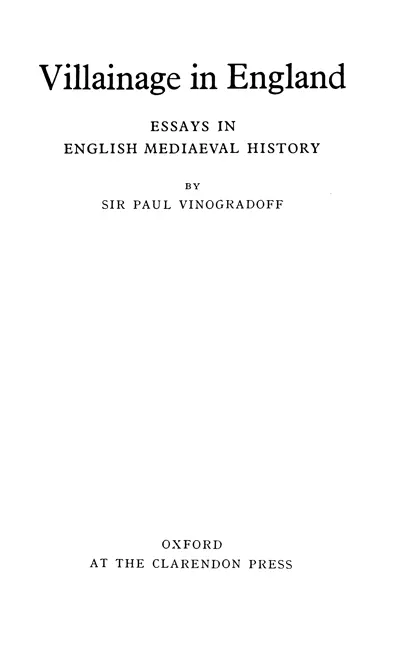
"Villainage in England: Essays in English Mediaeval History" by Sir Paul Vinogradoff is a scholarly historical account written in the late 19th century. The book delves into the complex social structures and legal status of the peasantry during the feudal period in England, particularly focusing on the concept of villainage, a form of servitude distinct from slavery. It examines the rights, disabilities, and socio-economic conditions of villains, offering a comprehensive analysis of how these factors shaped medieval agrarian society. The opening of the book presents a detailed preface where the author discusses his motivations for exploring such a nuanced topic as English social history, framed in the context of his Russian background. He articulates the significance of studying historical documents to uncover the dynamics of social classes, especially the relationship between lords and their peasant subjects. Vinogradoff emphasizes the importance of legal frameworks that defined villainage, arguing that understanding these relationships provides valuable insights into the broader historical narrative of agrarian development and social organization in medieval England. The initial portion sets the stage for an in-depth exploration of the peasantry's legal and economic positions, showcasing a methodical approach to historical inquiry that anticipates the detailed essays that follow.
Introduction adapted from the source catalogue; source summaries may be automatically generated.
Free to read · English · 173,596 words · No account needed
MAKE TIME FOR A GOOD BOOK
On by default. Untick to stop anonymous reading totals. Each page counts after 10 seconds in view. How this works.
Anonymous counting is on unless you have switched it off.
[364] Custumal of Battle Abbey (Camden Ser.), 30: 'Et debet herciare per duos dies ... pretium operis iiij. d. Et recipiet de domino utroque die repastus pretii iij d. Et sic erit dominus perdens j. d. Et sic nichil valet illa herciatio ad opus domini.'
[365] Coram Rege, Pasch., 14 Edw. I, Lege, 18: 'Villani circulare (sic) non consueverunt nisi ex voluntate.'
[366] Glastonbury Inqu. (Roxburghe Series), 82: 'Sed non debet carriare nisi dominus prestaverit suum plaustrum.'
[367] Cotton MSS., Claudius, C. xi, f. 30, b: 'Sed juratores dicunt quod nunquam hoc fecerunt nec de iure facere debent.'
[368] Rot. Hundred. ii. 758, a: 'Servi ... nec potest filiam maritare nec uxorem ducere sine licencia domini; debet et salvo contenemento suo talliari et ad omnia auxilia communia scottare et lottare secundum facultatem suam,' etc.
[369] Rot. Hundred. ii. 528, b: 'Et modo omnia illa arrentata sunt et dant per annum 14 sol. 8 d.'
[370] Exch. Q.R. Min. Acc., Bundle 510, No. 13: 'Et solebant facere servicia consueta, sed per voluntatem et ad placitum domini extenta sunt in denariis.' Cf. Abingdon Cartulary, ii. 303. Rot. Hundred. ii. 453, a: 'Omnes isti prenominati nomine villenagii sunt ad voluntatem domini de operibus eorundem,' Cf. Ibid. 407, b.
[371] Worcester Cartulary (Camden Series), 54, b: 'Haec villa tradita est ab antiquo villanis ad firmam, ad placitum cum omnibus ad nos pertinentibus.' Cf. Gloucester Cartulary, iii. 37.
[372] Worcester Cartulary (Camden Series), l. c.: 'Praeterea percipimus medietatem proventuum et herietum, praeterea debent metere, ligare et compostare bladum de antiquo dominico de Hordewell ... et gersummabunt filias.'
[373] Glastonbury Cartulary, Bodleian MSS., Wood, i., f. 241, a: 'Jocelynus dei gratia Bathoniensis episcopus.... Noveritis nos quietos clamasse omnes homines abbatie Glastonie de Winterburne in perpetuam de arruris et aliis operacionibus quas facere debebant castro Marleberghe de terra de Winterburne, quos homines nostros Henricus illustris rex Anglie nobis concessit.'
[374] Wartrey Priory Cartulary, Fairfax MSS. f. 19, a: 'Et Adam dicit quod predictus Prior villenagium in persona ipsius Ade allegare non potest quia dicit quod dudum convenit inter quemdam Johannem dudum priorem de Wartre ... et quendam Henricum de W ... patrem ipsius Ade videlicet quod isdem Prior ... per quoddam scriptum indenturam concesserunt Henrico ... quoddam toftum simul cum duabus bovatis terre.'
[375] Malmesbury Cartulary (Rolls Series), ii. 199: 'Nos tradidisse ... Roberto le H. de K. et Helenae uxori suae, et Agneti filiae eorum primogenitae nativis nostris, omnibus diebus vitae eorum, unam domum. Ita quod non licet praedicto Roberto alicui vendere nec occasione istius traditionis aliquam libertatem ipsis vendicare.'
[376] As to molmen, I shall follow in substance my article in the English Historical Review, 1886, IV. p. 734. We already find the class in Cartularies of the twelfth century, in the Burton Cartulary, and in the Boldon Book. See Round in the English Historical Review, 1886, V. 103, and Stevenson, ibidem, VI. 332.
Your reading position is saved on this browser. Take it to another device with a library code. Reading pages adapt to text, rather than matching a printed edition.
BEHIND THE BOOK
This eBook is for the use of anyone anywhere in the United States and most other parts of the world at no cost and with almost no restrictions whatsoever. You may copy it, give it away or re-use it under the terms of the Project Gutenberg License included with this eBook or online at www.gutenberg.org. If you are not located in the United States, you will have to check the laws of the country where you are located before using this eBook. Read the source licence.
The original source file, including credits and licence, is retained by this library. Request an original-format copy at no charge. Please include the book title and Project Gutenberg identifier #38876.
KEEP YOUR CURIOSITY GOING
Cécile Tormay

Moritz Busch
John L. Ransom
Frances Wright
Cécile Tormay

Mabel Potter Daggett