THE CLASSIC COLLECTION✦An outlaw’s diary: the CommuneCLASSIC FREE BOOKS
An outlaw’s diary: the Commune
Cécile Tormay
THE CLASSIC COLLECTION · 1892
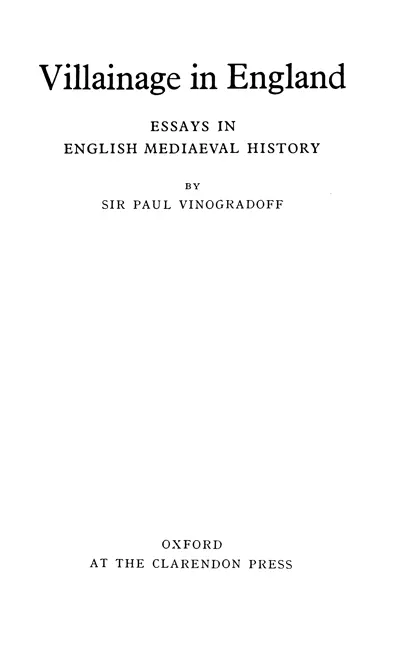
"Villainage in England: Essays in English Mediaeval History" by Sir Paul Vinogradoff is a scholarly historical account written in the late 19th century. The book delves into the complex social structures and legal status of the peasantry during the feudal period in England, particularly focusing on the concept of villainage, a form of servitude distinct from slavery. It examines the rights, disabilities, and socio-economic conditions of villains, offering a comprehensive analysis of how these factors shaped medieval agrarian society. The opening of the book presents a detailed preface where the author discusses his motivations for exploring such a nuanced topic as English social history, framed in the context of his Russian background. He articulates the significance of studying historical documents to uncover the dynamics of social classes, especially the relationship between lords and their peasant subjects. Vinogradoff emphasizes the importance of legal frameworks that defined villainage, arguing that understanding these relationships provides valuable insights into the broader historical narrative of agrarian development and social organization in medieval England. The initial portion sets the stage for an in-depth exploration of the peasantry's legal and economic positions, showcasing a methodical approach to historical inquiry that anticipates the detailed essays that follow.
Introduction adapted from the source catalogue; source summaries may be automatically generated.
Free to read · English · 173,596 words · No account needed
MAKE TIME FOR A GOOD BOOK
On by default. Untick to stop anonymous reading totals. Each page counts after 10 seconds in view. How this works.
Anonymous counting is on unless you have switched it off.
[351] Eynsham Cartulary, Christ Church MSS., No. 97, f. 6, a: 'Willelmus F. tenet unum cotagium et quartam partem unius virgate terre qui facere consuevit pro rata porcione sicut virgatarius. Modo ponitur ad firmam dum domina placet ad 6 solidos, 8 d.,' etc. Cf. Domesday of St. Paul's (Camden Series), 81. This is in substance the difference between 'bondagium et husbandland,' Inquis. p. mort. 46 Henry III, No. 25; Hexham Priory Cartulary (Surtees Series), p. xx.
[352] Domesday of St. Paul's (Camden Series), 49.
[353] St. Alban's Formulary, Cambridge Univ., Ee. iv. 20: 'Ne uno homini plures terre tradantur, et si modo unus plures tenet, dividantur, si commode et honeste fieri poterit.'
[354] Domesday of St. Paul's (Camden Series), 52; Duchy of Lancaster Court Rolls, B. 62, No. 750: 'Et quia huiusmodi tenementum nullus potest vendicare hereditarie ut de aliis villenagiis successive.'
[355] Hereford Rolls, 8 (Bodleian): 'Et concessum est ei tenere dictum mesuagium et unam acram terre sibi et heredibus suis secundum consuetudinem manerii per servicia inde debita et consueta.' Essex Rolls, 8 (Bodleian): 'Amicia de R. que tenet ex consuetudine manerii.'
[356] Extractus Rotulorum de Halimotis, Cambridge Univ, Dd. vii. 22, f.
1, a.
[357] Essex Rolls, 8 (Bodleian), m. 6: 'Johannes filius W.B. venit et clamavit unum mesuagium et quatuor acras terre cum pertinenciis ut jus et hereditatem suam post mortem dicti W. patris sui faciendo inde dominis predictis servicia debita et consueta nomine villenagii et dat domino ad inquirendum de jure suo et si sit plene etatis et heres dicti W. nec ne,' etc.
[358] Eynsham Cartulary, Christ Church MSS., No. 27, f. 11, b: 'Matildis B. tenet de domino unum cotagium cum curtilagio in voluntate domini.' Cf. Glastonbury Inqu. (Roxburghe Series), 66; Gloucester Cartulary (Rolls Series), iii. 134; Domesday of St. Paul's (Camden Series), 23.
[359] Reg. Cellararii Mon. Bury St Edmund's, Cambridge Univ., Gg. iv. 4, f. 52, b: '(Curia 7 Edw. II) ... dicunt quod quidam Robertus Heth pater dictorum R.W. et J. tenuit de conventu per virgam in villa de Berton magna ... Et quia dedixerunt cepisse dictam terram per virgam ideo potest seisiri dicta terra in manum domini.' Registr. album vestiarii abbatiae S. Edmundi, Cambridge Univ., Ee. iii. 60, f. 188, b: 'Tenentes de mollond ... tenent per virgam in curia.' Eynsham Cartulary, Christ Church MSS., No. 97: 'Ricardus W. tenet unum cotagium et duas acras terrae campestres per rotulum curie pro 3 sol.' Cf. 12, a.
[360] Note-book of Bracton, pl. 1237.
[361] Ely Register, Cotton, Claudius, C. xi. f. iii. b: 'Habebit duas pugillatas avene ex gratia, ut juratores dicunt, per longum tempus usitata.'
[362] Warwickshire Roll, Exch. Q.R. No. 29, f. 94, b: 'Servus ... cum fecerit exennium ... comedet cum domino.'
[363] Christ Church, Canterbury, Cartulary, Add. MSS. 6159, f. 22, b. Cf. Gloucester Cartulary (Rolls Series), iii. 203.
Your reading position is saved on this browser. Take it to another device with a library code. Reading pages adapt to text, rather than matching a printed edition.
BEHIND THE BOOK
This eBook is for the use of anyone anywhere in the United States and most other parts of the world at no cost and with almost no restrictions whatsoever. You may copy it, give it away or re-use it under the terms of the Project Gutenberg License included with this eBook or online at www.gutenberg.org. If you are not located in the United States, you will have to check the laws of the country where you are located before using this eBook. Read the source licence.
The original source file, including credits and licence, is retained by this library. Request an original-format copy at no charge. Please include the book title and Project Gutenberg identifier #38876.
KEEP YOUR CURIOSITY GOING
Cécile Tormay

Moritz Busch
John L. Ransom
Frances Wright
Cécile Tormay

Mabel Potter Daggett