THE CLASSIC COLLECTION✦An outlaw’s diary: the CommuneCLASSIC FREE BOOKS
An outlaw’s diary: the Commune
Cécile Tormay
THE CLASSIC COLLECTION · 1892
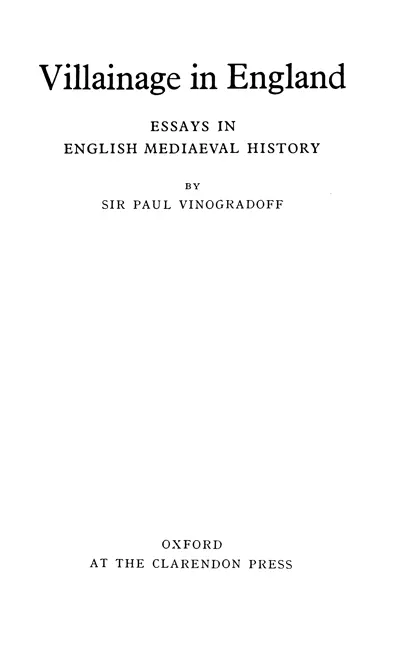
"Villainage in England: Essays in English Mediaeval History" by Sir Paul Vinogradoff is a scholarly historical account written in the late 19th century. The book delves into the complex social structures and legal status of the peasantry during the feudal period in England, particularly focusing on the concept of villainage, a form of servitude distinct from slavery. It examines the rights, disabilities, and socio-economic conditions of villains, offering a comprehensive analysis of how these factors shaped medieval agrarian society. The opening of the book presents a detailed preface where the author discusses his motivations for exploring such a nuanced topic as English social history, framed in the context of his Russian background. He articulates the significance of studying historical documents to uncover the dynamics of social classes, especially the relationship between lords and their peasant subjects. Vinogradoff emphasizes the importance of legal frameworks that defined villainage, arguing that understanding these relationships provides valuable insights into the broader historical narrative of agrarian development and social organization in medieval England. The initial portion sets the stage for an in-depth exploration of the peasantry's legal and economic positions, showcasing a methodical approach to historical inquiry that anticipates the detailed essays that follow.
Introduction adapted from the source catalogue; source summaries may be automatically generated.
Free to read · English · 173,596 words · No account needed
MAKE TIME FOR A GOOD BOOK
On by default. Untick to stop anonymous reading totals. Each page counts after 10 seconds in view. How this works.
Anonymous counting is on unless you have switched it off.
[1] Miss Lamond's edition of Walter of Henley did not appear until the greater part of my book was in type. I had studied the work in MS. So also I studied the Cartulary of Battle Abbey in MS. without being aware that it had been edited by Mr. Scargill Bird. Had Mr. Gomme's Village Communities come to my hands at an earlier date I should have made more references to it.
[2] English Historical Review, No. 1.
[3] In his Considerations sur l'histoire de France.
[4] History of Boroughs.
[5] Ancient Rights of the Commons of England.
[6] Quoted by Palgrave, English Commonwealth, i. 192, from the second edition of 1786. The first appeared in 1784.
[7] The first edition of the Commentaries appeared in 1765. I have been
using that of 1800.
[8] 'Es war eine Zeit, in der wir Unerhoertes und Unglaubliches erlebten, eine Zeit, welche die Aufmerksamkeit auf viele vergessene und abgelebte Ordnungen durch deren Zusammensturz hinzog.' Niebuhr in the preface to the first volume of his Roman history, quoted by Wegele, Geschichte der deutschen Historiographie, 998.
[9] Enquiry into the Rise and Progress of the Royal Prerogative, 1831.
[10] History of the English Commonwealth, 1832; Normandy and England,
1840.
[11] I do not give an analysis of Hallam's remarkable chapters on England in his work on the Middle Ages (first edition, 1818), because they are mostly concerned with Constitutional history, and the notes on the classes of Saxon and Anglo-Norman Society are chiefly valuable as discussions of technical points of law. Hallam's general position in historical literature must not be underrated; he is the English representative of the school which had Guizot for its most brilliant exponent on the Continent. In our subject, however, the turning-point in the development of research is marked by Palgrave, and not by Hallam. Heywood (Dissertation on Ranks and Classes of Society, 1818) is sound and useful, but cannot rank among the leaders.
[12] Histoire de la conquete de l'Angleterre par les Normands.
[13] Histoire du tiers etat.
[14] Histoire du droit municipal.
[15] Prolegomenes au polyptyque de l'abbe Irminon.
[16] Histoire des institutions de la France; Recherches sur quelques
problemes d'histoire.
[17] Gregor von Tours und seine Zeit.
[18] Deutsche Verfassungsgeschichte.
[19] Geschichte des Beneficialwesens, 1856; Feudalitaet und
Unterthanenverband, 1863.
[20] Roth is very strong on this point.
[21] Ueber angelsaechsische Rechtsverhaeltnisse, in the Munich Kritische Ueberschau, i. sqq. (1853).
[22] K. Maurer is very near Waitz in this respect.
[23] See especially his Englische Verfassungsgeschichte.
[24] Einleitung in die Geschichte der Hof-, Dorf-, Mark- und Staedteverfassung in Deutschland, 1 vol.; Geschichte der Frohnhoefe, 4 vol.; Geschichte der Dorfverfassung, 1 vol.; Geschichte der Markenverfassung, 1 vol.; Geschichte der Staedteverfassung, 4 vol.
[25] Collected in 2 volumes of Agrarhistorische Untersuchungen.
[26] Zur Geschichte der mittelalterlichen Feldgemeinschaft in England,
1869.
Your reading position is saved on this browser. Take it to another device with a library code. Reading pages adapt to text, rather than matching a printed edition.
BEHIND THE BOOK
This eBook is for the use of anyone anywhere in the United States and most other parts of the world at no cost and with almost no restrictions whatsoever. You may copy it, give it away or re-use it under the terms of the Project Gutenberg License included with this eBook or online at www.gutenberg.org. If you are not located in the United States, you will have to check the laws of the country where you are located before using this eBook. Read the source licence.
The original source file, including credits and licence, is retained by this library. Request an original-format copy at no charge. Please include the book title and Project Gutenberg identifier #38876.
KEEP YOUR CURIOSITY GOING
Cécile Tormay

Moritz Busch
John L. Ransom
Frances Wright
Cécile Tormay

Mabel Potter Daggett