THE CLASSIC COLLECTION✦An outlaw’s diary: the CommuneCLASSIC FREE BOOKS
An outlaw’s diary: the Commune
Cécile Tormay
THE CLASSIC COLLECTION · 1892
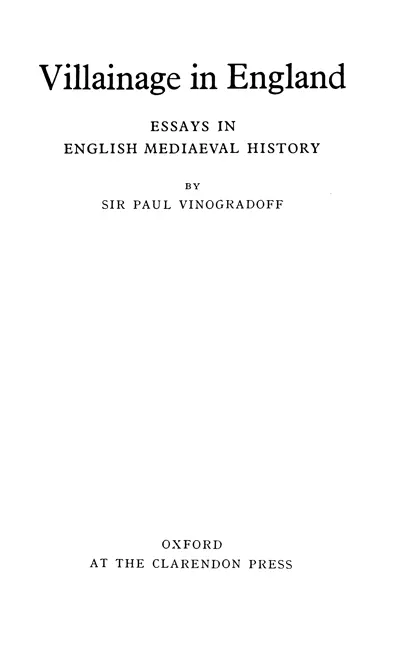
"Villainage in England: Essays in English Mediaeval History" by Sir Paul Vinogradoff is a scholarly historical account written in the late 19th century. The book delves into the complex social structures and legal status of the peasantry during the feudal period in England, particularly focusing on the concept of villainage, a form of servitude distinct from slavery. It examines the rights, disabilities, and socio-economic conditions of villains, offering a comprehensive analysis of how these factors shaped medieval agrarian society. The opening of the book presents a detailed preface where the author discusses his motivations for exploring such a nuanced topic as English social history, framed in the context of his Russian background. He articulates the significance of studying historical documents to uncover the dynamics of social classes, especially the relationship between lords and their peasant subjects. Vinogradoff emphasizes the importance of legal frameworks that defined villainage, arguing that understanding these relationships provides valuable insights into the broader historical narrative of agrarian development and social organization in medieval England. The initial portion sets the stage for an in-depth exploration of the peasantry's legal and economic positions, showcasing a methodical approach to historical inquiry that anticipates the detailed essays that follow.
Introduction adapted from the source catalogue; source summaries may be automatically generated.
Free to read · English · 173,596 words · No account needed
MAKE TIME FOR A GOOD BOOK
On by default. Untick to stop anonymous reading totals. Each page counts after 10 seconds in view. How this works.
Anonymous counting is on unless you have switched it off.
Molmen, 183.
Mondayland, 256.
Monopolies, manorial, 163.
Monstraverunt, writ of, 101, 104, 108, 110, 116.
Nasse, E., 26.
Nativus, 45, 142, 440.
Neat, niet, 144.
Ne injuste vexes, writ of, 420.
Nook, 256.
Note-book of Bracton, on conventions of lord with villain, 73;
on Martin of Bestenover's case, 79;
on manumission, 88;
on the Tavistock case, 119.
Nummata, 257.
Oath of fealty, 164.
Open field systems, 225, 237;
Nasse on, 27;
Seebohm on, 231;
origin, 399.
Operarius, 146.
Palgrave, Sir Francis, 12.
Pannage, 291.
Parvum breve de recto, 94, 100.
Pasture, 261.
Pedigree of villains, 440.
Pell, O., on acrewara, 242.
Penyearth, 282.
Petitions to the King, 102.
Ploughing work, 278.
Plough team, 238, 252.
Police, in relation to villainage, 66, 139.
Pollock, Sir Frederic, on conventions with villains, 72.
Precariae, 281, 284, 308.
Prepositus, 318.
Prescription, 63.
Presentments in the halimote, 368.
Prior of Hospitalers v. Ralph Crips and Thomas Barentyn, 54, 412.
Prior of Ripley v. Thomas Fitz-Adam, 83.
Prohibition against selling animals, 156.
Quare ejecit infra terminum, writ of, 330.
Quit-rent, 291.
Quo jure, writ of, 265, 270.
Radacre, 282.
Reaping work, 283.
Recognition, 348.
Reeveship, 157.
Regular arrangement, of villain holdings, 334, 345;
of free holdings, 337;
of socmen's holdings, 349.
Relief, 162.
Remuneration of servants, 321.
Rent, 181, 188, 215;
trifling, 290;
of free tenants, 342.
Revision of procedure, 99.
Rofliesland, 334.
Roger Fitz William v. Abbot of Bury St. Edmunds, 422.
Rogers, J. Thorold, on legal theory, 44;
on manorial documents, 138.
Roman influence, Palgrave's view, 14;
French scholars, 16;
Seebohm, 33.
Rotation of crops, 230.
Royal jurisdiction, 219.
Scrutton, T.E., 266.
Scutage, 294.
Scythepenny, 291.
Seebohm, F., 32.
Segheho, Beds, 233, 457.
Self-government, communal, 355, 361.
Selio, 231.
Seneschal, 318.
Sequela, 300.
Serfdom, 43, 152.
Serland, 257.
Servientes, 320.
Services, implying villainage, 82;
uncertain, 83;
certain on ancient demesne, 110;
labour, 167, 215, 305.
Servus, 45, 141.
Shareholding, 340, 347.
Sixteen of Aston and Cote, 393.
Slavery, 43, 47.
Socagium ad placitum, 334.
Sockemanemot, 365.
Soke, 391.
Socmen, free, 196, 204, 456;
on ancient demesne, 113, 197, 456;
villain, 89, 91, 199;
nature of tenure, 113, 116.
Solanda, 255.
Status, 83.
Statute of labourers, 54, 412.
Statute of Merton, 273.
Statute of Westminster II, 273, 274.
Steward, 318, 354.
Stoneleigh Abbey, 91, 93, 105, 116, 381, 426.
Stubbs, W., 23.
Suitors of halimote, 370;
in ancient demesne court, 380;
free, 386.
Sulung, 247.
Surrender and admittance, 371, 455.
Symon of Paris v. H. bailiff of Sir R. Tonny, 411.
Tallage, 163.
Tenmanland, tunmanland, 255.
Teutonic influence, Palgrave on, 13;
German scholars, 17;
Kemble, 19;
Freeman, 22;
Stubbs, 23;
Gneist, 24.
Township, 394.
Turnbedellus, 329.
Tywe, 282.
Undersette, 213.
Unlawenearth, 282.
Vagiator, 319.
Village community, Nasse on, 27;
Maine, 28;
Seebohm, 33;
acting in the interest of the lord, 355;
acting independently of the lord, 357;
as a farmer, 360;
its relation to the manor, 404.
Villain, sold, 151;
opposed to serf, 419;
civil disabilities, 67, 159,166;
free as to third persons, 68;
convention with the lord, 70, 182;
waynage, 74, 420;
not to be devised, 76;
claimed by kinship, 84, 417;
on ancient demesne, 114;
in manorial documents, 140, 150.
Villainage, definitions, 44;
exception of, 46;
in gross and regardant, 48, 411, 413.
Villain tenure, 77, 165;
free man holding in villainage, 80, 81, 143;
held by labour services, 167.
Virga, 173, 372.
Virgata, virgatarius, 148, 238.
Walter of Henley, on field systems, 225;
on the hide, 241.
Wara, 242.
Ward-penny, 291.
Waynage, 74, 420.
Week-work, 280.
William Fitz Henry v. Bartholomew Fitz Eustace, 80.
William Fitz Robert v. John Cheltewynd, 421.
William Taylor v. Roger of Sufford, 73.
Wista, 255.
Wood-penny, 291.
Workman, 186.
Wye, Kent, 309.
Yerdling, 148.
York Powell, F., on manumission, 87.
Your reading position is saved on this browser. Take it to another device with a library code. Reading pages adapt to text, rather than matching a printed edition.
BEHIND THE BOOK
This eBook is for the use of anyone anywhere in the United States and most other parts of the world at no cost and with almost no restrictions whatsoever. You may copy it, give it away or re-use it under the terms of the Project Gutenberg License included with this eBook or online at www.gutenberg.org. If you are not located in the United States, you will have to check the laws of the country where you are located before using this eBook. Read the source licence.
The original source file, including credits and licence, is retained by this library. Request an original-format copy at no charge. Please include the book title and Project Gutenberg identifier #38876.
KEEP YOUR CURIOSITY GOING
Cécile Tormay

Moritz Busch
John L. Ransom
Frances Wright
Cécile Tormay

Mabel Potter Daggett