THE CLASSIC COLLECTION✦An outlaw’s diary: the CommuneCLASSIC FREE BOOKS
An outlaw’s diary: the Commune
Cécile Tormay
THE CLASSIC COLLECTION · 1892
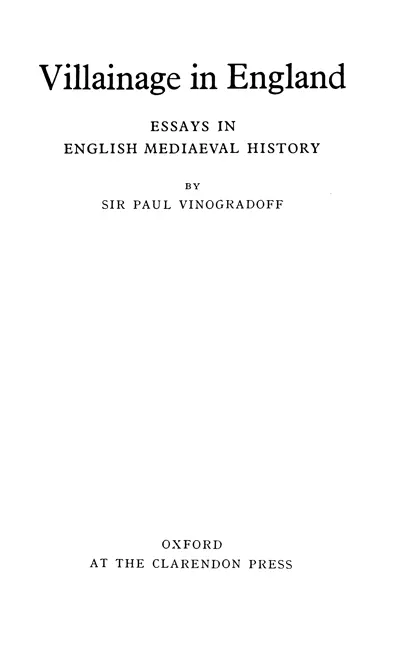
"Villainage in England: Essays in English Mediaeval History" by Sir Paul Vinogradoff is a scholarly historical account written in the late 19th century. The book delves into the complex social structures and legal status of the peasantry during the feudal period in England, particularly focusing on the concept of villainage, a form of servitude distinct from slavery. It examines the rights, disabilities, and socio-economic conditions of villains, offering a comprehensive analysis of how these factors shaped medieval agrarian society. The opening of the book presents a detailed preface where the author discusses his motivations for exploring such a nuanced topic as English social history, framed in the context of his Russian background. He articulates the significance of studying historical documents to uncover the dynamics of social classes, especially the relationship between lords and their peasant subjects. Vinogradoff emphasizes the importance of legal frameworks that defined villainage, arguing that understanding these relationships provides valuable insights into the broader historical narrative of agrarian development and social organization in medieval England. The initial portion sets the stage for an in-depth exploration of the peasantry's legal and economic positions, showcasing a methodical approach to historical inquiry that anticipates the detailed essays that follow.
Introduction adapted from the source catalogue; source summaries may be automatically generated.
Free to read · English · 173,596 words · No account needed
MAKE TIME FOR A GOOD BOOK
On by default. Untick to stop anonymous reading totals. Each page counts after 10 seconds in view. How this works.
Anonymous counting is on unless you have switched it off.
[Money-payments.]
In opposition to labour and rents in kind we find a great many payments in money. Some of these are said in as many words to have stept into the place of labour services; of mowing, carrying, making hedges[633], etc. The same may be the case in regard to produce: barlick-silver is paid instead of barley, fish-silver evidently instead of fish, malt-silver instead of malt; a certain payment instead of salt, and so on[634]. But sometimes the origin of the money rent is more difficult to ascertain. We find, for instance, a duty on sheep, which is almost certainly an original imposition when it appears as fald-silver. Even so the scythe-penny from every scythe, the bosing-silver from every horse and cart, the wood-penny, probably for the use of wood as fuel, must be regarded as original taxes and not quit-rents or commutation-rents[635]. Pannage is paid in the same way for the swine grazing in the woods[636]. Ward-penny appears also in connexion with cattle, but with some special shade of meaning which it is difficult to bring out definitely; the name seems to point to protection, and also occurs in connexion with police arrangements[637].
[Classification of money payments.]
I must acknowledge that in a good many cases I have been unable to find a satisfactory explanation for various terms which occur in the records for the divers payments. An attentive study of local usages will probably lead to definite conclusions as to most of them[638]. From a general point of view it is interesting to notice, that we find already in our records some attempts to bring all the perplexing variety of payments to a few main designations. Annual rents are, of course, reckoned out under the one head of 'census.' Very obvious reasons suggested the advisability of computing the entire money-proceed yielded by the estate[639]. It sometimes happens that the general sum made up in this way, fixed as it is at a constant amount, is used almost as a name for a complex of land[640]. A division of rents into old and new ones does not require any particular explanation[641]. But several other subdivisions are worth notice. The rent paid from the land often appears separately as landgafol or landchere. It is naturally opposed to payments that fall on the person as poll taxes[642]. These last are considered as a return for the personal protection guaranteed by the lord to his subjects. Of the contrast between gafol as a customary rent and mal as a payment in commutation I have spoken already, and I have only to add now, that gild is sometimes used in the same sense as mal[643]. Another term in direct opposition to gafol is the Latin donum[644]. It seems to indicate a special payment imposed as a kind of voluntary contribution on the entire village. To be sure, there was not much free will to be exercised in the matter; all the dependent people of the township had to pay according to their means[645]. But the tax must have been considered as a supplementary one in the same sense as supplementary boon-work. It may have been originally intended in some cases as an equivalent for some rights surrendered by the lord, as a mal or gild, in fact[646]. In close connexion with the donum we find the auxilium[647], also an extraordinary tax paid once a year, and distinguished from the ordinary rent. It appears as a direct consequence of the political subjection of the tenantry[648]: it is, in fact, merely an expression of the right to tallage. Our records mention it sometimes as apportioned according to the number of cattle owned by the peasant, but this concerns only the mode of imposition of the duty and hardly its origin[649]. As I have said already, the auxilium is in every respect like the donum. One very characteristic trait of both taxes is, that they are laid primarily on the whole village, which is made to pay a certain round sum as a body[650]. The burden is divided afterwards between the several householders, and the number of cattle, and more particularly of the beasts of plough kept on the holding, has of course to be taken into account more than anything else. But the manorial administration does not much concern itself with these details: the township is answerable for the whole sum.
Your reading position is saved on this browser. Take it to another device with a library code. Reading pages adapt to text, rather than matching a printed edition.
BEHIND THE BOOK
This eBook is for the use of anyone anywhere in the United States and most other parts of the world at no cost and with almost no restrictions whatsoever. You may copy it, give it away or re-use it under the terms of the Project Gutenberg License included with this eBook or online at www.gutenberg.org. If you are not located in the United States, you will have to check the laws of the country where you are located before using this eBook. Read the source licence.
The original source file, including credits and licence, is retained by this library. Request an original-format copy at no charge. Please include the book title and Project Gutenberg identifier #38876.
KEEP YOUR CURIOSITY GOING
Cécile Tormay

Moritz Busch
John L. Ransom
Frances Wright
Cécile Tormay

Mabel Potter Daggett