THE CLASSIC COLLECTION✦An outlaw’s diary: the CommuneCLASSIC FREE BOOKS
An outlaw’s diary: the Commune
Cécile Tormay
THE CLASSIC COLLECTION · 1892
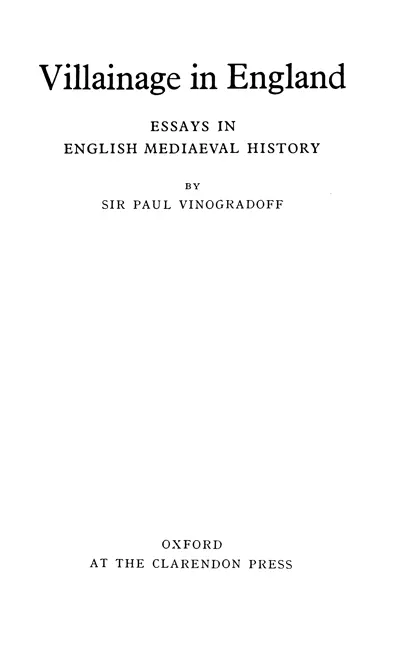
"Villainage in England: Essays in English Mediaeval History" by Sir Paul Vinogradoff is a scholarly historical account written in the late 19th century. The book delves into the complex social structures and legal status of the peasantry during the feudal period in England, particularly focusing on the concept of villainage, a form of servitude distinct from slavery. It examines the rights, disabilities, and socio-economic conditions of villains, offering a comprehensive analysis of how these factors shaped medieval agrarian society. The opening of the book presents a detailed preface where the author discusses his motivations for exploring such a nuanced topic as English social history, framed in the context of his Russian background. He articulates the significance of studying historical documents to uncover the dynamics of social classes, especially the relationship between lords and their peasant subjects. Vinogradoff emphasizes the importance of legal frameworks that defined villainage, arguing that understanding these relationships provides valuable insights into the broader historical narrative of agrarian development and social organization in medieval England. The initial portion sets the stage for an in-depth exploration of the peasantry's legal and economic positions, showcasing a methodical approach to historical inquiry that anticipates the detailed essays that follow.
Introduction adapted from the source catalogue; source summaries may be automatically generated.
Free to read · English · 173,596 words · No account needed
MAKE TIME FOR A GOOD BOOK
On by default. Untick to stop anonymous reading totals. Each page counts after 10 seconds in view. How this works.
Anonymous counting is on unless you have switched it off.
[Classification of labour-services.]
In consequence of the great variety of these labour-services they had to be reduced to some chief and plain subdivisions for purposes of a general oversight. Three main classes are very noticeable notwithstanding all variety: the araturae, averagia, and manuoperationes. These last are also called hand-dainae or daywerke[618]; and the records give sometimes the exact valuation of the work to be performed during a day in every kind of labour. Sometimes all the different classes are added up under one head for a general reckoning, and without any distinction as to work performed by hand or with the help of horse or ox. Among the manors of Christ Church, Canterbury[619], for instance, we find at Borle '1480 work-days divided into 44 weeks of labour from the virgaters, 88 from the cotters, 320 from the tofters holding small tenements in the fields.' In Bockyng the work-days of 52 weeks are reckoned to be 3222. It must be added, that when such a general summing up appears, it is mostly to be taken as an indication that the old system based on labour in kind is more or less shaken. The aim of throwing together the different classes of work is to get a general valuation of its worth, and such a valuation in money is commonly placed by the side of the reckoning. The single day-work yields sometimes only one penny or a little more, and the landlord is glad to exchange this cumbrous and cheap commodity for money-rents, even for small ones.
[Payments in kind.]
We must now proceed to examine the different forms assumed by payments in kind and money: they present a close parallel to the many varieties of labour-service. Thirteenth-century documents are full of allusions to payments in kind--that most archaic form of arranging the relations between a lord and his subjects. The peasants give corn under different names, and for various reasons: as gavelseed, in addition to the money-rent paid for their land[620]; as foddercorn, of oats for the feeding of horses[621]; as gathercorn, which a manorial servant has to collect or gather from the several homesteads[622]; as corn-bole, a best sheaf levied at harvest-time[623]. Of other provender supplied to the lord's household honey is the most common, both in combs and in a liquid form[624]. Ale is sometimes brewed for the same purpose, and sometimes malt and braseum furnished as material to be used in the manorial farm[625]. Animals are also given in rent, mostly sheep, lambs, and sucking-pigs. The mode of selection is peculiar in some cases. In the Christ Church (Canterbury) manor of Monckton each sulung has to render two lambs, and the lord's servant has the right to take those which he pleases, whereupon the owner gets a receipt, evidently in view of subsequent compensation from the other co-owners of the sulung[626]. If no suitable lamb is to be found, eight pence are paid instead of it as mail (mala). On one of the estates of Gloucester Abbey a freeman has to come on St. Peter's and Paul's day with a lamb of the value of 12d., and besides, 12 pence in money are to be hung in a purse on the animal's neck[627]. Poultry is brought almost everywhere, but these prestations are very different in their origin. The most common reason for giving capons is the necessity for getting the warranty of the lord[628]: in this sense the receipt and payment of the rent constitute an acknowledgment on the part of the lord that he is bound to protect his men, and on the part of the peasant that he is the lord's villain. 'Wood hens' are given for licence to take a load of wood in a forest; similar prestations occur in connexion with pasture and with the use of a moor for turbary[629]. At Easter the peasantry greet their protectors by bringing eggs: in Walton, a manor of St. Paul's, London, the custom is said to exist in honour of the lord, and at the free discretion of the tenants[630]. Besides all those things which may be 'put on the fire and eaten,' rents in kind sometimes take the shape of some object for permanent use, especially of some implement necessary for the construction of the plough[631]. Trifling rents, consisting of flowers or roots of ginger, are sometimes imposed with the object of testifying to the lord's seignory; but the payers of such rents are generally freeholders[632]. I need not dwell long on the enumeration of all the strange prestations which existed during the Middle Ages, and partly came down to our own time: any reader curious about them will find an enormous mass of interesting material in Hazlitt's 'Tenures of Land and Customs of Manors.'
Your reading position is saved on this browser. Take it to another device with a library code. Reading pages adapt to text, rather than matching a printed edition.
BEHIND THE BOOK
This eBook is for the use of anyone anywhere in the United States and most other parts of the world at no cost and with almost no restrictions whatsoever. You may copy it, give it away or re-use it under the terms of the Project Gutenberg License included with this eBook or online at www.gutenberg.org. If you are not located in the United States, you will have to check the laws of the country where you are located before using this eBook. Read the source licence.
The original source file, including credits and licence, is retained by this library. Request an original-format copy at no charge. Please include the book title and Project Gutenberg identifier #38876.
KEEP YOUR CURIOSITY GOING
Cécile Tormay

Moritz Busch
John L. Ransom
Frances Wright
Cécile Tormay

Mabel Potter Daggett