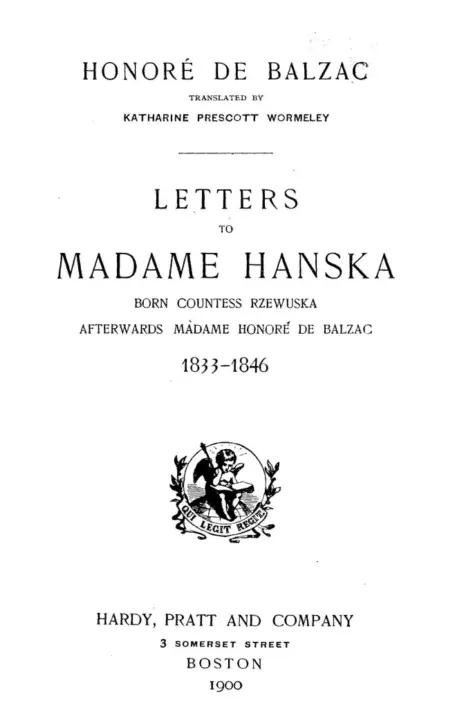
Letters to Madame Hanska, born Countess Rzewuska, afterwards Madame Honoré de Balzac, 1833-1846
Honoré de Balzac
THE CLASSIC COLLECTION · 1840
"Vautrin: A Drama in Five Acts" by Honoré de Balzac is a play written in the mid-19th century that explores complex themes of identity, motherhood, and the interplay of moral and social dilemmas in a post-revolutionary France. The narrative revolves around Jacques Collin, known as Vautrin, and his intricate schemes that entangle the lives of the aristocratic Duc de Montsorel, his wife, the Duchesse de Montsorel, and their son, the Marquis Albert. As secrets unfold, the characters are propelled towards a dramatic confrontation with their pasts and ambitions. The opening of the play introduces us to a world of uncertainty and intrigue, primarily through the perspective of the Duchesse de Montsorel, who displays a rare glimmer of hope upon believing she has found traces of her long-lost son, Fernand. Conversations between her and her aunt reveal her deep emotional turmoil, hinting at a significant family mystery that haunts her. The scene shifts to Vautrin, who appears both shadowy and charismatic, establishing his connections to the Montsorel family and hinting at deeper, intertwining plots as he interacts with the household. His arrival sets the stage for the potential unearthing of latent family secrets, as Vautrin maneuvers through the delicate social norms of the aristocratic circles, sparking anticipation for the conflicts ahead.
Introduction adapted from the source catalogue; source summaries may be automatically generated.
Free to read · English · 28,430 words · No account needed
MAKE TIME FOR A GOOD BOOK
On by default. Untick to stop anonymous reading totals. Each page counts after 10 seconds in view. How this works.
Anonymous counting is on unless you have switched it off.
Vautrin It was he himself who gave me these papers, among which you will notice the death certificate of the viscount, which proves that he and her grace the duchess never met after the Tenth of August, for he had then left the Abbaye for the Vendee, accompanied by Boulard, who seized the moment to betray and murder him.
The Duke
And so Fernand--
Vautrin
The child sent to Sardinia is undoubtedly your son.
The Duke
And her grace the duchess--
Vautrin
Is innocent.
The Duke
My God! (He sinks back into an armchair.) What have I done?
The Duchess
What a horrible proof--his death! And the assassin stands before us.
Vautrin
Monsieur le Duc de Montsorel, I have been a father to Fernand, and I
have just saved your two sons, each from the sword of the other; you
alone are the author of all this complication.
The Duchess
Stop! I know him better than you do, and he suffers at this moment all
that I have suffered during twenty years. In the name of mercy, where
is my son?
The Duke
What, Raoul de Frescas?
Vautrin
Fernand de Montsorel is on his way here. (To Saint-Charles) And what
do you say about all this?
Saint-Charles
You are a hero; let me be your servant.
Vautrin
You are ambitious. Would you follow me?
Saint-Charles
Anywhere.
Vautrin
I can well believe it.
Saint-Charles
Ah! what a master mind you obtain in me, and what a loss to the
government!
Vautrin
Go; and wait for me at the bureau of passports.
(Exit Saint-Charles.)
SCENE FIFTEENTH.
The same persons, the Duchesse de Christoval, Inez and Mademoiselle de
Vaudrey.
Mademoiselle de Vaudrey
Here they are!
The Duchesse de Christoval My daughter, madame, has received a letter from Monsieur Raoul, in which this noble young man declares that he would rather give up Inez, than deceive us; he has related his whole life's history. He is to fight a duel with your son to-morrow, and as Inez is the involuntary cause of this duel we are come to prevent it; for it is now entirely without ground or reason.
The Duchesse de Montsorel
There will be no duel, madame.
Inez
He will live then!
The Duchesse de Montsorel
And you shall marry the Marquis de Montsorel, my child.
SCENE SIXTEENTH.
The same persons, Raoul and Lafouraille. (The last named does not
tarry.)
Raoul (to Vautrin)
What! Would you imprison me to prevent my fighting a duel?
The Duke
With your brother?
Raoul
My brother?
The Duke
Yes.
The Duchesse de Montsorel
You are, then, really my child! (She embrace Raoul.) Ladies, this is
Fernand de Montsorel, my son, the--
Your reading position is saved on this browser. Take it to another device with a library code. Reading pages adapt to text, rather than matching a printed edition.
Honoré de Balzac
Honoré de Balzac
Honoré de Balzac
Honoré de Balzac
BEHIND THE BOOK
This eBook is for the use of anyone anywhere in the United States and most other parts of the world at no cost and with almost no restrictions whatsoever. You may copy it, give it away or re-use it under the terms of the Project Gutenberg License included with this eBook or online at www.gutenberg.org. If you are not located in the United States, you will have to check the laws of the country where you are located before using this eBook. Read the source licence.
The original source file, including credits and licence, is retained by this library. Request an original-format copy at no charge. Please include the book title and Project Gutenberg identifier #6861.
KEEP YOUR CURIOSITY GOING
Maurice Baring
W. B. (William Butler) Yeats
Edward Martyn

John Brougham & Charlotte Brontë
Marguerite Merington
Leonid Andreyev