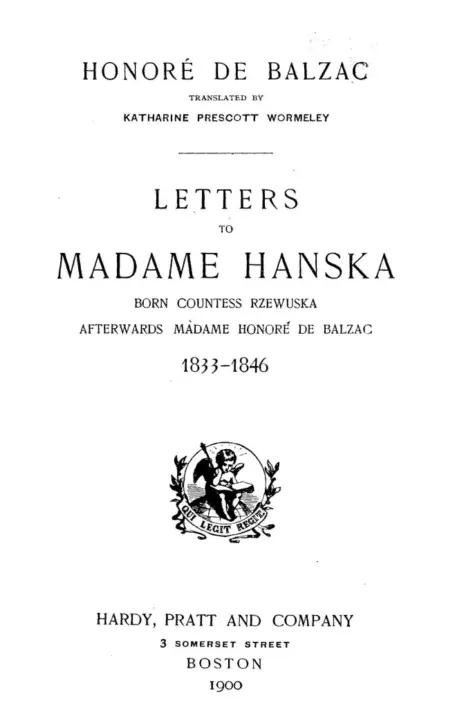
Letters to Madame Hanska, born Countess Rzewuska, afterwards Madame Honoré de Balzac, 1833-1846
Honoré de Balzac
THE CLASSIC COLLECTION · 1840
"Vautrin: A Drama in Five Acts" by Honoré de Balzac is a play written in the mid-19th century that explores complex themes of identity, motherhood, and the interplay of moral and social dilemmas in a post-revolutionary France. The narrative revolves around Jacques Collin, known as Vautrin, and his intricate schemes that entangle the lives of the aristocratic Duc de Montsorel, his wife, the Duchesse de Montsorel, and their son, the Marquis Albert. As secrets unfold, the characters are propelled towards a dramatic confrontation with their pasts and ambitions. The opening of the play introduces us to a world of uncertainty and intrigue, primarily through the perspective of the Duchesse de Montsorel, who displays a rare glimmer of hope upon believing she has found traces of her long-lost son, Fernand. Conversations between her and her aunt reveal her deep emotional turmoil, hinting at a significant family mystery that haunts her. The scene shifts to Vautrin, who appears both shadowy and charismatic, establishing his connections to the Montsorel family and hinting at deeper, intertwining plots as he interacts with the household. His arrival sets the stage for the potential unearthing of latent family secrets, as Vautrin maneuvers through the delicate social norms of the aristocratic circles, sparking anticipation for the conflicts ahead.
Introduction adapted from the source catalogue; source summaries may be automatically generated.
Free to read · English · 28,430 words · No account needed
MAKE TIME FOR A GOOD BOOK
On by default. Untick to stop anonymous reading totals. Each page counts after 10 seconds in view. How this works.
Anonymous counting is on unless you have switched it off.
Saint-Charles (alone) A bad beginning! Ten louis thrown away. To shadow him indeed! It is too stupid not to have a spice of wit in it, this habit of calling things by their right name, at the outset. If the pretended steward, for there is no steward here, if the baron is as clever as his footman, I shall have nothing to base my information on, excepting what they conceal from me. This room is very fine. There is neither portrait of the king, nor emblem of royalty here. Well, it is plain they do not frame their opinions. Is the furniture suggestive of anything? No. It is too new to have been even paid for. But for the air which the porter whistled, doubtless a signal, I should be inclined to believe in the De Frescas people.
SCENE EIGHTH. Saint-Charles, Vautrin and Lafouraille. (Vautrin wears a bright maroon coat, of old-fashioned cut, with large heavy buttons; his breeches are black silk, as are his stockings. His shoes have gold buckles, his waistcoat is flowered, he wears two watch-chains, his cravat belongs to the time of the Revolution; his wig is white, his face old, keen, withered, dissipated looking. He speaks low, and his voice is cracked.)
Vautrin (to Lafouraille) Very good; you may go. (Exit Lafouraille. Aside) Now for the tug of war, Monsieur Blondet. (Aloud) I am at your service, sir.
Saint-Charles (aside)
A worn out fox is still dangerous. (Aloud) Excuse me, baron, for
disturbing you, while yet unknown to you.
Vautrin
I can guess what your business is.
Saint-Charles (aside)
Indeed?
Vautrin
You are an architect, and have a proposal to make to me; but I have
already received most excellent offers.
Saint-Charles
Excuse me, your Dutchman must have mispronounced my name. I am the
Chevalier de Saint-Charles.
Vautrin (raising his spectacles) Let me see--we are old acquaintances. You were at the Congress of Vienna, and then bore the name of Count of Gorcum--a fine name!
Saint-Charles (aside)
Go choke yourself, old man! (Aloud) So you were there also?
Vautrin
I should think so! And I am glad to have come upon you again. You were
a deuced clever fellow, you know. How you fooled them all!
Saint-Charles (aside) We'll stick to Vienna, then. (Aloud) Ah, baron! I recall you perfectly now; you also steered your bark pretty cleverly there.
Vautrin
Of course I did, and what women we had there! Yes, indeed! And have
you still your fair Italian?
Saint-Charles
Did you know her? She was a woman of such tact.
Vautrin
My dear fellow, wasn't she, though? She actually wanted to find out
who I was.
Saint-Charles
And did she find out?
Your reading position is saved on this browser. Take it to another device with a library code. Reading pages adapt to text, rather than matching a printed edition.
Honoré de Balzac
Honoré de Balzac
Honoré de Balzac
Honoré de Balzac
BEHIND THE BOOK
This eBook is for the use of anyone anywhere in the United States and most other parts of the world at no cost and with almost no restrictions whatsoever. You may copy it, give it away or re-use it under the terms of the Project Gutenberg License included with this eBook or online at www.gutenberg.org. If you are not located in the United States, you will have to check the laws of the country where you are located before using this eBook. Read the source licence.
The original source file, including credits and licence, is retained by this library. Request an original-format copy at no charge. Please include the book title and Project Gutenberg identifier #6861.
KEEP YOUR CURIOSITY GOING
Maurice Baring
W. B. (William Butler) Yeats
Edward Martyn

John Brougham & Charlotte Brontë
Marguerite Merington
Leonid Andreyev