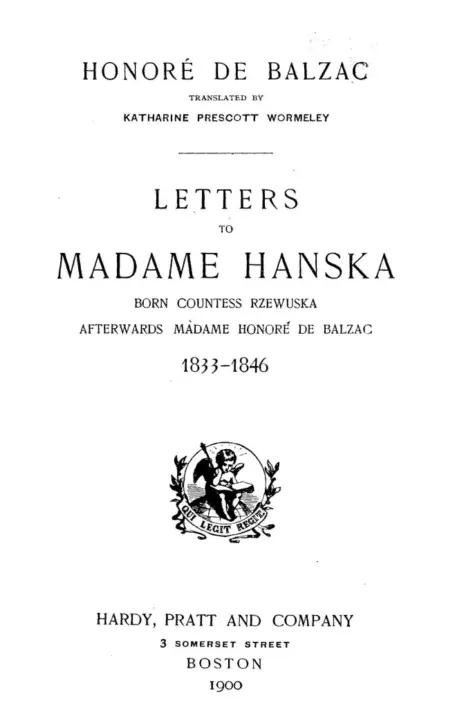
Letters to Madame Hanska, born Countess Rzewuska, afterwards Madame Honoré de Balzac, 1833-1846
Honoré de Balzac
THE CLASSIC COLLECTION · 1840
"Vautrin: A Drama in Five Acts" by Honoré de Balzac is a play written in the mid-19th century that explores complex themes of identity, motherhood, and the interplay of moral and social dilemmas in a post-revolutionary France. The narrative revolves around Jacques Collin, known as Vautrin, and his intricate schemes that entangle the lives of the aristocratic Duc de Montsorel, his wife, the Duchesse de Montsorel, and their son, the Marquis Albert. As secrets unfold, the characters are propelled towards a dramatic confrontation with their pasts and ambitions. The opening of the play introduces us to a world of uncertainty and intrigue, primarily through the perspective of the Duchesse de Montsorel, who displays a rare glimmer of hope upon believing she has found traces of her long-lost son, Fernand. Conversations between her and her aunt reveal her deep emotional turmoil, hinting at a significant family mystery that haunts her. The scene shifts to Vautrin, who appears both shadowy and charismatic, establishing his connections to the Montsorel family and hinting at deeper, intertwining plots as he interacts with the household. His arrival sets the stage for the potential unearthing of latent family secrets, as Vautrin maneuvers through the delicate social norms of the aristocratic circles, sparking anticipation for the conflicts ahead.
Introduction adapted from the source catalogue; source summaries may be automatically generated.
Free to read · English · 28,430 words · No account needed
MAKE TIME FOR A GOOD BOOK
On by default. Untick to stop anonymous reading totals. Each page counts after 10 seconds in view. How this works.
Anonymous counting is on unless you have switched it off.
The Duchess
Ah! you are a providence of horror!
Vautrin
What would you have had me do?
SCENE FOURTEENTH.
The same persons, the Duke, Lafouraille, Buteux, Saint-Charles, and
all the domestics.
The Duke (pointing to Vautrin)
Seize him! (Pointing to Saint-Charles) And obey no one but this
gentleman.
The Duchess
But you owe to him the life of your Albert! It was he who gave the
alarm.
The Duke
He!
Buteux (to Vautrin)
Ah! you have betrayed us! Why did you bring us here?
Saint-Charles (to the duke)
Does your grace hear them?
Lafouraille (to Buteux)
Cannot you keep silence? Have we any right to judge him?
Buteux
And yet he condemns us!
Vautrin (to the duke)
I would inform your grace that these two men belong to me, and I claim
possession of them.
Saint-Charles
Why, these are the domestics of Monsieur de Frescas!
Vautrin (to Saint-Charles) Steward of the Langeacs, hold your tongue! (He points to Lafouraille) This is Philip Boulard. (Lafouraille bows.) Will your grace kindly send every one out of the room?
The Duke
What! Do you dare give your orders in my house?
The Duchess
Ah! sir, he is master here.
The Duke
What! This wretch?
Vautrin
If his grace the duke wishes to have an audience present we will
proceed to talk of the son of Dona Mendes.
The Duke
Silence!
Vautrin
Whom you are passing off as the son of--
The Duke
Once more I say, silence!
Vautrin
Your grace perceives, evidently, that there are too many people within
hearing.
The Duke
All of you begone!
Vautrin (to the duke) Set a watch on every outlet from your house, and let no one leave it, excepting these two men. (To Saint-Charles) Do you remain here. (He draws a dagger and cuts the cords by which Lafouraille and Buteux are bound.) Take yourselves off by the postern; here is the key, and go to the house of mother Giroflee. (To Lafouraille) You must send Raoul to me.
Lafouraille (as he leaves the room)
Oh! our veritable emperor.
Vautrin
You shall receive money and passports.
Buteux (as he goes out)
After all, I shall have something for Adele!
The Duke
But how did you learn all these facts?
Vautrin (handing some documents to the duke)
These are what I took from your study.
The Duke
These comprise my correspondence, and the letters of the duchess to
the Viscount de Langeac.
Vautrin
Who was shot at Mortagne, October, 1792, through the kind efforts of
Charles Blondet, otherwise known as the Chevalier de Saint-Charles.
Saint-Charles
But your grace very well knows--
Your reading position is saved on this browser. Take it to another device with a library code. Reading pages adapt to text, rather than matching a printed edition.
Honoré de Balzac
Honoré de Balzac
Honoré de Balzac
Honoré de Balzac
BEHIND THE BOOK
This eBook is for the use of anyone anywhere in the United States and most other parts of the world at no cost and with almost no restrictions whatsoever. You may copy it, give it away or re-use it under the terms of the Project Gutenberg License included with this eBook or online at www.gutenberg.org. If you are not located in the United States, you will have to check the laws of the country where you are located before using this eBook. Read the source licence.
The original source file, including credits and licence, is retained by this library. Request an original-format copy at no charge. Please include the book title and Project Gutenberg identifier #6861.
KEEP YOUR CURIOSITY GOING
Maurice Baring
W. B. (William Butler) Yeats
Edward Martyn

John Brougham & Charlotte Brontë
Marguerite Merington
Leonid Andreyev