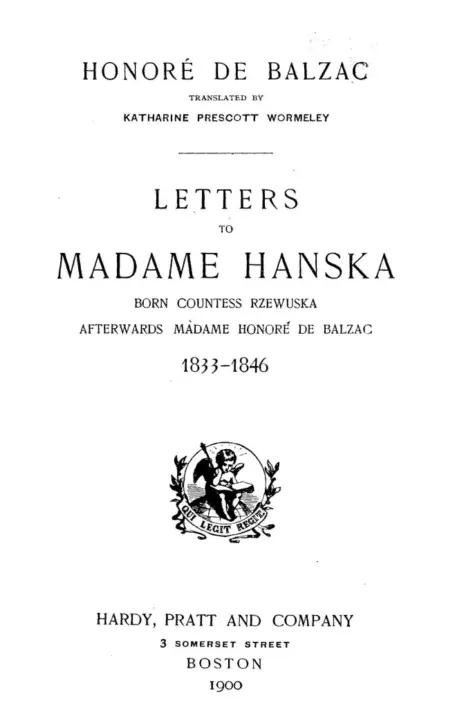
Letters to Madame Hanska, born Countess Rzewuska, afterwards Madame Honoré de Balzac, 1833-1846
Honoré de Balzac
THE CLASSIC COLLECTION · 1840
"Vautrin: A Drama in Five Acts" by Honoré de Balzac is a play written in the mid-19th century that explores complex themes of identity, motherhood, and the interplay of moral and social dilemmas in a post-revolutionary France. The narrative revolves around Jacques Collin, known as Vautrin, and his intricate schemes that entangle the lives of the aristocratic Duc de Montsorel, his wife, the Duchesse de Montsorel, and their son, the Marquis Albert. As secrets unfold, the characters are propelled towards a dramatic confrontation with their pasts and ambitions. The opening of the play introduces us to a world of uncertainty and intrigue, primarily through the perspective of the Duchesse de Montsorel, who displays a rare glimmer of hope upon believing she has found traces of her long-lost son, Fernand. Conversations between her and her aunt reveal her deep emotional turmoil, hinting at a significant family mystery that haunts her. The scene shifts to Vautrin, who appears both shadowy and charismatic, establishing his connections to the Montsorel family and hinting at deeper, intertwining plots as he interacts with the household. His arrival sets the stage for the potential unearthing of latent family secrets, as Vautrin maneuvers through the delicate social norms of the aristocratic circles, sparking anticipation for the conflicts ahead.
Introduction adapted from the source catalogue; source summaries may be automatically generated.
Free to read · English · 28,430 words · No account needed
MAKE TIME FOR A GOOD BOOK
On by default. Untick to stop anonymous reading totals. Each page counts after 10 seconds in view. How this works.
Anonymous counting is on unless you have switched it off.
Vautrin (aside) If Mexico saw herself represented in this way, the government would be capable of condemning me to embassades for life. (Aloud) Pray excuse me, madame. I have so many things to think about.
The Duchess
If absent-mindedness may be excused in any one, it is in a diplomat.
Vautrin
Yes, to civil diplomats, but I mean to remain a frank soldier. The
success which I derive must be the result of candor. But now that we
are alone, let us talk, for I have more than one delicate mission to
discharge.
The Duchess
Have you any news which my daughter should not hear?
Vautrin It may be so. Let me come to the point; the senorita is young and beautiful, she is rich and noble born; she probably has four times as many suitors as any other lady. Her hand is the object of rivalry. Well, her father has charged me to find whether she has singled out any one in particular.
The Duchess
With a frank man, general, I will be frank. Your question is so
strange that I cannot answer it.
Vautrin
Take care, for we diplomats, in our fear of being deceived, always put
the worst interpretation on silence.
The Duchess
Sir, you forget that we are talking of Inez de Christoval!
Vautrin
She is in love with no one. That is good; she will be able then to
carry out the wishes of her father.
The Duchess
How has Monsieur de Christoval disposed of his daughter's hand?
Vautrin You see my meaning, and your anxiety tells me that she has made her choice. I tremble to ask further, as much as you do to answer. Ah! if only the young man whom your daughter loves were a foreigner, rich, apparently without family, and bent on concealing the name of his native land!
The Duchess
The name, Frescas, which you lately uttered, is that of a young man
who seeks the hand of Inez.
Vautrin
Does he call himself also Raoul?
The Duchess
Yes, Raoul de Frescas.
Vautrin
A young man of refinement, elegance and wit, and twenty-three years of
age?
The Duchess
Gifted with manners which are never acquired, but innate.
Vautrin Romantic to the point of desiring to be loved for his own sake, in spite of his immense fortune; he wishes that passion should prevail in marriage--an absurdity! The young Amoagos, for it is he, madame.
The Duchess
But the name of Raoul is not--
Vautrin
Mexican--you are right. It was given to him by his mother, a
Frenchwoman, an emigree, a De Granville, who came from St. Domingo.
Is the reckless fellow favored by her?
Your reading position is saved on this browser. Take it to another device with a library code. Reading pages adapt to text, rather than matching a printed edition.
Honoré de Balzac
Honoré de Balzac
Honoré de Balzac
Honoré de Balzac
BEHIND THE BOOK
This eBook is for the use of anyone anywhere in the United States and most other parts of the world at no cost and with almost no restrictions whatsoever. You may copy it, give it away or re-use it under the terms of the Project Gutenberg License included with this eBook or online at www.gutenberg.org. If you are not located in the United States, you will have to check the laws of the country where you are located before using this eBook. Read the source licence.
The original source file, including credits and licence, is retained by this library. Request an original-format copy at no charge. Please include the book title and Project Gutenberg identifier #6861.
KEEP YOUR CURIOSITY GOING
Maurice Baring
W. B. (William Butler) Yeats
Edward Martyn

John Brougham & Charlotte Brontë
Marguerite Merington
Leonid Andreyev