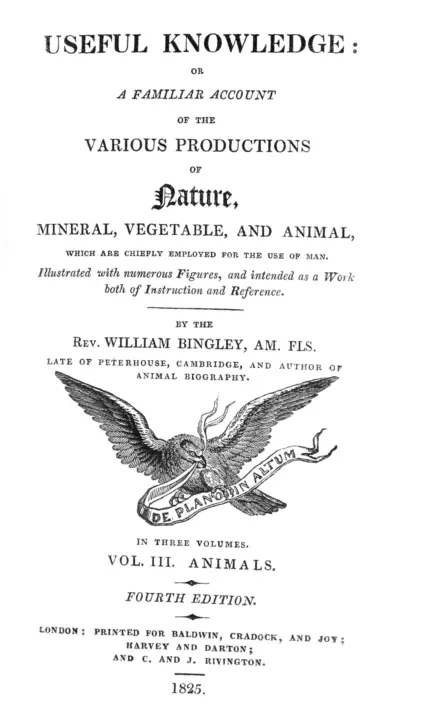
Useful Knowledge: Volume 3. Animals Or, a familiar account of the various productions of nature
William Bingley
THE CLASSIC COLLECTION · 1816
"Useful Knowledge: Volume 1. Minerals" by William Bingley is a scientific publication written in the early 19th century. This volume serves as an accessible introduction to the field of mineralogy, detailing natural minerals and their significance to human life and industry. The author aims to provide a comprehensive overview of various minerals, their properties, and their uses, making it approachable for general readers. The opening of the work establishes its educational intent, emphasizing the importance of understanding minerals in light of their numerous applications in everyday life. Bingley critiques previous methods of instruction, such as the use of catechisms for children's learning, and aims to provide a more thorough and engaging account suitable for all readers. He outlines the organization of the book, explaining how each mineral will be introduced with a definition, characteristics, and practical applications, highlighting its relevance to natural history and human progress. This systematic approach encourages readers to explore the foundational elements and classification of minerals, setting the stage for a detailed examination of specific minerals in the chapters to follow.
Introduction adapted from the source catalogue; source summaries may be automatically generated.
Free to read · English · 89,653 words · No account needed
MAKE TIME FOR A GOOD BOOK
On by default. Untick to stop anonymous reading totals. Each page counts after 10 seconds in view. How this works.
Anonymous counting is on unless you have switched it off.
259. PRIMITIVE TRAP is a mountain rock composed of a black mineral called hornblende, mixed, in some varieties, with felspar (110), and, in others, with mica (123).
The word trap is of German origin, signifying a stair; and rocks of this formation are called trap rocks, because their strata, when exposed, usually jut out, one beneath the other, somewhat like a stair. Under this term is comprehended a series of rocks, distinguished chiefly by the hornblende, which they all contain.
Rocks belonging to this formation are numerous. They occur in Scotland; and abundantly in Derbyshire and some other parts of England. In many countries they constitute considerable hills. They abound in ores.
260. SERPENTINE is a primitive rock, usually consisting of quartz (76), magnesia (198), alumine (197), with a portion of oxide (21) of iron.
This rock and its various uses, have been already described (132). It generally occurs in shapeless masses and beds; and seldom in distinct strata. It is found in Cornwall, the island of Anglesea, and several parts of Scotland; but it rarely forms mountains.
Ores of lead, silver, and copper, are sometimes found in serpentine.
261. PORPHYRY is a primitive rock, consisting of quartz (76) or felspar (110), or both, embedded in a solid and compact cement or ground.
The ground or basis of porphyry varies in the different kinds. In some it is claystone, in others pitchstone, hornstone, or compact felspar.
When not covered by other formations, porphyry sometimes forms single rocks; but it never constitutes elevated mountains. It occurs in beds of considerable magnitude, but never appears in distinct and well─defined strata.
There are many beautiful and splendid works in porphyry. Obelisks, statues, and columns, wrought in it, have had great celebrity. It is susceptible of a polish as high as that of marble, but is so hard, that the expense of working it has caused it to be much neglected by the moderns. This hardness, however, renders it very durable, and also constitutes it a material of great utility for mortars, slabs for grinding colours upon, and for several other purposes.
Porphyry was much esteemed by the ancient Egyptians; and Pliny informs us that the procurator─general in Egypt, under Claudius Cæsar, brought thence, for that Emperor, certain statues of porphyry, which he conceived to be very valuable: this act, however, was not much approved, and the example was not followed by any other Roman.
The principal quarries of porphyry are in Egypt; but this stone is also found in Italy, Germany, and various parts of the European continent. It may be traced from Norway to the borders of the Black Sea, and it has been discovered in some of the western and northern parts of Great Britain.
Your reading position is saved on this browser. Take it to another device with a library code. Reading pages adapt to text, rather than matching a printed edition.
William Bingley
William Bingley
William Bingley
BEHIND THE BOOK
This eBook is for the use of anyone anywhere in the United States and most other parts of the world at no cost and with almost no restrictions whatsoever. You may copy it, give it away or re-use it under the terms of the Project Gutenberg License included with this eBook or online at www.gutenberg.org. If you are not located in the United States, you will have to check the laws of the country where you are located before using this eBook. Read the source licence.
The original source file, including credits and licence, is retained by this library. Request an original-format copy at no charge. Please include the book title and Project Gutenberg identifier #57898.
KEEP YOUR CURIOSITY GOING
Cécile Tormay

Moritz Busch
John L. Ransom
Frances Wright
Cécile Tormay

Mabel Potter Daggett