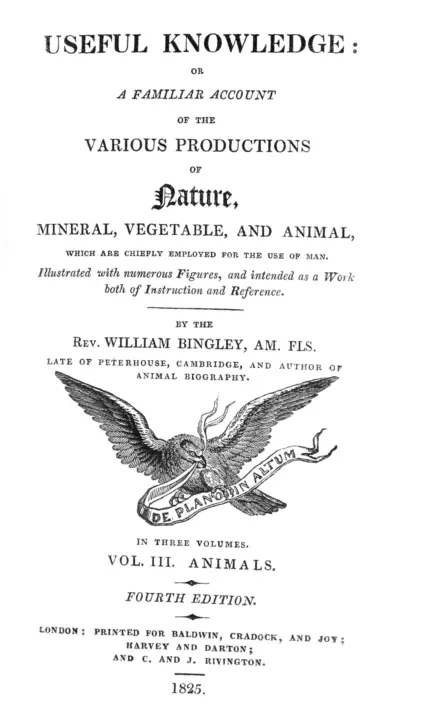
Useful Knowledge: Volume 3. Animals Or, a familiar account of the various productions of nature
William Bingley
THE CLASSIC COLLECTION · 1816
"Useful Knowledge: Volume 1. Minerals" by William Bingley is a scientific publication written in the early 19th century. This volume serves as an accessible introduction to the field of mineralogy, detailing natural minerals and their significance to human life and industry. The author aims to provide a comprehensive overview of various minerals, their properties, and their uses, making it approachable for general readers. The opening of the work establishes its educational intent, emphasizing the importance of understanding minerals in light of their numerous applications in everyday life. Bingley critiques previous methods of instruction, such as the use of catechisms for children's learning, and aims to provide a more thorough and engaging account suitable for all readers. He outlines the organization of the book, explaining how each mineral will be introduced with a definition, characteristics, and practical applications, highlighting its relevance to natural history and human progress. This systematic approach encourages readers to explore the foundational elements and classification of minerals, setting the stage for a detailed examination of specific minerals in the chapters to follow.
Introduction adapted from the source catalogue; source summaries may be automatically generated.
Free to read · English · 89,653 words · No account needed
MAKE TIME FOR A GOOD BOOK
On by default. Untick to stop anonymous reading totals. Each page counts after 10 seconds in view. How this works.
Anonymous counting is on unless you have switched it off.
Labrador felspar, description and uses of, 69
Lapis lazuli. See Azure stone.
Lapis ollaris, description and use of, 90
Lazulite. See Azure stone.
Lead, description of, 203
——, how extracted from the ore, 218
——, pig lead, what it is, 204
——, ancient and modern uses of, 204
——, injurious effects of leaden vessels, 204
——, alloys and oxides of, 205
——, silver, how obtained from, 178, 207
——, white, how manufactured, and uses of, 205
——, red or minium, how manufactured, and uses of, 206
——, sugar of, 207
——, how detected in wine, &c., 207
——, pleasing experiment with, 207
Lead mines, account of, 203
Lemnian earth, how obtained and use of, 86
Lias, use of for multiplying drawings, 116
Lime, 17; how burnt, and various uses of, 97
—— water, how made, 98
Lime carbonat of, 99
Lime sulphat of, 117
Lime fluat of, 119
Limestone, description and uses of, 99
——, primitive, 228
——, transition, 232
Litharge, how made and uses of, 206
—— plaster, of what made, 206
Loadstone, description of, where found, and uses of, 197
Loam, description and uses of, 73
Looking─glasses, process of silvering, 176
Lunar caustic, what it is, and uses of, 181
Lydian stone, description and uses of, 53
Your reading position is saved on this browser. Take it to another device with a library code. Reading pages adapt to text, rather than matching a printed edition.
William Bingley
William Bingley
William Bingley
BEHIND THE BOOK
This eBook is for the use of anyone anywhere in the United States and most other parts of the world at no cost and with almost no restrictions whatsoever. You may copy it, give it away or re-use it under the terms of the Project Gutenberg License included with this eBook or online at www.gutenberg.org. If you are not located in the United States, you will have to check the laws of the country where you are located before using this eBook. Read the source licence.
The original source file, including credits and licence, is retained by this library. Request an original-format copy at no charge. Please include the book title and Project Gutenberg identifier #57898.
KEEP YOUR CURIOSITY GOING
Cécile Tormay

Moritz Busch
John L. Ransom
Frances Wright
Cécile Tormay

Mabel Potter Daggett