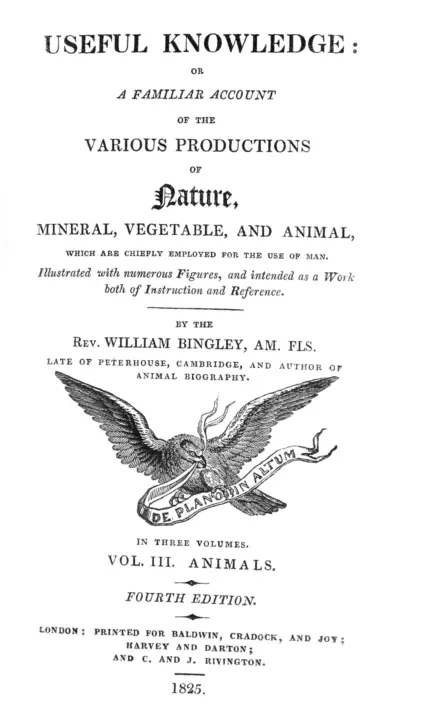
Useful Knowledge: Volume 3. Animals Or, a familiar account of the various productions of nature
William Bingley
THE CLASSIC COLLECTION · 1816
"Useful Knowledge: Volume 1. Minerals" by William Bingley is a scientific publication written in the early 19th century. This volume serves as an accessible introduction to the field of mineralogy, detailing natural minerals and their significance to human life and industry. The author aims to provide a comprehensive overview of various minerals, their properties, and their uses, making it approachable for general readers. The opening of the work establishes its educational intent, emphasizing the importance of understanding minerals in light of their numerous applications in everyday life. Bingley critiques previous methods of instruction, such as the use of catechisms for children's learning, and aims to provide a more thorough and engaging account suitable for all readers. He outlines the organization of the book, explaining how each mineral will be introduced with a definition, characteristics, and practical applications, highlighting its relevance to natural history and human progress. This systematic approach encourages readers to explore the foundational elements and classification of minerals, setting the stage for a detailed examination of specific minerals in the chapters to follow.
Introduction adapted from the source catalogue; source summaries may be automatically generated.
Free to read · English · 89,653 words · No account needed
MAKE TIME FOR A GOOD BOOK
On by default. Untick to stop anonymous reading totals. Each page counts after 10 seconds in view. How this works.
Anonymous counting is on unless you have switched it off.
262. SIENITE is a rock composed chiefly of felspar (110) and hornblende. Its colours are usually reddish and black.
Some varieties of it contain quartz (76) and mica (123), with but little hornblende. In these the colours are various.
Although this is a less abundant rock than any of those that have yet been mentioned, it occurs, in great abundance, at Mount Mado, in the island of Jersey. There are extensive quarries of it in that mountain, not only for the use of the island, but for exportation to England, and other distant countries. The cliffs, for a long space, and an elevation of a hundred feet or more, consist entirely of sienite, in large masses, which are apparently uninterrupted by a single fissure. Shafts for columns of considerable length have been taken from these quarries; and, were the demand sufficient to call for new openings, it is imagined that columns of twenty feet and upwards in length might be raised. The felspar is of a flesh colour, and the stone is capable of a beautiful polish.
A somewhat similar kind of sienite is found at Grande Roque, in the island of Guernsey, in large masses, which are quarried for building stones. Sienite also occurs in some parts of Scotland and Derbyshire; in Saxony, Hungary, the island of Cyprus, and Egypt. Its name has been derived from that of the city of Syene, in Upper Egypt, where it is found in great abundance.
Sienite was much used by the ancients in ornamental architecture. What was called the red granite of Egypt (for this rock has usually been considered a granite) furnished numerous magnificent obelisks and columns, of a single piece, which have been much admired in Rome and other places. The ancient artists sometimes cut this kind of stone into statues, vases, monumental and other works. The celebrated column in Egypt, upwards of ninety feet high, and known by the name of Pompey’s Pillar, is formed of sienite.
In veins of this rock are found, in different countries, many kinds of metallic ores: among others, silver, iron, tin, copper, and lead.
263. QUARTZ ROCK is a simple mountain rock, usually of granular
texture, and whitish colour.
It sometimes contains mica, in which case it has a slaty form.
In certain mountains of Scotland, and the Scottish islands, quartz rock is very abundant. On the Continent it appears in Saxony, Bohemia, Silesia, and several other countries. We are informed that a mountain, 350 feet high, and near 5000 feet broad and long, one of the Altaisch chain, in Siberia, consists entirely of a milk─white quartz.
The uses of quartz have been already described (76, &c.) This kind of rock does not contain metallic ores of any description.
Your reading position is saved on this browser. Take it to another device with a library code. Reading pages adapt to text, rather than matching a printed edition.
William Bingley
William Bingley
William Bingley
BEHIND THE BOOK
This eBook is for the use of anyone anywhere in the United States and most other parts of the world at no cost and with almost no restrictions whatsoever. You may copy it, give it away or re-use it under the terms of the Project Gutenberg License included with this eBook or online at www.gutenberg.org. If you are not located in the United States, you will have to check the laws of the country where you are located before using this eBook. Read the source licence.
The original source file, including credits and licence, is retained by this library. Request an original-format copy at no charge. Please include the book title and Project Gutenberg identifier #57898.
KEEP YOUR CURIOSITY GOING
Cécile Tormay

Moritz Busch
John L. Ransom
Frances Wright
Cécile Tormay

Mabel Potter Daggett