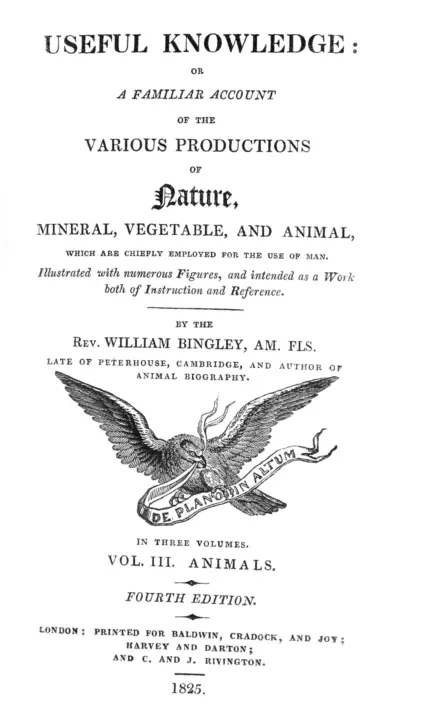
Useful Knowledge: Volume 3. Animals Or, a familiar account of the various productions of nature
William Bingley
THE CLASSIC COLLECTION · 1816
"Useful Knowledge: Volume 1. Minerals" by William Bingley is a scientific publication written in the early 19th century. This volume serves as an accessible introduction to the field of mineralogy, detailing natural minerals and their significance to human life and industry. The author aims to provide a comprehensive overview of various minerals, their properties, and their uses, making it approachable for general readers. The opening of the work establishes its educational intent, emphasizing the importance of understanding minerals in light of their numerous applications in everyday life. Bingley critiques previous methods of instruction, such as the use of catechisms for children's learning, and aims to provide a more thorough and engaging account suitable for all readers. He outlines the organization of the book, explaining how each mineral will be introduced with a definition, characteristics, and practical applications, highlighting its relevance to natural history and human progress. This systematic approach encourages readers to explore the foundational elements and classification of minerals, setting the stage for a detailed examination of specific minerals in the chapters to follow.
Introduction adapted from the source catalogue; source summaries may be automatically generated.
Free to read · English · 89,653 words · No account needed
MAKE TIME FOR A GOOD BOOK
On by default. Untick to stop anonymous reading totals. Each page counts after 10 seconds in view. How this works.
Anonymous counting is on unless you have switched it off.
Mountains of gneiss are not so steep as those of granite, and their summits are usually rounded. Ben Lomond and others in Scotland, and mount Rosa in Italy, are almost wholly of gneiss, as well as the middle part of the Pyrenees. It is not an uncommon rock, but in Britain is of less frequent occurrence than granite.
Many valuable metallic ores are found in veins of gneiss. This rock also sometimes contains crystals of garnet (70), and tourmaline (69).
256. MICA SLATE, or MICACEOUS SCHISTUS, is a primitive rock of slaty structure, consisting principally of quartz (76) and mica (123).
Like gneiss, it is rich in ores. It often contains beds of magnetic ironstone (235), galena (239), copper, blende (241), cinnabar (228), and sometimes even gold. It frequently has garnets, and sometimes tourmalines (69), interspersed in different parts of it.
Mica slate occurs in many parts of Scotland; the mountain of
Schehallien, and the rocky adjacent country, are in a great degree
composed of it.
257. CLAY SLATE is a primitive rock generally of dull blue colour, more or less compact, always slaty, and always stratified.
Under the appellation of clay slate are included roofing slate (120), whet slate (122), drawing slate (121), and some other kinds already described.
Few rocks abound more in veins and beds of valuable metals than slate. In different countries it contains ores of tin, lead, cobalt (247), silver, and copper; and gold, and mercury (228) sometimes occur in it. The celebrated quicksilver mines of Idria (228), and the immense mass of copper at Parys mountain in the island of Anglesea (230), are in clay slate. Crystals of pyrites (236), and sometimes garnets (70), and thin layers of quartz (76), and felspar (110), are all occasionally found embedded in it.
This is a widely─extended rock; it sometimes forms whole mountains, and even chains of mountains; but these usually have a gentle acclivity. The summit of the celebrated mountain called Skiddaw in Cumberland is of clay slate.
258. PRIMITIVE LIMESTONE is a simple mountain rock of crystalline or granular structure; and generally of white, yellowish, greenish, or reddish colour.
To this species of rock belong many of the rich and beautiful kinds of marble already described (143, &c.). Carrara, or statuary marble (146), is a familiar instance of it. Whole mountains in Stiria, Carinthia, Carniola, and the Pyrenees, and three mountains in Switzerland, 10,000 feet in height, are of primitive limestone. The mountain of Filabres in Spain, is said to consist of one block of white granular marble, 2,000 feet high, and three miles in circuit; without intermixture of other earths or stones, and almost without a fissure.
Various mineral ores, in beds and veins, as lead, zinc (241), and iron, are occasionally found in this kind of rock.
Your reading position is saved on this browser. Take it to another device with a library code. Reading pages adapt to text, rather than matching a printed edition.
William Bingley
William Bingley
William Bingley
BEHIND THE BOOK
This eBook is for the use of anyone anywhere in the United States and most other parts of the world at no cost and with almost no restrictions whatsoever. You may copy it, give it away or re-use it under the terms of the Project Gutenberg License included with this eBook or online at www.gutenberg.org. If you are not located in the United States, you will have to check the laws of the country where you are located before using this eBook. Read the source licence.
The original source file, including credits and licence, is retained by this library. Request an original-format copy at no charge. Please include the book title and Project Gutenberg identifier #57898.
KEEP YOUR CURIOSITY GOING
Cécile Tormay

Moritz Busch
John L. Ransom
Frances Wright
Cécile Tormay

Mabel Potter Daggett