
Uncle Sam’s Boys on Field Duty; or, Winning Corporal’s Chevrons
H. Irving (Harrie Irving) Hancock
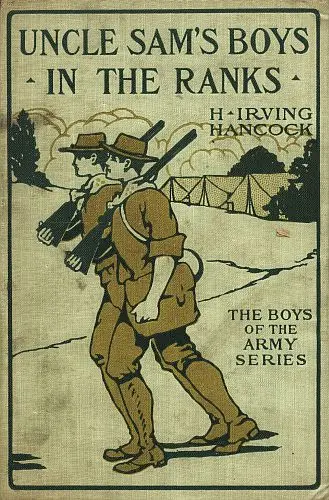
THE CLASSIC COLLECTION · 1910
"Uncle Sam's Boys in the Ranks; or, Two Recruits in the United States Army" by H. Irving Hancock is a novel written in the early 20th century. The story focuses on two young boys, Hal Overton and Noll Terry, who are eager to enlist in the United States Army, driven by a sense of patriotism and adventure. As they navigate the challenges of military life, they encounter a mix of camaraderie and the harsh realities of the discipline that comes with serving in the army. At the start of the book, we are introduced to the boys and their friends in a small New Jersey town, highlighting their differing opinions about soldiers and patriotism. After a heated debate, Hal and Noll resolve to enlist, despite the criticisms from others. The opening scenes depict their journey to the recruiting office, interactions with various characters, including a bully named Tip Branders, and their first experiences as recruits. Through humor and friendship, the narrative sets the stage for their transformation from inexperienced boys into disciplined soldiers, leading to adventures that await them in the army.
Introduction adapted from the source catalogue; source summaries may be automatically generated.
Free to read · English · 47,181 words · No account needed
MAKE TIME FOR A GOOD BOOK
On by default. Untick to stop anonymous reading totals. Each page counts after 10 seconds in view. How this works.
Anonymous counting is on unless you have switched it off.
"The man you call an officer is a non-commissioned officer--a sergeant, in fact," Hal replied. "Don't you see the chevrons on his sleeve?"
"That's so," Noll admitted slowly. "Cavalry, at that. His chevrons and facings are yellow. It was his fine uniform that made me take him for an officer."
"We'll go up to the sergeant and ask him where the recruiting office
is," Hal continued.
Certainly the sergeant looked "fine" enough to be an officer. His uniform was immaculate, rich-looking and faultless. Both sergeant and private wore the olive khaki, with handsome visored caps of the same material.
The early April forenoon was somewhat chilly, yet the benches in the center of the square were more than half-filled by men plainly "down on their luck." Some of these men, of course, were hopelessly besotted or vicious, and Uncle Sam had no use for any of these in his Army uniform. There were other men, however, on the seats, who looked like good and useful men who had met with hard times. Most of these men on the benches had not breakfasted, and had no assurance that they would lunch or dine on that day.
It was to the better elements among these men that the sergeant and the private soldier were intended to appeal. Yet the sergeant was not seeking unwilling recruits; he addressed no man who did not first speak to him.
In the tidy, striking uniforms, their well-built bodies, their well-fed appearance and their whole air of well-being, these two enlisted men of the regular army must have presented a powerful, if mute, appeal to the hungry unfortunate ones on the benches.
"Good morning, Sergeant," spoke Hal, as soon as the two chums had
reached the Army pair.
"Good morning, sir," replied the sergeant.
"You're in the recruiting service?" Hal continued.
"Yes, sir."
Always the invariable "sir" with which the careful soldier answers citizens. In the Army men are taught the use of that "sir," and to look upon all citizens as their employers.
"Then no doubt you will direct us to the recruiting office in this
neighborhood?" Hal went on.
"Certainly, sir," answered the sergeant, and wheeling still further
around he pointed north across the square to where the office was
situated.
"You can hardly miss it, sir, with the orderly standing outside," said
the sergeant, smiling.
"No, indeed," Hal agreed. "Thank you very much, Sergeant."
"You're welcome, sir. May I inquire if you are considering enlisting?"
"Both of us are," Hal nodded.
Your reading position is saved on this browser. Take it to another device with a library code. Reading pages adapt to text, rather than matching a printed edition.
H. Irving (Harrie Irving) Hancock

H. Irving (Harrie Irving) Hancock

H. Irving (Harrie Irving) Hancock

H. Irving (Harrie Irving) Hancock
BEHIND THE BOOK
This eBook is for the use of anyone anywhere in the United States and most other parts of the world at no cost and with almost no restrictions whatsoever. You may copy it, give it away or re-use it under the terms of the Project Gutenberg License included with this eBook or online at www.gutenberg.org. If you are not located in the United States, you will have to check the laws of the country where you are located before using this eBook. Read the source licence.
The original source file, including credits and licence, is retained by this library. Request an original-format copy at no charge. Please include the book title and Project Gutenberg identifier #27680.
KEEP YOUR CURIOSITY GOING
Coulson Kernahan

Maurice Baring
Frances Wright
Cécile Tormay

Frederic Jesup Stimson

W. H. P. (William Henry Pope) Jarvis