
Uncle Sam’s Boys on Field Duty; or, Winning Corporal’s Chevrons
H. Irving (Harrie Irving) Hancock
THE CLASSIC COLLECTION · 1910
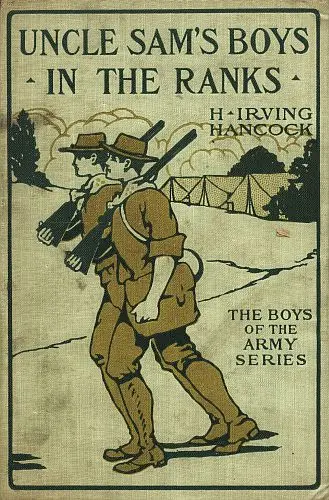
"Uncle Sam's Boys in the Ranks; or, Two Recruits in the United States Army" by H. Irving Hancock is a novel written in the early 20th century. The story focuses on two young boys, Hal Overton and Noll Terry, who are eager to enlist in the United States Army, driven by a sense of patriotism and adventure. As they navigate the challenges of military life, they encounter a mix of camaraderie and the harsh realities of the discipline that comes with serving in the army. At the start of the book, we are introduced to the boys and their friends in a small New Jersey town, highlighting their differing opinions about soldiers and patriotism. After a heated debate, Hal and Noll resolve to enlist, despite the criticisms from others. The opening scenes depict their journey to the recruiting office, interactions with various characters, including a bully named Tip Branders, and their first experiences as recruits. Through humor and friendship, the narrative sets the stage for their transformation from inexperienced boys into disciplined soldiers, leading to adventures that await them in the army.
Introduction adapted from the source catalogue; source summaries may be automatically generated.
Free to read · English · 47,181 words · No account needed
MAKE TIME FOR A GOOD BOOK
On by default. Untick to stop anonymous reading totals. Each page counts after 10 seconds in view. How this works.
Anonymous counting is on unless you have switched it off.
UNIFORMED rookies at last!
How proud each of our young rookies felt when at last he had a chance to survey himself in a glass.
Never, it seemed, had uniforms fitted quite as neatly before.
Never, at all events, had young recruits felt any keener delight than did Hal and Noll when they found themselves in their first infantry uniforms.
From that happy instant they were looked upon as the two brightest,
keenest recruits on post.
On the first day of their uniformed lives Sergeant Brimmer came to them.
"You are directed to fall in at parade, this afternoon, without arms. At formation I will place you in the rear rank."
Though they had their uniforms, their rifles had not yet been issued.
"What does it all mean?" wondered Noll. "We're not promoted to the company yet. We're not out of the squad work yet."
"We can wait to find out what it means," Hal answered. "It won't be many hours till parade time, now."
Then, at the bugle call, these young soldiers hurried outside, where Corporal Davis formed them and marched them away.
Having finished with the "school of the soldier" our two rookies were now in the "school of the squad."
In a company of infantry the squad consists of seven privates and a corporal. Marching in column of twos, or in column of fours, the corporal's place is on the left of the front rank of the squad; he himself makes the eighth man. But, for purposes of instructing recruits, the squad consists of eight rookies and a corporal.
Davis now led them away to the field, where he halted them.
"We will first," he announced, "take up the six setting-up drills of the manual, and go through with them three or four times. You men will do it as snappily as possible to-day."
These exercises consist of various gymnastic movements with the arms, of bending until the hands touch the ground, and of leg-raising work. The setting-up drills are very similar to ordinary work without apparatus in a gymnasium--but with this difference: the rookie is made to go through with them more and more snappily each time that he is set to the work. The result is that, within a few weeks, an awkward and perhaps shuffling, shambling young man is trained and built into the erect, alert, snappy and dignified soldier.
The setting-up work performed, Corporal Davis next drilled the rookies in alignments, interval-taking, marchings, turnings and "about," which corresponds to the old-time "about-face." It might be well to remark that all military commands in these days, have been greatly simplified as compared with the old style of doing things.
Your reading position is saved on this browser. Take it to another device with a library code. Reading pages adapt to text, rather than matching a printed edition.
H. Irving (Harrie Irving) Hancock

H. Irving (Harrie Irving) Hancock

H. Irving (Harrie Irving) Hancock

H. Irving (Harrie Irving) Hancock
BEHIND THE BOOK
This eBook is for the use of anyone anywhere in the United States and most other parts of the world at no cost and with almost no restrictions whatsoever. You may copy it, give it away or re-use it under the terms of the Project Gutenberg License included with this eBook or online at www.gutenberg.org. If you are not located in the United States, you will have to check the laws of the country where you are located before using this eBook. Read the source licence.
The original source file, including credits and licence, is retained by this library. Request an original-format copy at no charge. Please include the book title and Project Gutenberg identifier #27680.
KEEP YOUR CURIOSITY GOING
Coulson Kernahan

Maurice Baring
Frances Wright
Cécile Tormay

Frederic Jesup Stimson

W. H. P. (William Henry Pope) Jarvis