
Uncle Sam’s Boys on Field Duty; or, Winning Corporal’s Chevrons
H. Irving (Harrie Irving) Hancock
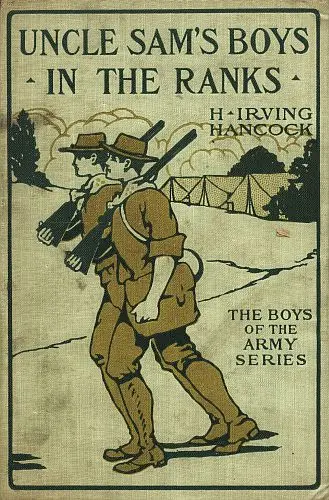
THE CLASSIC COLLECTION · 1910
"Uncle Sam's Boys in the Ranks; or, Two Recruits in the United States Army" by H. Irving Hancock is a novel written in the early 20th century. The story focuses on two young boys, Hal Overton and Noll Terry, who are eager to enlist in the United States Army, driven by a sense of patriotism and adventure. As they navigate the challenges of military life, they encounter a mix of camaraderie and the harsh realities of the discipline that comes with serving in the army. At the start of the book, we are introduced to the boys and their friends in a small New Jersey town, highlighting their differing opinions about soldiers and patriotism. After a heated debate, Hal and Noll resolve to enlist, despite the criticisms from others. The opening scenes depict their journey to the recruiting office, interactions with various characters, including a bully named Tip Branders, and their first experiences as recruits. Through humor and friendship, the narrative sets the stage for their transformation from inexperienced boys into disciplined soldiers, leading to adventures that await them in the army.
Introduction adapted from the source catalogue; source summaries may be automatically generated.
Free to read · English · 47,181 words · No account needed
MAKE TIME FOR A GOOD BOOK
On by default. Untick to stop anonymous reading totals. Each page counts after 10 seconds in view. How this works.
Anonymous counting is on unless you have switched it off.
It hurt both boys a bit, as long as any part of their home city remained in sight. Each tried bravely, however, to look as though going away from home had been a frequent occurrence in their lives.
By the time that they were ten miles on their way both youngsters had recovered their spirits. Indeed, now they were looking forward with almost feverish eagerness to their meeting the recruiting officer.
"I hope the Army surgeon doesn't find anything wrong with our physical condition," said Hal, at last.
"Dr. Brooks didn't," replied Noll, as confidently as though that settled
it.
"But Dr. Brooks has never been an Army surgeon," returned Hal. "He may not know all the fine points that Army surgeons know."
"Well we'll know before the day is over," replied Noll, with a catching of his breath. "Then, of course, we don't know whether the Army is at present taking boys under twenty-one."
"The law allows it," declared Hal stoutly.
"Yes; but you remember Sergeant Wright told us, fairly, that sometimes, when the right sort of recruits are coming along fast, the recruiting officers shut down on taking any minors."
"I imagine," predicted Hal, "that much more will depend upon how we happen, individually, to impress the recruiting officer."
In this Hal Overton was very close to being right.
The ride of more than two hours ended at last, bringing the young would-be soldiers to the ferry on the Jersey side. As they crossed the North River both boys admitted to themselves that they were becoming a good deal more nervous.
"We'll get a Broadway surface car, and that will take us right up to Madison Square," proposed Noll.
"It would take us too long," negatived Hal. "We can save a lot of time by taking the Sixth Avenue "L" uptown and walking across to Madison Square."
"You're in a hurry to have it over with?" laughed Noll, but there was a slight tremor in his voice.
"I'm in a hurry to know my fate," admitted Hal.
Oliver Terry had been in New York but once before. Hal, by virtue of his superiority in having made four visits to New York, led the way straight to the elevated railroad. They climbed the stairs, and were just in time to board a train.
A few minutes later they got out at Twenty-third Street, crossed to Fifth Avenue and Broadway, then made their way swiftly over to Madison Square.
"There's the place, over there!" cried Noll, suddenly seizing Hal's arm and dragging him along. "There's an officer and a man, and the soldier is holding a banner. It has something on it that says something about recruits for the Army."
Your reading position is saved on this browser. Take it to another device with a library code. Reading pages adapt to text, rather than matching a printed edition.
H. Irving (Harrie Irving) Hancock

H. Irving (Harrie Irving) Hancock

H. Irving (Harrie Irving) Hancock

H. Irving (Harrie Irving) Hancock
BEHIND THE BOOK
This eBook is for the use of anyone anywhere in the United States and most other parts of the world at no cost and with almost no restrictions whatsoever. You may copy it, give it away or re-use it under the terms of the Project Gutenberg License included with this eBook or online at www.gutenberg.org. If you are not located in the United States, you will have to check the laws of the country where you are located before using this eBook. Read the source licence.
The original source file, including credits and licence, is retained by this library. Request an original-format copy at no charge. Please include the book title and Project Gutenberg identifier #27680.
KEEP YOUR CURIOSITY GOING
Coulson Kernahan

Maurice Baring
Frances Wright
Cécile Tormay

Frederic Jesup Stimson

W. H. P. (William Henry Pope) Jarvis