
Uncle Sam’s Boys on Field Duty; or, Winning Corporal’s Chevrons
H. Irving (Harrie Irving) Hancock
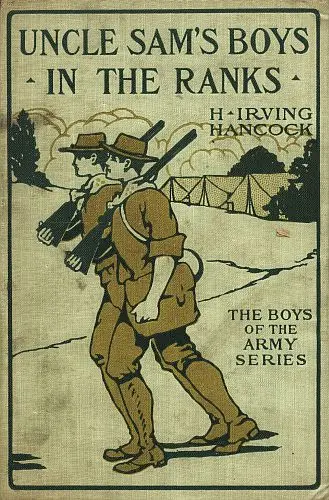
THE CLASSIC COLLECTION · 1910
"Uncle Sam's Boys in the Ranks; or, Two Recruits in the United States Army" by H. Irving Hancock is a novel written in the early 20th century. The story focuses on two young boys, Hal Overton and Noll Terry, who are eager to enlist in the United States Army, driven by a sense of patriotism and adventure. As they navigate the challenges of military life, they encounter a mix of camaraderie and the harsh realities of the discipline that comes with serving in the army. At the start of the book, we are introduced to the boys and their friends in a small New Jersey town, highlighting their differing opinions about soldiers and patriotism. After a heated debate, Hal and Noll resolve to enlist, despite the criticisms from others. The opening scenes depict their journey to the recruiting office, interactions with various characters, including a bully named Tip Branders, and their first experiences as recruits. Through humor and friendship, the narrative sets the stage for their transformation from inexperienced boys into disciplined soldiers, leading to adventures that await them in the army.
Introduction adapted from the source catalogue; source summaries may be automatically generated.
Free to read · English · 47,181 words · No account needed
MAKE TIME FOR A GOOD BOOK
On by default. Untick to stop anonymous reading totals. Each page counts after 10 seconds in view. How this works.
Anonymous counting is on unless you have switched it off.
"Glad to hear it, sir," the sergeant continued, looking both boys over with evident approval. "You look like the clean, solid, sensible, right sort that we're looking for in the Army. I wish you both the best of good luck."
"Thank you," Hal acknowledged. "Good morning, Sergeant."
"Good morning, sir."
Still that "sir" to the citizen. The sergeant would drop it, as far as these two boys were concerned, if they entered the service and became his subordinates.
It seemed to Hal and Noll as if they could not get over the ground fast enough until they reached that doorway where the orderly stood. The orderly directed them how to reach the office upstairs, and both boys, after thanking him, proceeded rapidly to higher regions.
They soon found themselves before the door. It stood ajar. Inside sat a sergeant at a flat-top desk. He, too, was of the cavalry. There were also two privates in the room.
Doffing their hats Hal and Noll entered the room. Overton led the way straight to the sergeant's desk.
"Good morning, Sergeant. We have come to see whether we can enlist."
"How old were you on your last birthday?" inquired the sergeant, eyeing
Hal keenly.
"Eighteen, Sergeant."
"And you?" turning to Noll.
"Seventeen," Noll replied.
"You are too young, I'm sorry to say," replied the sergeant to Noll.
Then, turning to Hal, he added:
"You may be accepted."
"But I've got another birthday coming very soon," interjected Noll.
"How soon?"
"To-morrow."
"You'll be eighteen to-morrow?" questioned the sergeant.
"Yes, sir."
"That will be all right, then," nodded the sergeant. "You won't need to be sworn in before to-morrow. You have both of you parents living?"
"Yes, sir," Hal answered, this time.
"It is not necessary, or usual, to say 'sir,' when answering a non-commissioned officer," the sergeant informed them. "Say 'sir,' always, when addressing a commissioned officer or a citizen."
"Thank you," Hal acknowledged.
"Now, you have the consent of your parents to enlist?"
"Yes, Sergeant."
"Both of you?"
"Yes."
"Aldridge!"
One of the pair of very spruce-looking privates in the room wheeled
about.
"Furnish these young men with application blanks, and take them over to
the high desk."
Having said this the sergeant turned back to some papers that he had
been examining.
"You will fill out these papers," Private Aldridge explained to the boys, after he had led them to the high desk. "I think all the questions are plain enough. If there are any you don't understand then ask me."
It was a race between Hal and Noll to see which could get a pen in his hand first. Then they began to write.
Your reading position is saved on this browser. Take it to another device with a library code. Reading pages adapt to text, rather than matching a printed edition.
H. Irving (Harrie Irving) Hancock

H. Irving (Harrie Irving) Hancock

H. Irving (Harrie Irving) Hancock

H. Irving (Harrie Irving) Hancock
BEHIND THE BOOK
This eBook is for the use of anyone anywhere in the United States and most other parts of the world at no cost and with almost no restrictions whatsoever. You may copy it, give it away or re-use it under the terms of the Project Gutenberg License included with this eBook or online at www.gutenberg.org. If you are not located in the United States, you will have to check the laws of the country where you are located before using this eBook. Read the source licence.
The original source file, including credits and licence, is retained by this library. Request an original-format copy at no charge. Please include the book title and Project Gutenberg identifier #27680.
KEEP YOUR CURIOSITY GOING
Coulson Kernahan

Maurice Baring
Frances Wright
Cécile Tormay

Frederic Jesup Stimson

W. H. P. (William Henry Pope) Jarvis