
Uncle Sam’s Boys on Field Duty; or, Winning Corporal’s Chevrons
H. Irving (Harrie Irving) Hancock
THE CLASSIC COLLECTION · 1919
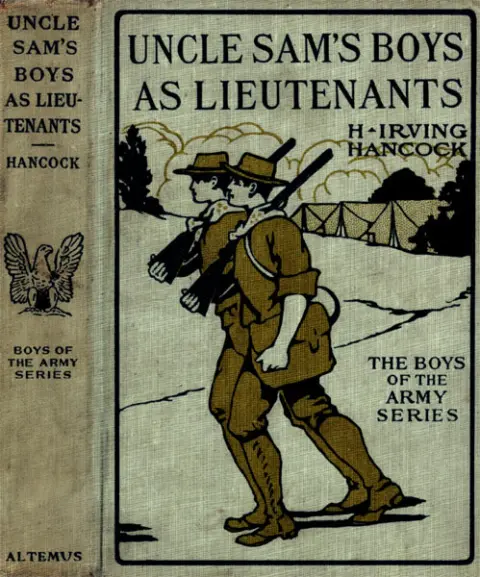
"Uncle Sam's Boys as Lieutenants; or, Serving Old Glory as Line Officers" by H. Irving Hancock is a historical novel written in the early 20th century. The story revolves around two young soldiers, Hal Overton and Noll Terry, who transition from enlisted men to second lieutenants in the United States Army. The book captures their anticipation and experiences as they settle into their roles as officers and confront personal and professional challenges that arise during their service. The opening of the book establishes a sense of suspense and eagerness among the characters as they await news from the War Department regarding their commission status. Hal and Noll's conversation with Hal's mother highlights their strong desire to rise through the ranks and serve their country, setting the tone for their journey. As they receive their official appointments, the narrative hints at their imminent challenges, including dealing with conflict in their new roles and the reactions of those around them, such as the antagonistic Bunny Hepburn. This introduction paves the way for a tale of camaraderie, duty, and the complexities of military life.
Introduction adapted from the source catalogue; source summaries may be automatically generated.
Free to read · English · 48,950 words · No account needed
MAKE TIME FOR A GOOD BOOK
On by default. Untick to stop anonymous reading totals. Each page counts after 10 seconds in view. How this works.
Anonymous counting is on unless you have switched it off.
Catching up clean underclothing Lieutenant Hal retired to the bathroom. Completing his toilet with soldierly speed, the youthful lieutenant opened the door into his parlor.
Private Ellis arose, standing at attention.
Hal tarried only long enough to note that the striker had placed his swords in a corner, and that his revolver, belt and ammunition box lay on the desk.
"Ellis has done this sort of work before," Hal told himself. Then he stepped out, knocking on Noll's door. The latter's striker opened it at once.
"Lieutenant Terry is nearly ready, sir," reported Noll's striker.
An officer's striker is a species of military servant, yet it is not considered in the Army that the striker's work is really menial, or in any way degrading. Some of the best and brightest of the commissioned officers now serving in the Army have been employed in the past as strikers to officers. No private soldier is compelled to serve as striker. He does it only of his own choice, and is always paid by the officer, the amount of pay depending upon the extent and nature of the services so performed. A striker's work must not interfere with his performance of his own soldierly duties. A trained striker knows just the hours when he is expected to be at his officer's quarters, and just what he must do when he gets there.
Noll soon came out, presenting a striking sight in his brand-new, finely
fitting uniform.
"I can't rid myself of the notion that I'm liable to arrest by the guard," laughed Noll as the chums made their way down the stairs.
"Why?" asked Hal.
"For daring to masquerade in an officer's uniform," grinned Noll.
"You'll get used to it soon," replied Hal. "You haven't been an enlisted man all your life, you know."
"But I have been during all the years that I've been really living," Noll retorted. "You look out, too, Hal, old bunkie, or you'll be saluting the first second lieutenant you see."
"I shall, anyway," Overton retorted. "Any other second lieutenant on the post, except yourself, ranks me, and I'm not sure but that you do."
Nor had the young lieutenants taken ten steps from their room when a soldier, turning the corner, brought his hand up to the visor of his cap in trim salute.
Hal was ready with his acknowledgment of the salute, but Noll started guiltily, half a second later, and hurriedly raised his own hand to return the soldier's courtesy.
"I was nearly caught that time," admitted Terry, in an undertone.
"Watch, out, chum. It's a grave matter, as you well enough know, for an officer to overlook a soldier's salute."
Your reading position is saved on this browser. Take it to another device with a library code. Reading pages adapt to text, rather than matching a printed edition.
H. Irving (Harrie Irving) Hancock

H. Irving (Harrie Irving) Hancock

H. Irving (Harrie Irving) Hancock

H. Irving (Harrie Irving) Hancock
BEHIND THE BOOK
This eBook is for the use of anyone anywhere in the United States and most other parts of the world at no cost and with almost no restrictions whatsoever. You may copy it, give it away or re-use it under the terms of the Project Gutenberg License included with this eBook or online at www.gutenberg.org. If you are not located in the United States, you will have to check the laws of the country where you are located before using this eBook. Read the source licence.
The original source file, including credits and licence, is retained by this library. Request an original-format copy at no charge. Please include the book title and Project Gutenberg identifier #26381.
KEEP YOUR CURIOSITY GOING
Cécile Tormay

Moritz Busch
Coulson Kernahan
John L. Ransom

Maurice Baring
Frances Wright