
Uncle Sam’s Boys on Field Duty; or, Winning Corporal’s Chevrons
H. Irving (Harrie Irving) Hancock
THE CLASSIC COLLECTION · 1919
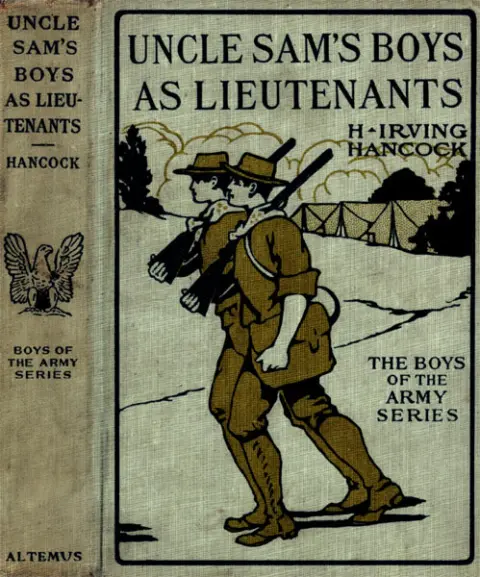
"Uncle Sam's Boys as Lieutenants; or, Serving Old Glory as Line Officers" by H. Irving Hancock is a historical novel written in the early 20th century. The story revolves around two young soldiers, Hal Overton and Noll Terry, who transition from enlisted men to second lieutenants in the United States Army. The book captures their anticipation and experiences as they settle into their roles as officers and confront personal and professional challenges that arise during their service. The opening of the book establishes a sense of suspense and eagerness among the characters as they await news from the War Department regarding their commission status. Hal and Noll's conversation with Hal's mother highlights their strong desire to rise through the ranks and serve their country, setting the tone for their journey. As they receive their official appointments, the narrative hints at their imminent challenges, including dealing with conflict in their new roles and the reactions of those around them, such as the antagonistic Bunny Hepburn. This introduction paves the way for a tale of camaraderie, duty, and the complexities of military life.
Introduction adapted from the source catalogue; source summaries may be automatically generated.
Free to read · English · 48,950 words · No account needed
MAKE TIME FOR A GOOD BOOK
On by default. Untick to stop anonymous reading totals. Each page counts after 10 seconds in view. How this works.
Anonymous counting is on unless you have switched it off.
Private Simms soon returned, bringing with him Check and Varnum and the two Mexican prisoners. The Mexicans were forced to join their kind in the cabin, and Hal had two more soldiers to back his authority.
"Simms, hurry back to camp, looking out for the noose on the way. Report to Captain Foster what you've seen here, and inform him, with my compliments, that I await his further commands. This boat will wait at some distance out in the stream."
Just before Hal gave these instructions, Captain Boggs had been directed to run his boat back against the pier. Simms, saluting, stepped ashore and went off at brisk stride.
"One bell ahead, Captain," ordered Lieutenant Hal, showing his face at
the wheel-house window.
"I don't know whether I'll do that or not," growled Boggs, filling a short, black pipe and lighting the tobacco.
"You'll either obey orders, sir, or you'll go back into the cabin with the Mexicans, and let your mate run the boat. If your mate refuses he'll join in the cabin and I'll do the best I can with the boat myself. Now, sir, are you going to obey orders?"
"Where do you want to go?" growled the riverman.
"One bell ahead."
"But where are you bound for?"
"That is none of your business, as you are no longer in command here.
One bell ahead, sir."
Boggs looked as though he were going to balk flat, until he saw Hal turn as though to summon a soldier. Then the tug's master reached for the bell-pull. Clang! The tug's propeller began to churn slowly.
"Throw the wheel over two points to port," Hal continued. "Now, hold her
steady ahead."
Still at half speed the craft moved out into the river some four hundred
feet.
"Stop your speed, Captain."
Boggs obeyed, demanding next, "What now?"
"Nothing until I tell you," Lieutenant Hal responded.
"But the drift will carry us downstream."
"If we get too far down we'll steam back. Mate!"
"Aye, aye, sir," answered the man standing beside the tug's master.
"Get your masthead light out. Then display your starboard and port sidelights. Men," called Hal to his soldiers, "I call upon you to note and remember that this craft had no lights out until I ordered them out."
"We don't need lights out at the pier," growled Boggs, comprehending the meaning of Lieutenant Overton's remark.
"I believe you do," Hal rejoined, "when you are about to leave the pier for the stream. However, that's a point for higher authority than yours or mine to determine."
The mate soon had the running lights properly displayed and returned to
the wheel-house.
Your reading position is saved on this browser. Take it to another device with a library code. Reading pages adapt to text, rather than matching a printed edition.
H. Irving (Harrie Irving) Hancock

H. Irving (Harrie Irving) Hancock

H. Irving (Harrie Irving) Hancock

H. Irving (Harrie Irving) Hancock
BEHIND THE BOOK
This eBook is for the use of anyone anywhere in the United States and most other parts of the world at no cost and with almost no restrictions whatsoever. You may copy it, give it away or re-use it under the terms of the Project Gutenberg License included with this eBook or online at www.gutenberg.org. If you are not located in the United States, you will have to check the laws of the country where you are located before using this eBook. Read the source licence.
The original source file, including credits and licence, is retained by this library. Request an original-format copy at no charge. Please include the book title and Project Gutenberg identifier #26381.
KEEP YOUR CURIOSITY GOING
Cécile Tormay

Moritz Busch
Coulson Kernahan
John L. Ransom

Maurice Baring
Frances Wright