
Uncle Sam’s Boys on Field Duty; or, Winning Corporal’s Chevrons
H. Irving (Harrie Irving) Hancock
THE CLASSIC COLLECTION · 1919
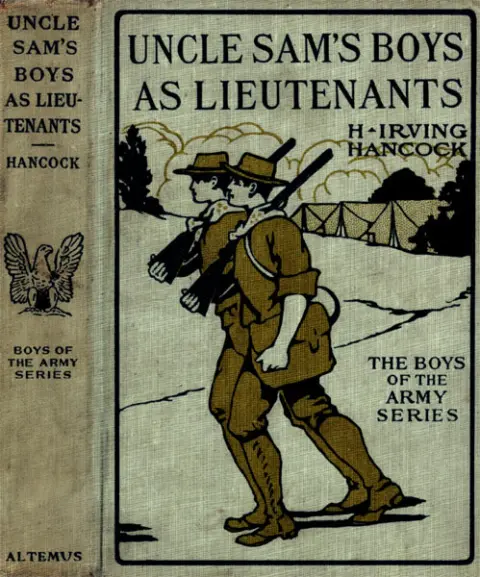
"Uncle Sam's Boys as Lieutenants; or, Serving Old Glory as Line Officers" by H. Irving Hancock is a historical novel written in the early 20th century. The story revolves around two young soldiers, Hal Overton and Noll Terry, who transition from enlisted men to second lieutenants in the United States Army. The book captures their anticipation and experiences as they settle into their roles as officers and confront personal and professional challenges that arise during their service. The opening of the book establishes a sense of suspense and eagerness among the characters as they await news from the War Department regarding their commission status. Hal and Noll's conversation with Hal's mother highlights their strong desire to rise through the ranks and serve their country, setting the tone for their journey. As they receive their official appointments, the narrative hints at their imminent challenges, including dealing with conflict in their new roles and the reactions of those around them, such as the antagonistic Bunny Hepburn. This introduction paves the way for a tale of camaraderie, duty, and the complexities of military life.
Introduction adapted from the source catalogue; source summaries may be automatically generated.
Free to read · English · 48,950 words · No account needed
MAKE TIME FOR A GOOD BOOK
On by default. Untick to stop anonymous reading totals. Each page counts after 10 seconds in view. How this works.
Anonymous counting is on unless you have switched it off.
"Officers' club," otherwise known as "officers' mess," is a term that might be misunderstood by a civilian. The "club" is where the bachelor officers eat their meals; other officers on post often eat there, too, especially in the absence of their families. There are reading and writing rooms at the "club," and other features that make it a somewhat pleasant lounging place for young officers in their few leisure hours. While there is plenty of comfort at an officers' club there are few in which anything like real luxury is to be found. And, while the civilian may remain at his club until well into the small hours the Army officer, with his next day of arduous duty ahead of him, usually leaves his club between nine and ten in the evening, if not much earlier.
Major Tipton then led the young officers to the bachelor house, explaining that he had assigned them quarters upstairs, as they would find them much pleasanter than the downstairs rooms.
The two sets of quarters proved to be facing each other, Hal's on the east side, Noll's on the west side. Each set consisted of a parlor and bedroom, with bath and dressing-room adjoining.
"There's room enough here, sir, to start married life in," smiled
Lieutenant Overton.
"Have you that bee buzzing about you?" asked the major, giving him a
keen glance.
"Not in the least, sir."
"I have arranged for two excellent men to act as your strikers," continued the commanding officer. "Their selection is, of course, subject to your approval. At Fort Butler an officer pays a striker eight dollars a month."
The two lieutenants expressed their thanks. While they were still inspecting their quarters two private soldiers came up with the baggage from the railway station.
"I'll take my leave, now, and give you time to dress," said the major, rising. "I shall be at the club during the noon-time to-day, and will introduce you to such of the officers as may be present."
Both young officers saluted as their commander withdrew.
"Now we've got to hustle," admonished Hal. "We'll have a lot to do."
"I'm busy," affirmed Noll, rising and making for the door to go to his
own quarters.
Hardly had the door closed when a knock came. Another knock could be
heard at Noll's door.
"Come in," called Hal, and a young private entered, saluting.
"Major Tipton arranged with me to serve as your striker, sir, until you make some other arrangement," reported the soldier.
"You've come at just the right moment, then," answered Hal. "Your name?"
"Ellis, sir."
"Very good, Ellis. Unpack my trunk and bags in the bedroom. I'm going
into my bath."
"Very good, sir."
Your reading position is saved on this browser. Take it to another device with a library code. Reading pages adapt to text, rather than matching a printed edition.
H. Irving (Harrie Irving) Hancock

H. Irving (Harrie Irving) Hancock

H. Irving (Harrie Irving) Hancock

H. Irving (Harrie Irving) Hancock
BEHIND THE BOOK
This eBook is for the use of anyone anywhere in the United States and most other parts of the world at no cost and with almost no restrictions whatsoever. You may copy it, give it away or re-use it under the terms of the Project Gutenberg License included with this eBook or online at www.gutenberg.org. If you are not located in the United States, you will have to check the laws of the country where you are located before using this eBook. Read the source licence.
The original source file, including credits and licence, is retained by this library. Request an original-format copy at no charge. Please include the book title and Project Gutenberg identifier #26381.
KEEP YOUR CURIOSITY GOING
Cécile Tormay

Moritz Busch
Coulson Kernahan
John L. Ransom

Maurice Baring
Frances Wright