
Uncle Sam’s Boys on Field Duty; or, Winning Corporal’s Chevrons
H. Irving (Harrie Irving) Hancock
THE CLASSIC COLLECTION · 1919
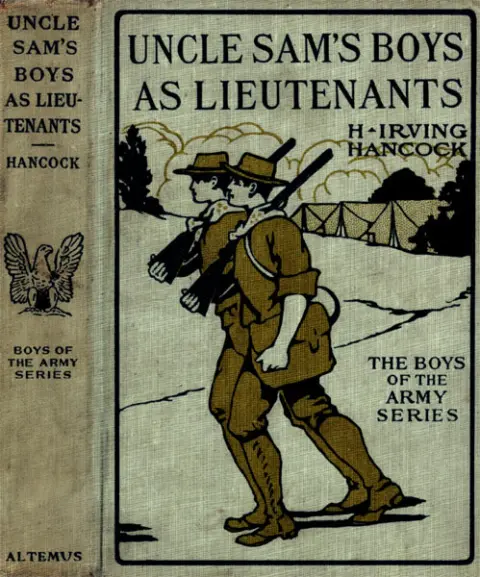
"Uncle Sam's Boys as Lieutenants; or, Serving Old Glory as Line Officers" by H. Irving Hancock is a historical novel written in the early 20th century. The story revolves around two young soldiers, Hal Overton and Noll Terry, who transition from enlisted men to second lieutenants in the United States Army. The book captures their anticipation and experiences as they settle into their roles as officers and confront personal and professional challenges that arise during their service. The opening of the book establishes a sense of suspense and eagerness among the characters as they await news from the War Department regarding their commission status. Hal and Noll's conversation with Hal's mother highlights their strong desire to rise through the ranks and serve their country, setting the tone for their journey. As they receive their official appointments, the narrative hints at their imminent challenges, including dealing with conflict in their new roles and the reactions of those around them, such as the antagonistic Bunny Hepburn. This introduction paves the way for a tale of camaraderie, duty, and the complexities of military life.
Introduction adapted from the source catalogue; source summaries may be automatically generated.
Free to read · English · 48,950 words · No account needed
MAKE TIME FOR A GOOD BOOK
On by default. Untick to stop anonymous reading totals. Each page counts after 10 seconds in view. How this works.
Anonymous counting is on unless you have switched it off.
"Whew, but it's hot here!" grumbled Sergeant Noll Terry, of the United
States Army.
"That's an odd complaint to hear from a young man who served so actively for two years in the tropics," laughed Mrs. Overton, a short, plump, middle-aged matron.
"Well, Mother, it is a hot day," put in Sergeant Hal Overton quietly.
"Yes, it is," agreed Hal's mother, "though you two, who came from the Philippines the very picture of health can't feel the weather to-day much. New Jersey isn't in the tropics."
Hal's mother said that with an air of finality. Her son and his chum had been through the most strenuous forms of active army service in Uncle Sam's colonial possessions, the Philippine Islands. If they could endure the heat in that tropical belt, even that day's broiling weather at home must seem cool by comparison.
"I suppose you have an idea, Mother, that the nearer you go to the equator the hotter the weather gets."
"Well, isn't it so?" challenged Mrs. Overton.
"It may be, as far as actual degrees of heat are marked off on the thermometer," explained Sergeant Hal. "But I'll stick to it, Mother, that the average of weather that we struck in the Philippines was not nearly so disagreeable as the weather is here to-day."
"That's so," nodded youthful Sergeant Terry, with emphasis.
"I don't understand that," replied Mrs. Overton, looking a good deal
puzzled.
"I don't pretend to understand it, either, Mother," Hal continued. "But it's a fact that there are very few spots in the actual tropics that seem so disagreeable as are New York City and some places in New Jersey in the heated terms of July and August."
"That astonishes me," declared Mrs. Overton. "I have always supposed that, the further south one goes in summer, the hotter one finds it. So New York City is hotter in summer than the tropics?"
"It seems hotter," Sergeant Hal affirmed.
The boys were more or less inclined to joke Mrs. Overton, because, while there are many pleasant days in the tropics, particularly near the coast, the weather is for the most part undeniably hot and oppressive.
"Anyhow," remarked Noll, philosophically, "the hardest thing we have to do here is to walk a short distance down the street and buy another ice cream."
"I'd rather be working," retorted Hal quickly. "I'd rather be doing anything than lying idly around like this!"
"Henry!" cried his mother reproachfully. She was sure to be hurt or angry when she addressed him so formally. "Don't you care anything about being at home, after you've been away from us for more than three years?"
Your reading position is saved on this browser. Take it to another device with a library code. Reading pages adapt to text, rather than matching a printed edition.
H. Irving (Harrie Irving) Hancock

H. Irving (Harrie Irving) Hancock

H. Irving (Harrie Irving) Hancock

H. Irving (Harrie Irving) Hancock
BEHIND THE BOOK
This eBook is for the use of anyone anywhere in the United States and most other parts of the world at no cost and with almost no restrictions whatsoever. You may copy it, give it away or re-use it under the terms of the Project Gutenberg License included with this eBook or online at www.gutenberg.org. If you are not located in the United States, you will have to check the laws of the country where you are located before using this eBook. Read the source licence.
The original source file, including credits and licence, is retained by this library. Request an original-format copy at no charge. Please include the book title and Project Gutenberg identifier #26381.
KEEP YOUR CURIOSITY GOING
Cécile Tormay

Moritz Busch
Coulson Kernahan
John L. Ransom

Maurice Baring
Frances Wright