
Uncle Sam’s Boys on Field Duty; or, Winning Corporal’s Chevrons
H. Irving (Harrie Irving) Hancock
THE CLASSIC COLLECTION · 1919
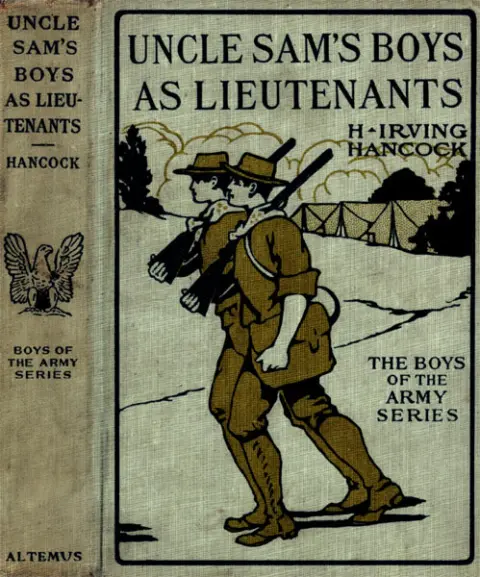
"Uncle Sam's Boys as Lieutenants; or, Serving Old Glory as Line Officers" by H. Irving Hancock is a historical novel written in the early 20th century. The story revolves around two young soldiers, Hal Overton and Noll Terry, who transition from enlisted men to second lieutenants in the United States Army. The book captures their anticipation and experiences as they settle into their roles as officers and confront personal and professional challenges that arise during their service. The opening of the book establishes a sense of suspense and eagerness among the characters as they await news from the War Department regarding their commission status. Hal and Noll's conversation with Hal's mother highlights their strong desire to rise through the ranks and serve their country, setting the tone for their journey. As they receive their official appointments, the narrative hints at their imminent challenges, including dealing with conflict in their new roles and the reactions of those around them, such as the antagonistic Bunny Hepburn. This introduction paves the way for a tale of camaraderie, duty, and the complexities of military life.
Introduction adapted from the source catalogue; source summaries may be automatically generated.
Free to read · English · 48,950 words · No account needed
MAKE TIME FOR A GOOD BOOK
On by default. Untick to stop anonymous reading totals. Each page counts after 10 seconds in view. How this works.
Anonymous counting is on unless you have switched it off.
"Have you any more evidence to offer, Chief?"
"I have two witnesses outside, sir, whom I think you would like to
hear."
"Will you send for them?"
Bunny and his crew, during the testimony of Chief Blake, which had not been expected by them, had felt partly dazed. They sat either scowling or grinning sheepishly while the new witnesses were being awaited. The elder Hepburn sat behind the younger men, running the fingers of his right hand through his glossy black hair.
When the two witnesses entered, the gangsters started and exchanged glances. One was a middle-aged man, the other Skinny Carroll.
"This gentleman," announced Chief Blake, "is Mr. Robert Enwright. Mr. Enwright's store is at the corner below the scene of the affray now being investigated. Mr. Enwright sometimes sleeps over his store. He did during the night of the fight. He was awakened by hearing this other witness, Carroll, shout a warning that the police were coming. Mr. Enwright looked out of the window and recognized Carroll. So Mr. Enwright notified me, the next day, and I gathered Carroll in. Carroll finally admitted that he had belonged to the Hepburn gang, and that he had shouted a warning to his mates."
Mr. Enwright was then sworn, and substantiated Chief Blake's remarks. Next Skinny Carroll, nervously avoiding the black looks of Bunny and his crew, came forward and was sworn. He told the truth, now, as glibly as Bunny's friends had lied.
"Then, on that night, and at the time of the fight, you did act as lookout for young Hepburn and his friends?" asked Major Elbert.
"Sure," agreed Skinny readily.
"Who told you to act as lookout?"
"Bun Hepburn himself!"
"'Bject!" shouted the Hepburn lawyer.
The sergeant moved over and laid a hand on the attorney's shoulder.
"At what period in the affair," inquired the major, "were you so instructed to run up to the corner to act as a lookout against the coming of the police?"
"Just before de gang closed in," declared Skinny.
"Closed in--for what?"
"T' soak Overton and Terry."
"Then the gang did deliberately combine to waylay and attack Lieutenant
Overton and Terry?"
"Surest pipe you ever lit," affirmed Skinny Carroll, in the only style of speech of which he was master.
The Hepburn attorney was then given an opportunity to cross-examine the police witnesses. He did not, however, succeed in shaking any of the testimony.
Within ten minutes more the inquiry was declared closed. Army courts do not announce their findings, which are sent, sealed, to the War Department, there to be acted upon as the President of the United States directs.
Your reading position is saved on this browser. Take it to another device with a library code. Reading pages adapt to text, rather than matching a printed edition.
H. Irving (Harrie Irving) Hancock

H. Irving (Harrie Irving) Hancock

H. Irving (Harrie Irving) Hancock

H. Irving (Harrie Irving) Hancock
BEHIND THE BOOK
This eBook is for the use of anyone anywhere in the United States and most other parts of the world at no cost and with almost no restrictions whatsoever. You may copy it, give it away or re-use it under the terms of the Project Gutenberg License included with this eBook or online at www.gutenberg.org. If you are not located in the United States, you will have to check the laws of the country where you are located before using this eBook. Read the source licence.
The original source file, including credits and licence, is retained by this library. Request an original-format copy at no charge. Please include the book title and Project Gutenberg identifier #26381.
KEEP YOUR CURIOSITY GOING
Cécile Tormay

Moritz Busch
Coulson Kernahan
John L. Ransom

Maurice Baring
Frances Wright