
Uncle Sam’s Boys on Field Duty; or, Winning Corporal’s Chevrons
H. Irving (Harrie Irving) Hancock
THE CLASSIC COLLECTION · 1919
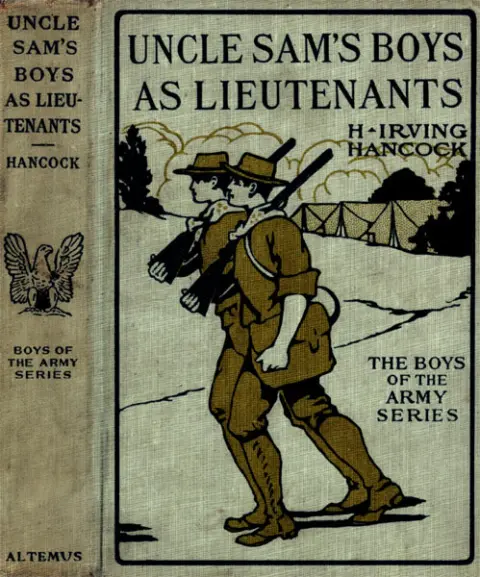
"Uncle Sam's Boys as Lieutenants; or, Serving Old Glory as Line Officers" by H. Irving Hancock is a historical novel written in the early 20th century. The story revolves around two young soldiers, Hal Overton and Noll Terry, who transition from enlisted men to second lieutenants in the United States Army. The book captures their anticipation and experiences as they settle into their roles as officers and confront personal and professional challenges that arise during their service. The opening of the book establishes a sense of suspense and eagerness among the characters as they await news from the War Department regarding their commission status. Hal and Noll's conversation with Hal's mother highlights their strong desire to rise through the ranks and serve their country, setting the tone for their journey. As they receive their official appointments, the narrative hints at their imminent challenges, including dealing with conflict in their new roles and the reactions of those around them, such as the antagonistic Bunny Hepburn. This introduction paves the way for a tale of camaraderie, duty, and the complexities of military life.
Introduction adapted from the source catalogue; source summaries may be automatically generated.
Free to read · English · 48,950 words · No account needed
MAKE TIME FOR A GOOD BOOK
On by default. Untick to stop anonymous reading totals. Each page counts after 10 seconds in view. How this works.
Anonymous counting is on unless you have switched it off.
"I object!" shouted the Hepburn lawyer, rising.
"To what do you object?" inquired the major mildly, glancing at the lawyer. "To having the characters of the complaining witnesses stated?"
"We object, may it please the court, on the ground that the chief of police is not qualified to express a competent opinion."
"We will hear what Chief Blake has to say," decided the president of the court, "and we will pass on the value of his evidence later on."
"'Bject!" snapped the lawyer.
"Be good enough, sir, to sit down!"
Chief Blake began his statement by explaining that the elder Hepburn had been for years a notorious local character----
"'Bject!" shouted the lawyer.
"Sit down, sir"--from the president of the court.
Chief Blake continued his testimony, producing copies of official records to show that the elder Hepburn had been four times arrested for inciting disorder and on similar complaints.
"'Bject!"
"Orderly," called Major Elbert. A sergeant who had accompanied the officers of the court stepped forward. "Orderly," continued the major, mildly, "if this attorney makes any further disturbance, put him out of the room. You should understand, Counsellor, that this is a military court, and that you, as a civilian attorney, are admitted here as a matter of courtesy. The chief of police will now go on with his testimony, and if there be anything in it, Counsellor, to which you wish to take exception, at the proper time you will be afforded an opportunity. But we cannot have the court's time wasted by boisterous conduct on the part of any one present."
Major Elbert's manner was not that of the bully, or of one abusing brief authority. His voice was mild and soft, but he meant business.
Chief Blake continued, testifying that not one of the young fellows in Bunny's crew was a valuable or reliable member of the community. Four of them had been arrested on minor charges in the past, and all of them, Bunny included, had given the police of the town many kinds of trouble and annoyance in the past.
"Chief," inquired the major softly, "what do you feel at liberty to say regarding the truthfulness of any of the complaining witnesses?"
"I wouldn't believe one of 'em, sir, under any oath that could be imposed on 'em," replied Chief Blake bluntly. "In the past my policemen and I have known every one of that outfit to lie repeatedly when accused of different kinds of disorderly conduct."
"Then you believe, Chief, that the complaining witnesses are members of a definite gang, and that they are all wholly untruthful and undependable?"
"To that question, sir, I have no hesitation whatever in saying 'yes.'"
Your reading position is saved on this browser. Take it to another device with a library code. Reading pages adapt to text, rather than matching a printed edition.
H. Irving (Harrie Irving) Hancock

H. Irving (Harrie Irving) Hancock

H. Irving (Harrie Irving) Hancock

H. Irving (Harrie Irving) Hancock
BEHIND THE BOOK
This eBook is for the use of anyone anywhere in the United States and most other parts of the world at no cost and with almost no restrictions whatsoever. You may copy it, give it away or re-use it under the terms of the Project Gutenberg License included with this eBook or online at www.gutenberg.org. If you are not located in the United States, you will have to check the laws of the country where you are located before using this eBook. Read the source licence.
The original source file, including credits and licence, is retained by this library. Request an original-format copy at no charge. Please include the book title and Project Gutenberg identifier #26381.
KEEP YOUR CURIOSITY GOING
Cécile Tormay

Moritz Busch
Coulson Kernahan
John L. Ransom

Maurice Baring
Frances Wright