
Uncle Sam’s Boys on Field Duty; or, Winning Corporal’s Chevrons
H. Irving (Harrie Irving) Hancock
THE CLASSIC COLLECTION · 1919
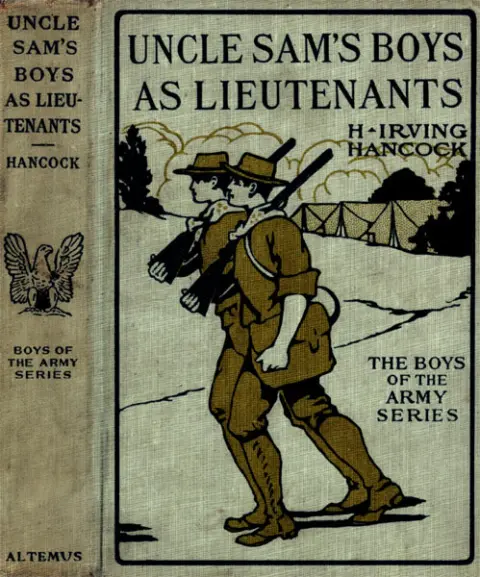
"Uncle Sam's Boys as Lieutenants; or, Serving Old Glory as Line Officers" by H. Irving Hancock is a historical novel written in the early 20th century. The story revolves around two young soldiers, Hal Overton and Noll Terry, who transition from enlisted men to second lieutenants in the United States Army. The book captures their anticipation and experiences as they settle into their roles as officers and confront personal and professional challenges that arise during their service. The opening of the book establishes a sense of suspense and eagerness among the characters as they await news from the War Department regarding their commission status. Hal and Noll's conversation with Hal's mother highlights their strong desire to rise through the ranks and serve their country, setting the tone for their journey. As they receive their official appointments, the narrative hints at their imminent challenges, including dealing with conflict in their new roles and the reactions of those around them, such as the antagonistic Bunny Hepburn. This introduction paves the way for a tale of camaraderie, duty, and the complexities of military life.
Introduction adapted from the source catalogue; source summaries may be automatically generated.
Free to read · English · 48,950 words · No account needed
MAKE TIME FOR A GOOD BOOK
On by default. Untick to stop anonymous reading totals. Each page counts after 10 seconds in view. How this works.
Anonymous counting is on unless you have switched it off.
"With pleasure," replied Mr. Ralston promptly. "But you will be doing me a genuine service, Mr. Overton, if you will tell me in what way the present waiter has offended you."
"He didn't offend me personally," Hal replied quietly, "but he spoke
disrespectfully of the Flag I serve, and the uniform I am proud to
wear."
"Thank you very much. Will you tell me what the waiter said?"
Hal repeated the words accurately.
"I will send you another waiter, Mr. Overton, and will see to it personally that you are not again annoyed. I thank you for having reported the matter to me."
Hal returned to his seat. Bunny had already vanished behind the swinging doors at the rear. Mr. Ralston followed him out into the cook's domain.
"Peterson, I want you to wait on Mr. Overton's party," called Mr. Ralston, whereat Bunny started slightly. "And, Peterson, I want you to serve and attend to their wants in your best style."
"Yes, sir," replied Peterson, an older waiter.
"Chef," continued the proprietor, "you will see to it that the delayed dinner for the Overton party is served ahead of anything else, and in your best style. Hepburn, come here!"
Bunny approached, a defiant scowl on his sulky face.
"Hepburn, I am told that you grossly insulted the Flag and the Army
uniform."
"I didn't," retorted Bunny, "but I won't allow any of them tin-soldier
dudes to put it over me."
"Your present language sufficiently justifies the charge made against you," replied Mr. Ralston quietly. "This restaurant is intended as a resort for ladies and gentlemen, and all right-minded persons respect our Army and Navy and those who serve their country."
"I'll tell you, right now, I hain't got any respect for them tin-soldiers," retorted Bunny defiantly.
"That will be all, Hepburn. Get out of here!"
With that the proprietor turned on his heel, leaving the cook's domain. Bunny was white with wrath. He tried to talk to some of the other employes present, but none of them paid any attention to him.
No effort did young Hepburn make to get his street clothes until the head waiter brought him back an envelope containing his wages.
"I'll remain here until I see you get out," remarked the head waiter
coldly.
"You may wait a long time," sneered Bunny.
"No, I won't. If you're not out of here in a hurry I'll help you through
the back door."
Not until then did Bunny Hepburn realize that he was actually
discharged.
"Get out now," ordered the head waiter, looking as if he would be glad of an opportunity to help the discharged one through the back door.
Your reading position is saved on this browser. Take it to another device with a library code. Reading pages adapt to text, rather than matching a printed edition.
H. Irving (Harrie Irving) Hancock

H. Irving (Harrie Irving) Hancock

H. Irving (Harrie Irving) Hancock

H. Irving (Harrie Irving) Hancock
BEHIND THE BOOK
This eBook is for the use of anyone anywhere in the United States and most other parts of the world at no cost and with almost no restrictions whatsoever. You may copy it, give it away or re-use it under the terms of the Project Gutenberg License included with this eBook or online at www.gutenberg.org. If you are not located in the United States, you will have to check the laws of the country where you are located before using this eBook. Read the source licence.
The original source file, including credits and licence, is retained by this library. Request an original-format copy at no charge. Please include the book title and Project Gutenberg identifier #26381.
KEEP YOUR CURIOSITY GOING
Cécile Tormay

Moritz Busch
Coulson Kernahan
John L. Ransom

Maurice Baring
Frances Wright