
Uncle Sam’s Boys on Field Duty; or, Winning Corporal’s Chevrons
H. Irving (Harrie Irving) Hancock
THE CLASSIC COLLECTION · 1919
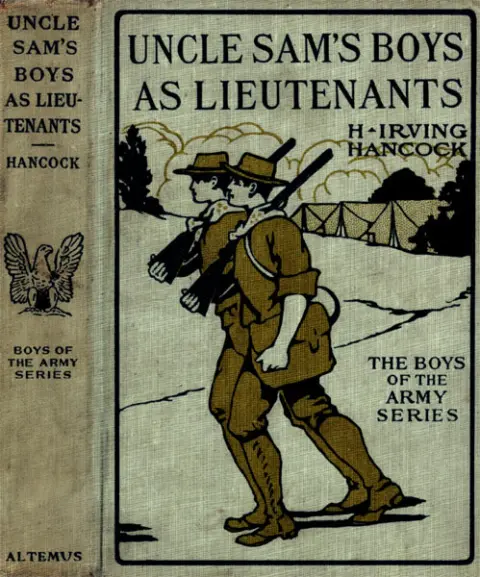
"Uncle Sam's Boys as Lieutenants; or, Serving Old Glory as Line Officers" by H. Irving Hancock is a historical novel written in the early 20th century. The story revolves around two young soldiers, Hal Overton and Noll Terry, who transition from enlisted men to second lieutenants in the United States Army. The book captures their anticipation and experiences as they settle into their roles as officers and confront personal and professional challenges that arise during their service. The opening of the book establishes a sense of suspense and eagerness among the characters as they await news from the War Department regarding their commission status. Hal and Noll's conversation with Hal's mother highlights their strong desire to rise through the ranks and serve their country, setting the tone for their journey. As they receive their official appointments, the narrative hints at their imminent challenges, including dealing with conflict in their new roles and the reactions of those around them, such as the antagonistic Bunny Hepburn. This introduction paves the way for a tale of camaraderie, duty, and the complexities of military life.
Introduction adapted from the source catalogue; source summaries may be automatically generated.
Free to read · English · 48,950 words · No account needed
MAKE TIME FOR A GOOD BOOK
On by default. Untick to stop anonymous reading totals. Each page counts after 10 seconds in view. How this works.
Anonymous counting is on unless you have switched it off.
"We are very grateful for your invitation, Mrs. Redding," Lieutenant Hal continued. "Terry and I feel that we are not in the least certain about being able to keep any engagements that we might make, since we are both awaiting orders from the War Department. Besides all my engagements are in the charge and keeping of my mother."
"Then you will accept for yourself and friends, won't you, my dear Mrs. Overton?" asked Mrs. Redding, again turning to Hal's mother.
"I--I am very much afraid that we can't go to-morrow afternoon," replied
Mrs. Overton slowly.
"Oh, well, then, we will make a later appointment," smiled Mrs. Redding affably. "There will be plenty of time, I am sure. So glad to have seen you this evening."
Still smiling, Mrs. Redding swept on through the restaurant with Mr. Redding in her wake. Somehow, one instinctively felt sorry for Mr. Redding; he looked very much like a small boat towing astern of a larger craft.
"I am wondering very much," smiled Hal's mother. "Although we have gone to the same church for the last fifteen years, Mrs. Redding has never before seemed to know who I am. She is suddenly very cordial."
"That is because you now have a son who is an officer in the Army," interposed Noll's father. "An Army officer is supposed to be a man of some social consequence."
"But that doesn't give me any more social consequence. I'm just the same woman that I always was," objected Mrs. Overton sensibly.
"But at least, my dear," suggested Hal's father, "you will be visiting your son at his post one of these days, and he may also urge you to bring some of your women friends."
"I certainly shall," Hal agreed.
"And Mrs. Redding may feel that she would like to be one of the invited," continued the elder Overton. "So, my dear, you see that you will become of social consequence. Others than Mrs. Redding, who have never even bowed to you before, will now be calling on you."
"I don't want new friends of that sort," remarked Hal's mother quietly.
"My dear, you'll have to be very agile if you expect to dodge all such new friends," laughed Hal's father.
Since Hal had given the order the orchestra had played several numbers. All of the little dining party were now becoming rather impatient for dinner.
"I guess our waiter doesn't like us very well," half-grumbled Lieutenant
Hal.
"Very likely," nodded his father. "Of course you recognized the waiter."
"I can't say, sir, that I did."
"The waiter is Bunny Hepburn, more than three years older than when you last saw him," replied Mr. Overton.
Your reading position is saved on this browser. Take it to another device with a library code. Reading pages adapt to text, rather than matching a printed edition.
H. Irving (Harrie Irving) Hancock

H. Irving (Harrie Irving) Hancock

H. Irving (Harrie Irving) Hancock

H. Irving (Harrie Irving) Hancock
BEHIND THE BOOK
This eBook is for the use of anyone anywhere in the United States and most other parts of the world at no cost and with almost no restrictions whatsoever. You may copy it, give it away or re-use it under the terms of the Project Gutenberg License included with this eBook or online at www.gutenberg.org. If you are not located in the United States, you will have to check the laws of the country where you are located before using this eBook. Read the source licence.
The original source file, including credits and licence, is retained by this library. Request an original-format copy at no charge. Please include the book title and Project Gutenberg identifier #26381.
KEEP YOUR CURIOSITY GOING
Cécile Tormay

Moritz Busch
Coulson Kernahan
John L. Ransom

Maurice Baring
Frances Wright