THE CLASSIC COLLECTION✦An outlaw’s diary: the CommuneCLASSIC FREE BOOKS
An outlaw’s diary: the Commune
Cécile Tormay
THE CLASSIC COLLECTION · 1880
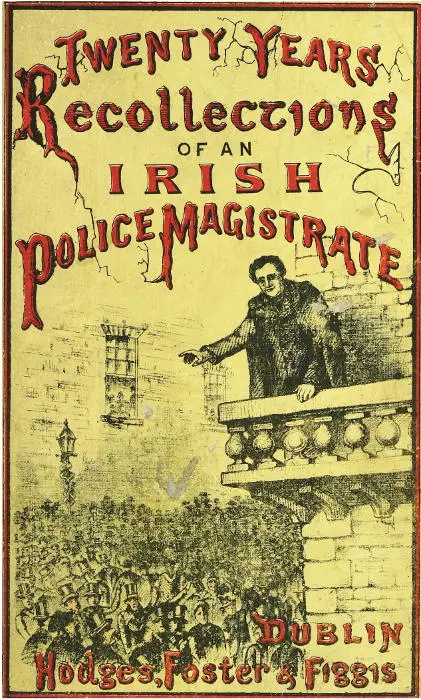
"Twenty Years' Recollections of an Irish Police Magistrate" by Frank Thorpe Porter is a historical account written in the late 19th century. The book offers a collection of narratives recounting incidents from the author's lengthy career as a police magistrate in Dublin, providing insights into the criminal justice system of the time, as well as anecdotes involving various characters connected to law and order. The opening of the memoir presents the case of a man named Lonergan, accused of poisoning his employer, Mr. O'Flaherty. Following a complicated legal process, Lonergan is convicted and sentenced to be hanged and quartered, although he maintains his innocence until the end. The narrative highlights the somber realities of justice in historical Dublin, emphasizing the impact on both the condemned and those around him. The chapter concludes with a dramatic account of Lonergan's eventual escape from execution, illustrating themes of fate, human error, and the complexities of truth versus perception.
Introduction adapted from the source catalogue; source summaries may be automatically generated.
Free to read · English · 141,864 words · No account needed
MAKE TIME FOR A GOOD BOOK
On by default. Untick to stop anonymous reading totals. Each page counts after 10 seconds in view. How this works.
Anonymous counting is on unless you have switched it off.
Mrs. Gilmore heard this intelligence with surprising calmness, and replied by informing the landlady of Mr. Gilmore's position, and of the place where he was stationed; adding that she would stay for the time for which the rent was paid, and that then, when she would be really destitute, she would go to THE WORKHOUSE. She imparted a good deal of confidence to the landlady, whom we shall name Mrs. Canavan, and who, seeing that she would not lose anything, gave Mrs. Gilmore her utmost sympathy. Mrs. Canavan was a fair specimen of human nature; for we never refuse our sympathy to our unfortunate fellow-creatures when we are not asked for anything more.
In another week Mrs. Gilmore proceeded to the South Dublin Union Workhouse, and there informed the admission committee that her husband was a constabulary officer; that his income was about double the reality; that he had some private property and great expectations; and that she, on the eve of her accouchement, was deserted by her husband, and compelled to become an inmate of the workhouse.
The committee admitted the applicant, registered the admission, and brought the case before the Board of Guardians on the following Thursday, when they obtained a ready sanction to prosecute Mr. Gilmore for deserting his wife, and leaving her, as a pauper, chargeable on the rates. A summons bearing my signature issued, and the constabulary officer appeared at the police-court. The marriage was proved, as were the circumstances of the desertion. On the part of the Guardians a demand was made for the immediate committal of the delinquent, to be imprisoned, with hard labor for three months. Richard Gilmore escaped a formal conviction by paying the expenses already incurred, and undertaking to allow twenty shillings weekly for his wife's maintenance. All parties left the police-court; but in an hour or two after the case had been heard, Richard Gilmore returned and applied to me to have Elizabeth Jones, calling herself Gilmore, apprehended on a charge of bigamy. He alleged that she had been married in Wales about four years previous to her marriage with him, and that her husband, Thomas Jones, was still living. His assertions were made on statements which he had received from others. He had no legal evidence of the charge, and I refused to issue a warrant for the apprehension of the alleged bigamist, but he determined to persist in the accusation. He seized on his wife in the public street, and gave her into the custody of a constable on a charge of felony. On the following morning he stated on oath that he had been informed, and fully believed, that the prisoner had been married to one Thomas Jones in a parish church near Carnarvon; that said Thomas was still living; and he further swore to the marriage of the prisoner with himself in the city of Dublin. He asked for a remand, and stated that he expected to produce witnesses from Wales to prove his charge. I remanded the accused for six days, and Richard left Dublin by the next Holyhead packet in quest of evidence to convict his wife. Before she was removed to prison she sent to me a short note, in which she implored me to direct that no person should be permitted to see her in the prison unless at her own request; and further, that on the day for resuming the investigation, she should be placed amongst a number of females, and that the witnesses should be required to identify her from amongst the others. I considered those requests to be fair and reasonable, and directed that they should be complied with. Richard Gilmore returned to Dublin the day before the resumption of the case. He brought over two witnesses, and sought at the prison to give them a view of the accused, but they were denied admittance. On the appointed day Elizabeth Gilmore was brought from the prison, and placed in the carriage-court with about a dozen of other females, amongst whom was Mrs. Canavan, her Nicholas Street landlady, who manifested great interest in her sufferings, and great indignation at Richard Gilmore's attempt to transport an innocent creature whom he had vowed to love and cherish. Without separating the prisoner from the other women, I proceeded to swear the first witness, one William Jones, who stated that he was a parish clerk of some unpronounceable place in Wales; that he remembered the marriage of Thomas Jones and Elizabeth Jones, and he produced the registry; he recollected the matter very distinctly, the more so from the parties being both of the same name as himself. I directed him to look at the women present, and to point out the one whom he had seen married at the time mentioned in the registry if she was amongst them. Mr. Jones walked to the group, viewed all the women, and very deliberately placing his hand on Mrs. Canavan's shoulder, identified her as the culprit. He was instantly electrified by a burst of abuse, delivered in an accent acquired much nearer to Patrick Street than to Penmaemawr.
Your reading position is saved on this browser. Take it to another device with a library code. Reading pages adapt to text, rather than matching a printed edition.
BEHIND THE BOOK
This eBook is for the use of anyone anywhere in the United States and most other parts of the world at no cost and with almost no restrictions whatsoever. You may copy it, give it away or re-use it under the terms of the Project Gutenberg License included with this eBook or online at www.gutenberg.org. If you are not located in the United States, you will have to check the laws of the country where you are located before using this eBook. Read the source licence.
The original source file, including credits and licence, is retained by this library. Request an original-format copy at no charge. Please include the book title and Project Gutenberg identifier #55668.
KEEP YOUR CURIOSITY GOING
Cécile Tormay

Moritz Busch
John L. Ransom
Frances Wright
Cécile Tormay

Mabel Potter Daggett