THE CLASSIC COLLECTION✦An outlaw’s diary: the CommuneCLASSIC FREE BOOKS
An outlaw’s diary: the Commune
Cécile Tormay
THE CLASSIC COLLECTION · 1880
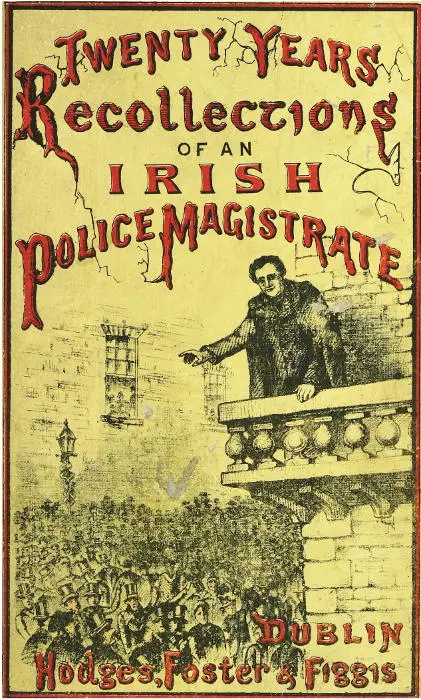
"Twenty Years' Recollections of an Irish Police Magistrate" by Frank Thorpe Porter is a historical account written in the late 19th century. The book offers a collection of narratives recounting incidents from the author's lengthy career as a police magistrate in Dublin, providing insights into the criminal justice system of the time, as well as anecdotes involving various characters connected to law and order. The opening of the memoir presents the case of a man named Lonergan, accused of poisoning his employer, Mr. O'Flaherty. Following a complicated legal process, Lonergan is convicted and sentenced to be hanged and quartered, although he maintains his innocence until the end. The narrative highlights the somber realities of justice in historical Dublin, emphasizing the impact on both the condemned and those around him. The chapter concludes with a dramatic account of Lonergan's eventual escape from execution, illustrating themes of fate, human error, and the complexities of truth versus perception.
Introduction adapted from the source catalogue; source summaries may be automatically generated.
Free to read · English · 141,864 words · No account needed
MAKE TIME FOR A GOOD BOOK
On by default. Untick to stop anonymous reading totals. Each page counts after 10 seconds in view. How this works.
Anonymous counting is on unless you have switched it off.
MURDER OF MR. LITTLE--DETECTIVE INEFFICIENCY--INDIVIDUAL EFFICIENCY--A FALSE ACCUSATION EXPOSED--EXTRAORDINARY GRATITUDE--A SALUTARY REFORMATION--A CHARGE OF FELONY--POOR PUSS, WHO SHOT HER?--BAXTER AND BARNES.
I shall now advert to a most atrocious murder which was committed in the Metropolitan Police District in 1856. It occurred in the Northern division, and I was requested by the learned and worthy Chief Magistrate, Mr. J. W. O'Donnell, to assist in its investigation. Mr. George Little, the Cashier of the Midland Great Western Railway, had not returned to his residence on the evening of the 14th November, and on the following morning, his relatives enquired for him at the office in the station. The office door was broken open, and he was found lying on his face in a pool of blood, his throat having been cut from ear to ear. At first the impression was that he had committed suicide, for a considerable sum of money was on his desk. However, it was ascertained by an examination of the body, that many very severe injuries had been inflicted, and that the skull had been fractured by blows from a heavy, blunt instrument. A coroner's inquest returned a verdict of "Wilful murder by some person or persons unknown," and a large reward was advertised for the discovery and conviction of the perpetrator. No arrest was made on suspicion until the 21st of December, when a person was brought before the Northern Police Court, but was very speedily discharged. I refrain from mentioning the name, because there is no doubt that the charge was unfounded. It was rumoured that an experienced London detective had been specially engaged to afford his assistance in the furtherance of justice, but nothing of importance transpired until the 26th June, 1857, when a woman, named Spollen, informed a superintendent of police that her husband, James Spollen, was the murderer, and that he had concealed the bank-notes which he took from Mr. Little's office in a certain place immediately adjoining a small house which he occupied on the railway premises, he being in the Company's employment as a painter and cleanser. The superintendent immediately arrested Spollen, but kept him in his own custody from ten o'clock in the morning until nearly ten o'clock at night, when he brought him to a police station-house and gave him in charge for the murder, producing the wife of the accused as the charging party. The place indicated by the woman was immediately searched, and a considerable sum in bank-notes was discovered concealed in an ashpit, and packed in a small firkin, which had previously contained white paint. Some money in silver was also found in a canvas bag deposited in a cistern, and the utmost publicity was given to the searches, the results, and the source from whence the information concerning them was derived. His wife's evidence against Spollen was properly rejected by the magistrates; and although the case was sent for trial on other grounds, the result was an acquittal. During the magisterial investigation, I suggested that a portion of the Royal Canal close to the railway premises should be drained and searched, as I considered it very probable that some of the implements used in the murder had been thrown into the water. When the search commenced, the superintendent announced that whoever found the razor should receive a guinea. A razor was accordingly found in the mud almost immediately, but it was manifest that it had not been there until the search was directed, for it was perfectly free from rust or corrosion. However, another razor was found, and the name of "Spollen" was on the handle. A fitter's hammer was also taken out of the canal, and it was more than probable that the razor and hammer had been in fatal proximity to the throat and head of the unfortunate George Little. After the trial, some of the London papers commented in the strongest terms on the ignorance and stupidity evinced in the preliminary proceedings of the police officer to whom the case had been assigned. The bungling, blundering incompetency which characterised the transaction was described as truly Irish. They also complained that the English detectives who had been sent to Dublin were thwarted and impeded in all their efforts by the members of the Dublin force. I fully admit that the case was thoroughly mismanaged, but I must add that the person most prominently engaged, the superintendent, was an Englishman, and I deny that English detectives had to encounter Irish jealousy, as no person of the description was sent to Dublin in reference to that crime, or indeed in any instance within my recollection, without meeting a cordial, perhaps I might venture to say, a fraternal, reception from the Dublin Police. I may add that whenever our constables were sent to the English metropolitan district, they invariably returned with a grateful recollection of the kindness manifested towards them.
Your reading position is saved on this browser. Take it to another device with a library code. Reading pages adapt to text, rather than matching a printed edition.
BEHIND THE BOOK
This eBook is for the use of anyone anywhere in the United States and most other parts of the world at no cost and with almost no restrictions whatsoever. You may copy it, give it away or re-use it under the terms of the Project Gutenberg License included with this eBook or online at www.gutenberg.org. If you are not located in the United States, you will have to check the laws of the country where you are located before using this eBook. Read the source licence.
The original source file, including credits and licence, is retained by this library. Request an original-format copy at no charge. Please include the book title and Project Gutenberg identifier #55668.
KEEP YOUR CURIOSITY GOING
Cécile Tormay

Moritz Busch
John L. Ransom
Frances Wright
Cécile Tormay

Mabel Potter Daggett