THE CLASSIC COLLECTION✦An outlaw’s diary: the CommuneCLASSIC FREE BOOKS
An outlaw’s diary: the Commune
Cécile Tormay
THE CLASSIC COLLECTION · 1880
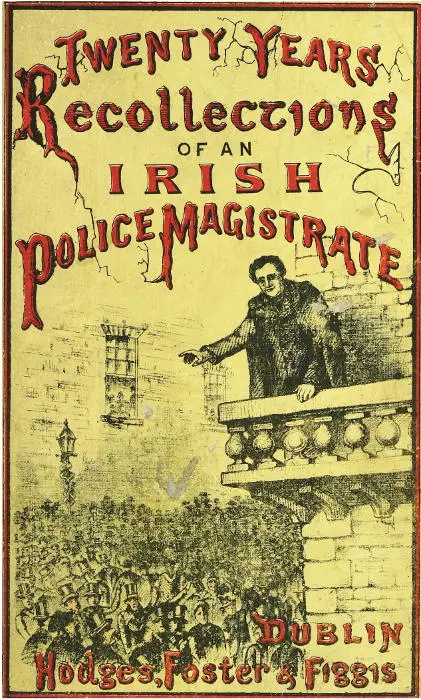
"Twenty Years' Recollections of an Irish Police Magistrate" by Frank Thorpe Porter is a historical account written in the late 19th century. The book offers a collection of narratives recounting incidents from the author's lengthy career as a police magistrate in Dublin, providing insights into the criminal justice system of the time, as well as anecdotes involving various characters connected to law and order. The opening of the memoir presents the case of a man named Lonergan, accused of poisoning his employer, Mr. O'Flaherty. Following a complicated legal process, Lonergan is convicted and sentenced to be hanged and quartered, although he maintains his innocence until the end. The narrative highlights the somber realities of justice in historical Dublin, emphasizing the impact on both the condemned and those around him. The chapter concludes with a dramatic account of Lonergan's eventual escape from execution, illustrating themes of fate, human error, and the complexities of truth versus perception.
Introduction adapted from the source catalogue; source summaries may be automatically generated.
Free to read · English · 141,864 words · No account needed
MAKE TIME FOR A GOOD BOOK
On by default. Untick to stop anonymous reading totals. Each page counts after 10 seconds in view. How this works.
Anonymous counting is on unless you have switched it off.
I have already mentioned that old Skinner Row contained a considerable number of establishments belonging to goldsmiths and jewellers. Pre-eminent amongst them was one kept, in the early part of the present century, by Matthew West, who realised an ample fortune there, and attained to high civic distinctions in Dublin. His concern was celebrated for an extensive assortment of jewelry, and for the tasteful and correct execution of orders specially relative to the setting of precious stones. When such were brought to be cleaned, arranged, or set, the owner was required to state the value which he attached to the property, and to sign such statement on the back of the receipt given for the articles. Mr. West gave considerable employment, especially in gem-setting, to a man named Delandre, who occupied the upper part of a house in Great Ship Street, in front of the ground on which the church of St. Michael le Pole formerly stood, and over the yard of which the windows of his working-room opened. A narrow passage led from the street under the house to a building in the rere, and a high wall separated this passage from the old cemetery. The top of the wall was thickly studded with broken glass, to prevent trespasses. In the year 1811, a gentleman called on Mr. West, and produced a diamond to which he attached considerable value, and which he wished to have set in a peculiar style. His order was taken, and a receipt was given for the stone, with an endorsement of its value at £950. Delandre was sent for, and received the diamond, with directions for the setting, and with an injunction to be expeditious. He took it to his work-room, and, the weather being very warm, the window close to his bench had been opened. He was using heavy pressure of the diamond against the material in which it was to be set, when either the tool or the gem slipped, and the latter flew out of the opened window. Instantly alarming his family, he watched the passage and the yard until means were adopted to prevent the entrance of any strangers. Then the passage was swept, and the sweepings were sifted. The surface of the old cemetery, for a considerable space, was similarly treated, the top of the wall was brushed carefully, and a tombstone in which a fissure was observed was raised and examined; but all the searching was fruitless. Finally, Delandre had to betake himself to Mr. West, and communicate the disastrous loss of the valuable jewel. Extraordinary as was the statement, Mr. West did not discredit the workman, in whose probity he placed great confidence. He undertook to afford constant employment to Delandre and to his son, but stipulated that an insurance should be effected on the life of the former, and that weekly deductions should be made from their earnings, so as to provide for the premium on the insurance policy, and form a reserve for the value of the diamond. Delandre scrupulously observed his engagements. He had full employment from West, and although he was working, as he termed it, "for a dead horse," he kept his hands busy and his heart light. Each year lessened his liabilities, and at length, having paid for the diamond, he received an assignment of the policy of insurance, for the ultimate benefit of his family. He had grown old and rather feeble, but still, in conjunction with his son, attended industriously to his trade. Mr. West had died, and I, who had been a schoolboy when the diamond was lost, had become a magistrate of the Head Police Court of Dublin. In my younger days I had often heard of the Ship Street diamond, and the various accounts of its loss were occasionally exaggerated immensely in reference to its size and value. In 1842 some much-needed repairs were in progress at the rere of Delandre's dwelling. Whitewashing and plastering were intended, and the top of the wall between the yard and passage was to be re-glassed. Old Delandre had gone out to buy some provisions, and on his return he was accosted by one of the workmen who had been removing the glass from the wall, and who showed him a curiosity which he had found. Delandre did not require a second look to satisfy himself that it was the long-lost gem. Amongst the glass which had been on the wall there was the neck of a pint bottle, which had been placed in the plaster with the mouth downwards, and it had formed the trap in which the diamond had been caught on falling from the window. Delandre gave the finder a liberal reward; but with a laudable anxiety to remove all suspicion of a sinister nature from himself, he had the discovery of the diamond made the subject of a solemn declaration, which the finder subscribed before me in the Head Police Court. The loss of the gem had been eventually highly advantageous to the man, by whom it was at first very naturally considered a great calamity. It had induced him to adopt a life of strict economy and industry, which easier circumstances would not have suggested or enforced.
Your reading position is saved on this browser. Take it to another device with a library code. Reading pages adapt to text, rather than matching a printed edition.
BEHIND THE BOOK
This eBook is for the use of anyone anywhere in the United States and most other parts of the world at no cost and with almost no restrictions whatsoever. You may copy it, give it away or re-use it under the terms of the Project Gutenberg License included with this eBook or online at www.gutenberg.org. If you are not located in the United States, you will have to check the laws of the country where you are located before using this eBook. Read the source licence.
The original source file, including credits and licence, is retained by this library. Request an original-format copy at no charge. Please include the book title and Project Gutenberg identifier #55668.
KEEP YOUR CURIOSITY GOING
Cécile Tormay

Moritz Busch
John L. Ransom
Frances Wright
Cécile Tormay

Mabel Potter Daggett