THE CLASSIC COLLECTION✦An outlaw’s diary: the CommuneCLASSIC FREE BOOKS
An outlaw’s diary: the Commune
Cécile Tormay
THE CLASSIC COLLECTION · 1880
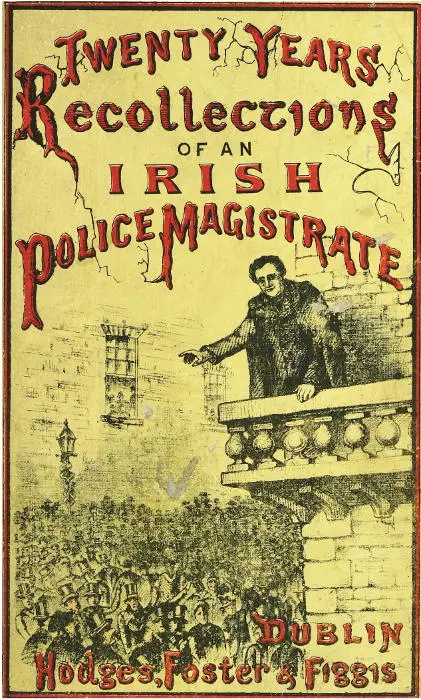
"Twenty Years' Recollections of an Irish Police Magistrate" by Frank Thorpe Porter is a historical account written in the late 19th century. The book offers a collection of narratives recounting incidents from the author's lengthy career as a police magistrate in Dublin, providing insights into the criminal justice system of the time, as well as anecdotes involving various characters connected to law and order. The opening of the memoir presents the case of a man named Lonergan, accused of poisoning his employer, Mr. O'Flaherty. Following a complicated legal process, Lonergan is convicted and sentenced to be hanged and quartered, although he maintains his innocence until the end. The narrative highlights the somber realities of justice in historical Dublin, emphasizing the impact on both the condemned and those around him. The chapter concludes with a dramatic account of Lonergan's eventual escape from execution, illustrating themes of fate, human error, and the complexities of truth versus perception.
Introduction adapted from the source catalogue; source summaries may be automatically generated.
Free to read · English · 141,864 words · No account needed
MAKE TIME FOR A GOOD BOOK
On by default. Untick to stop anonymous reading totals. Each page counts after 10 seconds in view. How this works.
Anonymous counting is on unless you have switched it off.
I now proceed to the narration of the other case which I received from M. Hubert, the facts of which are far more extraordinary than any of the exuberant fictions presented in the pages of romance.
In the early part of May, 1818, the Place Vendome was occupied by detachments from the garrison of Paris, for the purpose of effecting certain military requirements and arrangements. They were under the command of the Comte de Pontis de Sainte-Helene, colonel of the 72nd Legion. Amidst a brilliant cortege, he appeared, bearing on his breast the insignia of officer of the Legion of Honor, Chevalier de Saint-Louis, and also the Spanish orders of Alcantara and Saint-Wladimir. One of the spectators, meanly attired, and of rather sinister appearance, attempted to approach the distinguished officer, but he was unceremoniously repelled by those to whom the duty of keeping the ground had been assigned. He found no difficulty, however, in ascertaining that the residence of the Comte was in the Rue Basse-Saint-Denis; and when the military duties of the day had been fulfilled, and the gallant nobleman returned to his house, he was apprised that a stranger was waiting in the ante-chamber on some affairs which he declared to be of paramount importance. The Count proceeded to the apartment, and was there accosted in rather familiar terms.
"You must remember me; I am Darios, your former comrade of the chain. I bear you no ill-will, and do not wish to take any advantage of you, but you are rich and I am miserably destitute. Give me your succour, relieve my necessities, and you may depend on my prudence and gratitude."
The Comte de Pontis de Sainte-Helene affected to treat this intruder as an impostor or madman. He summoned his attendants, and had Darios at once expelled from the premises. The latter, in the highest state of exasperation at such treatment, betook himself to the office of the Minister of the Interior, and having eventually succeeded in obtaining an audience of the Duc Decazes, declared to the minister that the Comte de Pontis de Sainte-Helene was no other than Pierre Coignard, who, on the 18th October, 1800, had been condemned by the criminal tribunal of the department of the Seine to fourteen years of hard labor, for various robberies committed by nocturnal housebreaking, and also by means of false keys. That in about five years he had managed to elude the vigilance of the prison authorities of Toulon, and had escaped from the Bagne. The Duc Decazes was completely amazed at this statement, and inasmuch as it was made by one who acknowledged himself to be a convicted criminal, he at first considered it to be false and malicious. Other reasons, of a political nature, made him determine to avoid any personal participation in an inquiry resulting from such averments; and as the imputations were directed against a person in a high military position, he referred the matter to General Despinoy, who commanded the division of the army to which the accused belonged. The co-operation of the police was obtained, and the celebrated Vidocq was brought into requisition. It was fully ascertained that Coignard, after escaping from Toulon, had made his way to Catalonia, in Spain, where he formed an intimate acquaintance with a young female, named Maria Rosa. She constituted the entire domestic establishment of the veritable Comte de Pontis de Sainte-Helene, who was a French emigrant, and of an ancient family belonging to Soissons. He had been in the Spanish service, and had distinguished himself in South America. Having returned to Europe in broken health, he was reduced to great poverty by the inability of the Spanish government to meet the claims of their dependants, or even to make any effectual resistance against the French invasion, which was then in very active progress. Death relieved him from his privations, and Coignard induced Maria Rosa to become his accomplice in assuming the designation of the deceased nobleman. The family papers and pedigree were made available by the spurious Comte and Comtesse, and Coignard proceeded to join the irregular troops or guerilla bands, which were under the orders of Mina, to whom he introduced himself as a French nobleman, exiled as a legitimist, and anxious to combat to the utmost the upstart who had usurped the throne of his country. He either received, or subsequently pretended that he received, the orders of Alcantara and Saint-Wladimir during his time of service under Mina, but he did not remain long in the Spanish ranks, and alleged that ill health rendered his retirement unavoidable. In a short time, however, he presented himself to Soult, and implored to be received into the army of his native country. He continued in a military capacity, fortunate in escaping the casualties of war, and in gradually attaining higher rank, until the departure of Napoleon for Elba, and then, free from all suspicions of his false pretensions, he professed to belong to the ancienne noblesse, and to regard the restoration of the Bourbon dynasty as the vindication of a right and the realization of a blessing. When Napoleon returned, Louis the Eighteenth betook himself to Ghent, and the Comte de Pontis de Sainte-Helene conciliated his confidence and esteem by becoming a participator of his short exile. He was basking in courtly favor, when his former "comrade of the chain" recognised him in the Place Vendome, and when his prudence, nay, even his instinctive caution, so completely deserted him that he effected to treat a statement which he knew to be perfectly true, as the threats of an impostor or the ravings of a lunatic. It is highly probable that a small pension, paid weekly or monthly, to Darios would have ensured his silence.
Your reading position is saved on this browser. Take it to another device with a library code. Reading pages adapt to text, rather than matching a printed edition.
BEHIND THE BOOK
This eBook is for the use of anyone anywhere in the United States and most other parts of the world at no cost and with almost no restrictions whatsoever. You may copy it, give it away or re-use it under the terms of the Project Gutenberg License included with this eBook or online at www.gutenberg.org. If you are not located in the United States, you will have to check the laws of the country where you are located before using this eBook. Read the source licence.
The original source file, including credits and licence, is retained by this library. Request an original-format copy at no charge. Please include the book title and Project Gutenberg identifier #55668.
KEEP YOUR CURIOSITY GOING
Cécile Tormay

Moritz Busch
John L. Ransom
Frances Wright
Cécile Tormay

Mabel Potter Daggett